


Share This Article:
Summer Safety Series
Welcome to The Science Behind Workplace Injuries: 30 Days of Summer Safety, where we explore the environmental hazards, human physiology, behavioral science, and organizational decisions shaping workplace safety. This article is part of our July series examining the science behind workplace injuries and the factors influencing workplace safety during the summer months.
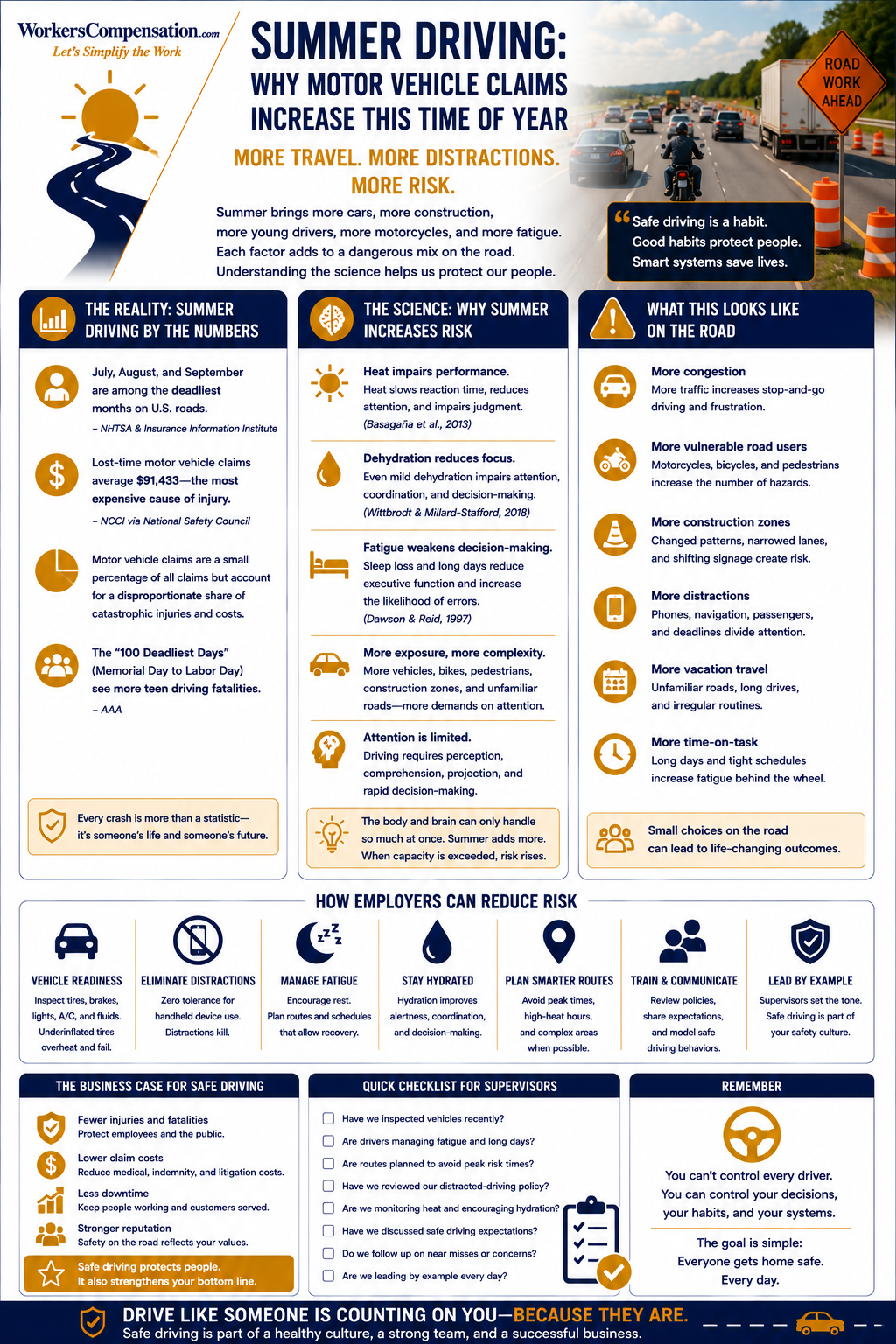
Most people associate winter with dangerous driving because of ice, snow, and limited visibility. Summer tells a different story. According to the National Highway Traffic Safety Administration and the Insurance Information Institute, July, August, and September consistently rank among the deadliest months on American roads. The explanation is not simply better weather or worse weather. Summer places more vehicles, more inexperienced drivers, more motorcycles, more cyclists, more pedestrians, more road construction, and more travel onto the roadway at the same time. Each factor increases the demands placed on human attention and decision-making.
Motor vehicle crashes also represent one of the most significant challenges in workers' compensation. NCCI data summarized by the National Safety Council show lost-time motor vehicle claims average approximately $91,433, making them the most expensive cause of workplace injury. Although these claims represent only a small percentage of total lost-time injuries, they account for a disproportionate share of catastrophic injuries, fatalities, and million-dollar claims. The human cost extends far beyond the collision itself. Families, coworkers, employers, and entire communities often feel the consequences for years.
Summer driving illustrates an important principle we have explored throughout this series. Rarely does one factor explain an injury. Instead, multiple physiological, psychological, and environmental influences begin interacting long before the crash occurs. Heat slows reaction time. Dehydration reduces attention. Fatigue weakens executive function. Road construction changes familiar traffic patterns. Vacation travel introduces unfamiliar drivers. More motorcycles and bicycles require greater visual scanning. Every additional demand consumes another portion of the brain's available cognitive capacity. By the time a driver responds to an unexpected event, many contributing factors may already be influencing performance.
Researchers continue documenting the biological effects of heat on driving performance. Basagaña and colleagues found crash risk increased during heat waves, with an even greater increase for crashes involving driver-performance factors such as distraction, fatigue, and judgment errors. Later research demonstrated the risk continued increasing as temperatures became more extreme. Laboratory studies reached similar conclusions. Heat slows reaction time, reduces selective attention, and impairs executive function before drivers recognize meaningful changes in performance. Physiology changes before behavior does.
Hydration influences the same cognitive systems. A large meta-analysis found dehydration impaired attention, executive function, and motor coordination, while driving studies demonstrated dehydrated drivers committed substantially more driving errors than when adequately hydrated. Summer heat accelerates fluid loss, creating another hidden contributor to roadway risk. The body rarely experiences heat, dehydration, fatigue, and stress independently. It responds to the total physiological load created by all of them.
The behavioral environment changes during summer as well. AAA refers to the period between Memorial Day and Labor Day as the 100 Deadliest Days for teen drivers because fatal crashes involving teen drivers increase during this window. More young drivers are on the road, often with passengers, at night, and on unfamiliar routes. At the same time, employers may have delivery drivers, sales teams, field adjusters, home health workers, utility crews, and construction teams sharing the road with vacation traffic. A workplace driving exposure rarely occurs in isolation from the larger transportation environment around it.
Vulnerable road users also increase during the summer months. More motorcyclists, bicyclists, pedestrians, scooters, and recreational travelers require drivers to scan more carefully and anticipate more movement. That added complexity matters because driving is already a demanding cognitive task. Safe driving requires perception, comprehension, projection, and rapid decision-making. In other words, it depends on situational awareness. When attention is divided by phones, navigation systems, heat, fatigue, deadlines, or unfamiliar roads, the driver's ability to notice and respond to changing conditions becomes more fragile.
Workers' compensation professionals should treat motor vehicle claims as high-severity exposures from the moment they are reported. These claims frequently involve head, neck, spine, multiple body parts, traumatic brain injuries, and extended recovery periods. NCCI has found motor vehicle claims represent a small share of lost-time claims while accounting for a much larger share of claim costs and catastrophic outcomes. A prompt investigation should document driving conditions, route familiarity, weather, heat, fatigue, distraction, vehicle condition, work schedule, and whether the employee was operating within company policy at the time of the crash.
Employer prevention begins before anyone starts the engine. Summer vehicle inspections should include tire pressure, air conditioning, cooling systems, brakes, lights, and emergency supplies. Underinflated tires build heat more quickly and increase blowout risk, especially on hot pavement. Written distracted-driving policies, fatigue management, hydration expectations, route planning, and realistic scheduling all reduce avoidable pressure on drivers. Safety improves when organizations design driving programs around the realities of summer rather than assuming road conditions are easier because snow and ice are absent.
Technology can also support safer driving when used thoughtfully. Forward collision warning, automatic emergency braking, telematics, and driver-monitoring systems can help identify risky patterns before a crash occurs. The Insurance Institute for Highway Safety has found forward collision warning and automatic emergency braking reduce several types of rear-end crashes. Fleet data also suggest AI-enabled dash cameras and real-time coaching may reduce crashes when paired with a strong safety culture. Technology works best as a decision-support tool. It should strengthen awareness rather than replace human responsibility.
Summer driving reminds us safe travel depends on far more than road conditions. Human performance is shaped by heat, hydration, fatigue, distraction, traffic volume, vehicle condition, and the behavior of everyone sharing the road. The safest employers recognize driving as a workplace exposure requiring the same level of planning as any other high-risk task. Every trip begins before the vehicle moves. Every prevention strategy begins before the crash occurs.
Tomorrow in The Science Behind Workplace Injuries - E-Bikes, Scooters, and the New Face of Transportation Injuries. Transportation is changing quickly. E-bikes, scooters, delivery platforms, campus mobility, and urban commuting patterns are creating new risks for employees, employers, and claims professionals. Tomorrow, we explore how speed, balance, visibility, infrastructure, and human behavior are reshaping transportation-related workplace injuries.


AI best practices california case file caselaw case management case management focus claims compensability compliance compliance corner courts do you know the rule employers exclusive remedy florida fraud glossary check Healthcare hr homeroom insurance insurers iowa kentucky leadership NCCI new jersey new york ohio pennsylvania Safety safety at work state info tech technology the case manager violence WDYT what do you think women's history women's history month workers' comp 101 workers' recovery Workplace Safety Workplace Violence
Read Also
About The Author
About The Author
-
Claire Muselman
Meet Dr. Claire C. Muselman, the Chief Operating Officer at WorkersCompensation.com, where she blends her vast academic insight and professional innovation with a uniquely positive energy. As the President of DCM, Dr. Muselman is renowned for her dynamic approach that reshapes and energizes the workers' compensation industry. Dr. Muselman's academic credentials are as remarkable as her professional achievements. Holding a Doctor of Education in Organizational Leadership from Grand Canyon University, she specializes in employee engagement, human behavior, and the science of leadership. Her diverse background in educational leadership, public policy, political science, and dance epitomizes a multifaceted approach to leadership and learning. At Drake University, Dr. Muselman excels as an Assistant Professor of Practice and Co-Director of the Master of Science in Leadership Program. Her passion for teaching and commitment to innovative pedagogy demonstrate her dedication to cultivating future leaders in management, leadership, and business strategy. In the industry, Dr. Muselman actively contributes as an Ambassador for the Alliance of Women in Workers’ Compensation and plays key roles in organizations such as Kids Chance of Iowa, WorkCompBlitz, and the Claims and Litigation Management Alliance, underscoring her leadership and advocacy in workers’ compensation. A highly sought-after speaker, Dr. Muselman inspires professionals with her engaging talks on leadership, self-development, and risk management. Her philosophy of empathetic and emotionally intelligent leadership is at the heart of her message, encouraging innovation and progressive change in the industry. "Empowerment is key to progress. By nurturing today's professionals with empathy and intelligence, we're crafting tomorrow's leaders." - Dr. Claire C. Muselman
More by This Author
Read More
- Oct 10, 2026
- Claire Muselman
- Oct 10, 2026
- Frank Ferreri
- Oct 10, 2026
- Claire Muselman
- Oct 10, 2026
- Chris Parker
- Oct 08, 2026
- Claire Muselman