


Share This Article:
Stuffed with Safety
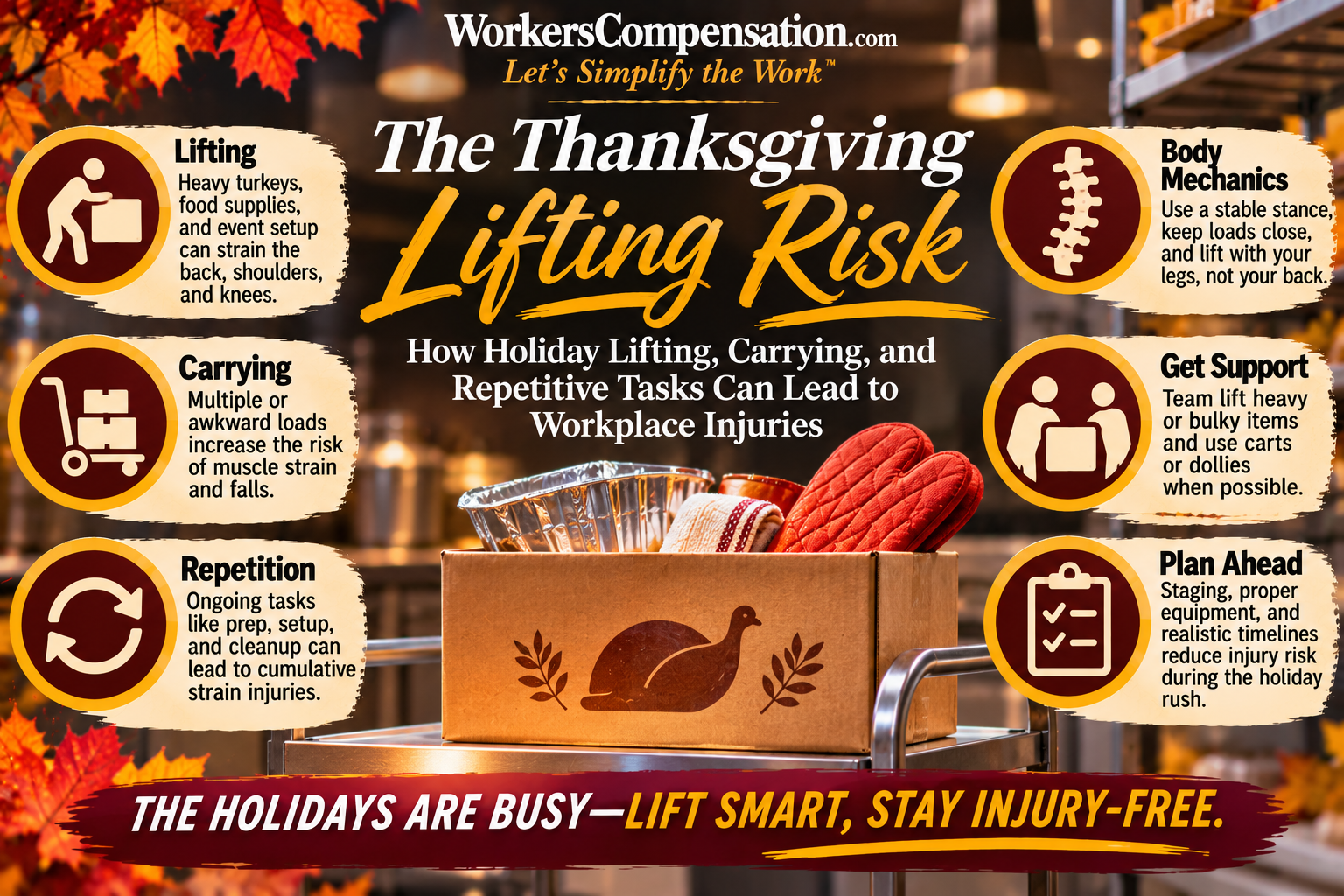
A conference table becomes a buffet station. Folding chairs emerge from storage. Boxes of decorations travel down hallways while employees carry serving equipment into rooms normally reserved for meetings. The annual Thanksgiving celebration may require only an hour of preparation, yet the physical demands can be entirely unfamiliar to the people completing them. An administrative employee accustomed to computer work suddenly handles awkward furniture, unpredictable loads, and repeated lifting. The celebration introduces a temporary change in job demands that deserves attention from employers and workers’ compensation professionals. Research on manual handling and acute injury helps explain why seemingly ordinary preparations can produce meaningful occupational exposure.
Weight Is Only Part of the Problem
Overexertion involving outside sources accounted for approximately $13.7 billion in direct workers’ compensation costs in Liberty Mutual's 2025 Workplace Safety Index, based on 2022 injury data. The category includes injuries associated with lifting, pushing, pulling, and carrying objects. A folding table may appear manageable until its width forces the employee to hold the load away from the body. The Revised NIOSH Lifting Equation recognizes horizontal distance, twisting, lifting frequency, and other task characteristics when evaluating physical demands. Moving a table through a narrow doorway can therefore create different biomechanical demands from lifting a compact box of similar weight. Object shape, route design, and load stability deserve consideration alongside pounds.
Researchers examining 999 patients with acute low back pain identified several short-term exposures associated with symptom onset. Awkward postures carried approximately eight times the odds, holding objects away from the body approximately six times, and handling unstable loads approximately five times. Distraction showed an especially large association, although its estimate was imprecise. The findings came from a case-crossover study of back-pain episodes rather than occupational holiday events, so the results cannot predict potluck injury rates. They nevertheless identify conditions that frequently appear when employees carry folding furniture, stacked chairs, or loosely packed decorations. A seemingly simple setup assignment can combine several recognized risk factors within minutes.
When Familiar Employees Perform Unfamiliar Work
Job familiarity matters because people develop expectations about the equipment, movements, and demands they encounter repeatedly. Research by F. Curtis Breslin and Peter Smith found that workers in their first month of employment experienced more than four times the lost-time injury claim rate of workers with at least one year of tenure. The study examined employment experience rather than temporary holiday assignments. Its findings provide a useful analogy for an experienced office employee suddenly asked to perform unfamiliar physical work. Knowing the organization does not necessarily mean knowing how to move its folding tables, operate a chair dolly, or navigate storage areas safely. Employers should evaluate experience with the specific task before assigning setup responsibilities.
Holiday preparation also creates competing demands on attention. Employees may carry boxes while answering questions, coordinating volunteers, or watching the clock before an event begins. The acute back-pain research associated distraction and fatigue with increased odds of symptom onset, while occupational hand-injury research has identified unusual work methods and rushing as transient risk factors. Social interaction and compressed setup windows can introduce those conditions into otherwise routine workplaces. Assigning a clear route, protecting adequate setup time, and limiting interruptions during carrying tasks address the demands surrounding the lift. The work deserves the same operational planning as any other temporary assignment.
Why Better Lifting Advice Has Limits
Traditional injury prevention frequently emphasizes bending the knees, lifting with the legs, and maintaining proper technique. A Cochrane review examining randomized trials and cohort studies found that manual-handling training and advice did not reliably prevent back pain or related disability. The findings challenge the assumption that a brief lifting demonstration adequately addresses a poorly designed task. Employees still face awkward objects, distant storage locations, repeated handling, and restricted pathways after completing training. A more effective ergonomic approach begins by reducing unnecessary lifts and changing the conditions under which handling occurs. Training remains useful for operating equipment and understanding procedures, but workplace design carries much of the preventive responsibility.
Practical improvements can begin before the event. Vendors can deliver tables and catering supplies directly to the serving location, while carts and chair dollies reduce repeated manual carrying. Storage near the event room limits unnecessary travel, and smaller containers make loads easier to manage. Adequate setup and teardown windows reduce the temptation to rush, particularly when employees are already completing their regular responsibilities. Facilities teams can identify appropriate equipment and assist with unfamiliar movements. The strongest prevention opportunity belongs to the person planning the event because many physical exposures are determined before anyone begins lifting.
When Volunteering Becomes a Workers’ Compensation Claim
Holiday celebrations create important distinctions between attending an event and performing work that supports it. In Goulding v. NJ Friendship House (2021), the New Jersey Supreme Court considered an employee injured while helping facilitate an employer-sponsored family event. The court recognized that performing work-related duties during a recreational event differed from participating in recreation. The decision illustrates why an employee's responsibilities may matter more than the festive setting when evaluating compensability. State workers’ compensation laws vary, and attendance requirements, employer benefit, and assigned duties can influence the analysis. Describing setup assistance as voluntary does not automatically resolve whether an injury arose from employment.
Claims professionals investigating a holiday setup injury should document the employee's assigned activity, who requested assistance, the equipment involved, and the conditions surrounding the incident. A back strain while moving tables deserves timely reporting, appropriate medical evaluation, and consideration of modified duty when needed. Employers should also examine whether carts were available, whether the employee had experience with the task, and whether the setup schedule encouraged rushing. The same findings can inform prevention for future celebrations and other temporary assignments. A holiday event does not suspend the physical demands of work or the employer's responsibility to manage foreseeable exposures.
Design the Celebration Before Moving the Furniture
The strongest holiday ergonomics strategy begins with event planning. Employers can reduce unnecessary handling, provide appropriate equipment, assign experienced personnel, and protect sufficient time for setup and cleanup. Workers’ compensation professionals can use resulting injury patterns to identify gaps in temporary-task planning that may otherwise escape routine safety reviews. Thanksgiving celebrations bring people together, and thoughtful preparation helps preserve the experience for everyone involved. The broader lesson extends to office moves, employee appreciation events, conferences, and other activities that temporarily change job demands. An unfamiliar task deserves a familiar commitment to prevention.
Research Referenced
Breslin, F. C., & Smith, P. (2006). Trial by fire: A multivariate examination of the relation between job tenure and work injuries. Occupational and Environmental Medicine, 63(1), 27–32.
Steffens, D., et al. (2015). What triggers an episode of acute low back pain? A case-crossover study. Arthritis Care & Research, 67(3), 403–410.
Verbeek, J. H., et al. (2011). Manual material handling advice and assistive devices for preventing and treating back pain in workers. Cochrane Database of Systematic Reviews, CD005958.
Waters, T. R., et al. (1993). Revised NIOSH equation for the design and evaluation of manual lifting tasks. Ergonomics, 36(7), 749–776.


AI best practices california case file caselaw case management case management focus claims compensability compliance compliance corner courts do you know the rule employers exclusive remedy florida fraud glossary check Healthcare hr homeroom insurance insurers iowa kentucky leadership NCCI new jersey new york ohio pennsylvania Safety safety at work state info tech technology the case manager violence WDYT what do you think women's history women's history month workers' comp 101 workers' recovery Workplace Safety Workplace Violence
Read Also
About The Author
About The Author
-
Claire Muselman
Meet Dr. Claire C. Muselman, the Chief Operating Officer at WorkersCompensation.com, where she blends her vast academic insight and professional innovation with a uniquely positive energy. As the President of DCM, Dr. Muselman is renowned for her dynamic approach that reshapes and energizes the workers' compensation industry. Dr. Muselman's academic credentials are as remarkable as her professional achievements. Holding a Doctor of Education in Organizational Leadership from Grand Canyon University, she specializes in employee engagement, human behavior, and the science of leadership. Her diverse background in educational leadership, public policy, political science, and dance epitomizes a multifaceted approach to leadership and learning. At Drake University, Dr. Muselman excels as an Assistant Professor of Practice and Co-Director of the Master of Science in Leadership Program. Her passion for teaching and commitment to innovative pedagogy demonstrate her dedication to cultivating future leaders in management, leadership, and business strategy. In the industry, Dr. Muselman actively contributes as an Ambassador for the Alliance of Women in Workers’ Compensation and plays key roles in organizations such as Kids Chance of Iowa, WorkCompBlitz, and the Claims and Litigation Management Alliance, underscoring her leadership and advocacy in workers’ compensation. A highly sought-after speaker, Dr. Muselman inspires professionals with her engaging talks on leadership, self-development, and risk management. Her philosophy of empathetic and emotionally intelligent leadership is at the heart of her message, encouraging innovation and progressive change in the industry. "Empowerment is key to progress. By nurturing today's professionals with empathy and intelligence, we're crafting tomorrow's leaders." - Dr. Claire C. Muselman
More by This Author
Read More
- Nov 21, 2026
- Frank Ferreri
- Nov 19, 2026
- Claire Muselman
- Nov 19, 2026
- Chriss Swaney
- Nov 19, 2026
- Claire Muselman
- Nov 19, 2026
- Chris Parker