


Share This Article:
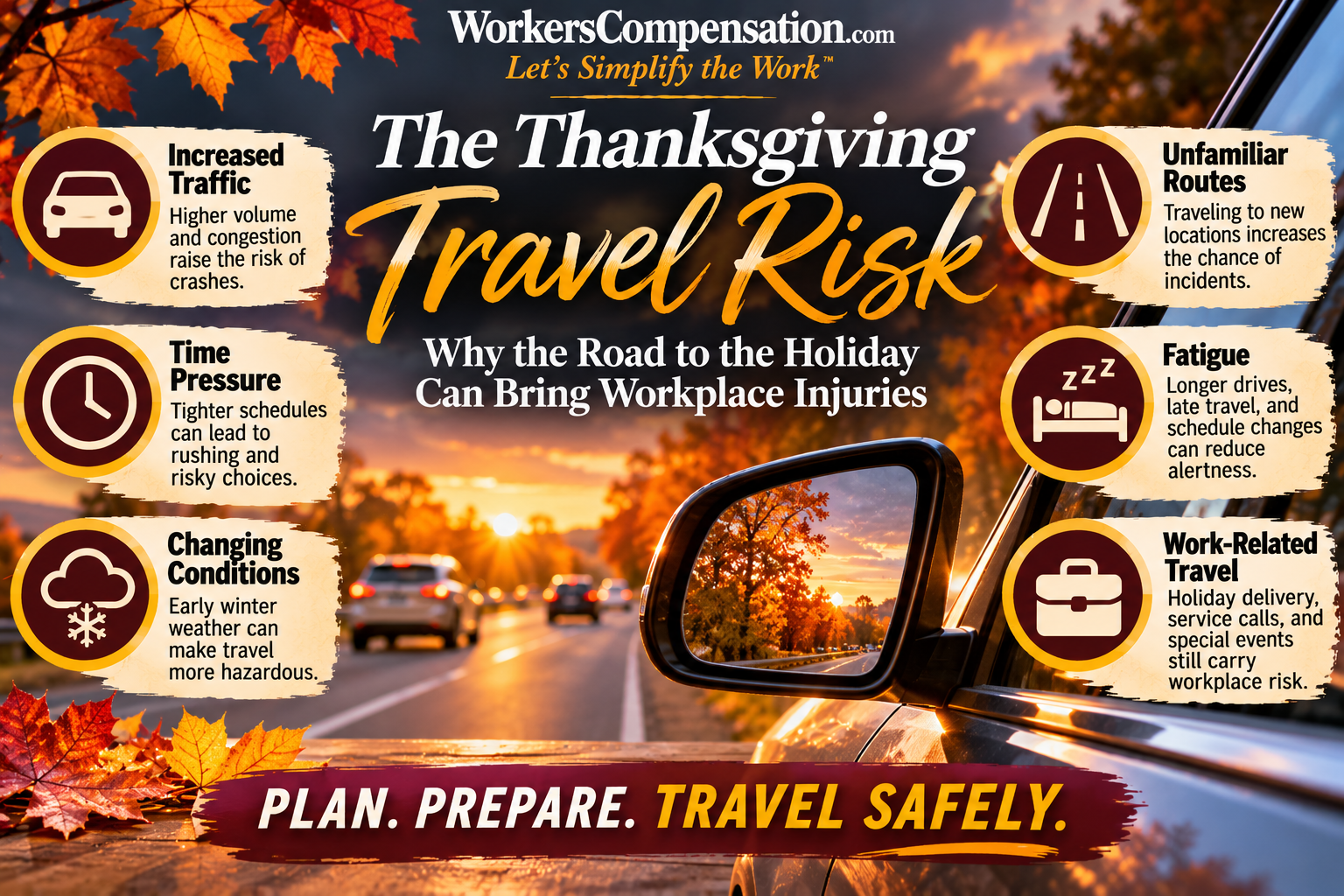
Over the River and Through the Woods: Thanksgiving Travel, Fatigue, and Driving Risk
19 Nov, 2026 Claire Muselman
Stuffed with Safety
The Wednesday before Thanksgiving can begin with a completed shift and end hundreds of miles from home. Delivery drivers are finishing routes, healthcare employees are leaving overnight shifts, and traveling professionals are trying to reach their next destination before the holiday. Heavy traffic and early darkness add demands to a driver whose sleep may already be shortened by work and family plans. Thanksgiving is not established as the deadliest driving holiday, and research has not identified a Thanksgiving-specific increase in occupational crashes. The stronger concern is the convergence of familiar fatigue exposures during a week when people have powerful reasons to keep moving. For workers’ compensation professionals, understanding the journey requires examining both the driver's physical condition and the employment circumstances surrounding the trip.
Sleep Loss Changes Performance, Period.
Brian Tefft examined crash-involved drivers and found a steep relationship between sleep duration and crash responsibility. Compared with seven or more hours of sleep, four to five hours was associated with approximately four times the crash risk, while fewer than four hours was associated with more than eleven times the risk. The estimates come from observational crash research and do not describe Thanksgiving travel specifically. Their importance for employers lies in how ordinary schedules shape sleep opportunity. An employee who works late, packs for a trip, and departs before sunrise may begin driving with a measurable performance disadvantage before encountering the first congested interchange.
Sleep pressure also accumulates across several nights. In controlled experiments, Hans Van Dongen and colleagues found that participants restricted to six hours of sleep nightly developed progressively more attention lapses over two weeks. Their self-reported sleepiness increased much less dramatically than their objective performance impairment. Drivers may therefore feel reasonably functional even as their ability to detect hazards and respond promptly deteriorates. Experience with a route or vehicle cannot restore attention lost to insufficient sleep. The discrepancy between perceived alertness and actual performance makes fatigue especially challenging to identify during an incident investigation.
The Drive After Work Deserves Its Own Risk Assessment
Michael Lee and colleagues compared driving performance after night work with performance after sleep in a small closed-track experiment. Following a night shift, six of sixteen participants experienced near-crashes, and seven drives were stopped for safety; neither outcome occurred in the rested condition. The sample was small, but the results demonstrate how quickly fatigue can affect driving after an extended period awake. A healthcare employee leaving an overnight shift, a technician finishing a late service call, or a delivery driver completing a final route may encounter elevated risk before reaching home. Early-morning hours and the midafternoon circadian dip add further vulnerability. Employers should consider the timing of travel alongside the length of the shift that preceded it.
Long drives compound the problem because monotonous roads require sustained monitoring while fatigue increases attention lapses and delayed reactions. Drivers may recognize heavy eyelids or repeated difficulty staying alert yet underestimate the consequences of continuing. Opening a window or increasing the radio volume provides only temporary stimulation without correcting sleep debt. A safe response requires stopping in a secure location and obtaining rest, with naps or caffeine providing limited short-term assistance when appropriate. Dispatch schedules and travel expectations must make stopping a realistic option. A policy encouraging rest loses its effectiveness when employees face penalties for delayed arrivals.
The Workers’ Compensation Investigation Begins with the Trip
When a crash occurs during Thanksgiving week, the first workers’ compensation question concerns the purpose of the journey. An employee completing an assigned delivery or traveling between business appointments is generally operating within employment, subject to applicable state law. Ordinary commuting and personal holiday travel are generally excluded, although special errands and traveling-employee exceptions may apply. Mixed-purpose travel requires closer examination because an employee may combine a business assignment with a family visit. Claims professionals should establish the employee's destination, assigned duties, departure point, route, employer instructions, and any personal deviations. Those facts help determine whether the injury arose in the course of employment before fatigue becomes part of the causal analysis.
Once the employment relationship is established, the investigation should examine the conditions preceding the crash. Shift records, overtime history, dispatch instructions, delivery deadlines, driving duration, and available rest opportunities can reveal how work contributed to fatigue exposure. Vehicle information, witness accounts, police reports, and available electronic driving records may help reconstruct the incident. Claims teams should also identify whether another driver, vehicle defect, or roadway condition contributed to the collision because potential third-party recovery may affect claim costs. Early documentation is especially valuable when travel combines personal and professional purposes. Fatigue should be evaluated through available evidence rather than assumptions about how tired an employee appeared.
Compensability and Employer Liability Are Different Questions
Workers’ compensation generally provides benefits for covered employment-related injuries without requiring proof of employer negligence. A driver's fatigue or ordinary error does not automatically defeat an otherwise compensable claim, although state-specific exclusions and circumstances remain relevant. Employers may also encounter liability outside workers’ compensation when their scheduling decisions foreseeably expose other motorists to harm. The Oregon litigation involving an exhausted McDonald's employee illustrates how a third party's negligence claim and the employee's workers’ compensation claim can produce different legal outcomes. Such cases are fact-specific and should never be treated as universal rules. The practical lesson is that employers need to examine the downstream consequences of schedules that place fatigued employees on public roads.
A Safer Journey Begins Before Departure
Thanksgiving travel combines busy roads with a powerful desire to finish the journey and reach the people waiting at the destination. Employers can reduce exposure by protecting sleep opportunities, avoiding extended shifts before long drives, scheduling realistic travel windows, and authorizing employees to stop when fatigue develops. Claims professionals can strengthen prevention by sharing patterns involving late departures, extended driving assignments, and fatigue-related crashes with safety and operational leaders. The most useful investigation identifies the circumstances that made an incident possible and informs decisions about future travel. Fatigue risk begins with the schedule and becomes visible on the road. The safest journey is designed before the employee starts the engine.
Research Referenced
Barger, L. K., et al. (2005). Extended work shifts and the risk of motor vehicle crashes among interns. New England Journal of Medicine, 352, 125–134.
Lee, M. L., et al. (2016). High risk of near-crash driving events following night-shift work. Proceedings of the National Academy of Sciences, 113(1), 176–181.
Tefft, B. C. (2018). Acute sleep deprivation and culpable motor vehicle crash involvement. Sleep.
Van Dongen, H. P. A., et al. (2003). The cumulative cost of additional wakefulness: Dose-response effects on neurobehavioral functions and sleep physiology from chronic sleep restriction and total sleep deprivation. Sleep, 26(2), 117–126.


AI best practices california case file caselaw case management case management focus claims compensability compliance compliance corner courts do you know the rule employers exclusive remedy florida fraud glossary check Healthcare hr homeroom insurance insurers iowa kentucky leadership NCCI new jersey new york ohio pennsylvania Safety safety at work state info tech technology the case manager violence WDYT what do you think women's history women's history month workers' comp 101 workers' recovery Workplace Safety Workplace Violence
Read Also
- Nov 19, 2026
- Chriss Swaney
- Nov 19, 2026
- Claire Muselman
About The Author
About The Author
-
Claire Muselman
Meet Dr. Claire C. Muselman, the Chief Operating Officer at WorkersCompensation.com, where she blends her vast academic insight and professional innovation with a uniquely positive energy. As the President of DCM, Dr. Muselman is renowned for her dynamic approach that reshapes and energizes the workers' compensation industry. Dr. Muselman's academic credentials are as remarkable as her professional achievements. Holding a Doctor of Education in Organizational Leadership from Grand Canyon University, she specializes in employee engagement, human behavior, and the science of leadership. Her diverse background in educational leadership, public policy, political science, and dance epitomizes a multifaceted approach to leadership and learning. At Drake University, Dr. Muselman excels as an Assistant Professor of Practice and Co-Director of the Master of Science in Leadership Program. Her passion for teaching and commitment to innovative pedagogy demonstrate her dedication to cultivating future leaders in management, leadership, and business strategy. In the industry, Dr. Muselman actively contributes as an Ambassador for the Alliance of Women in Workers’ Compensation and plays key roles in organizations such as Kids Chance of Iowa, WorkCompBlitz, and the Claims and Litigation Management Alliance, underscoring her leadership and advocacy in workers’ compensation. A highly sought-after speaker, Dr. Muselman inspires professionals with her engaging talks on leadership, self-development, and risk management. Her philosophy of empathetic and emotionally intelligent leadership is at the heart of her message, encouraging innovation and progressive change in the industry. "Empowerment is key to progress. By nurturing today's professionals with empathy and intelligence, we're crafting tomorrow's leaders." - Dr. Claire C. Muselman
More by This Author
- Nov 19, 2026
- Claire Muselman
- Nov 18, 2026
- Claire Muselman
Read More
- Nov 19, 2026
- Chriss Swaney
- Nov 19, 2026
- Claire Muselman
- Nov 19, 2026
- Chris Parker
- Nov 19, 2026
- Frank Ferreri
- Nov 18, 2026
- Claire Muselman
- Nov 18, 2026
- Anne Llewellyn