


Share This Article:
The Human Side of Alignment
Article 8 of 8
An injured worker opens a treatment determination letter and reads it twice. The decision is documented, yet the next step remains unclear. The adjuster had asked for plain-language instructions before the template was approved. A supervisor agreed clarity matters but explained revisions require authorization from another department. The injured worker calls for an explanation while the adjuster asks again for guidance. A single letter reveals the relationship between leadership promises, employee authority and an injured worker's experience.
Every workers' compensation organization communicates through its written policies and daily decisions. Employees learn what matters by observing incentives and the response to difficult questions. Injured workers experience the results through the clarity and consistency of their interactions. Claims professionals also need room to act according to their professional values. The Congruency Effect asks how internal alignment may travel across these relationships and influence the experience of injury recovery.
The Research Behind Alignment
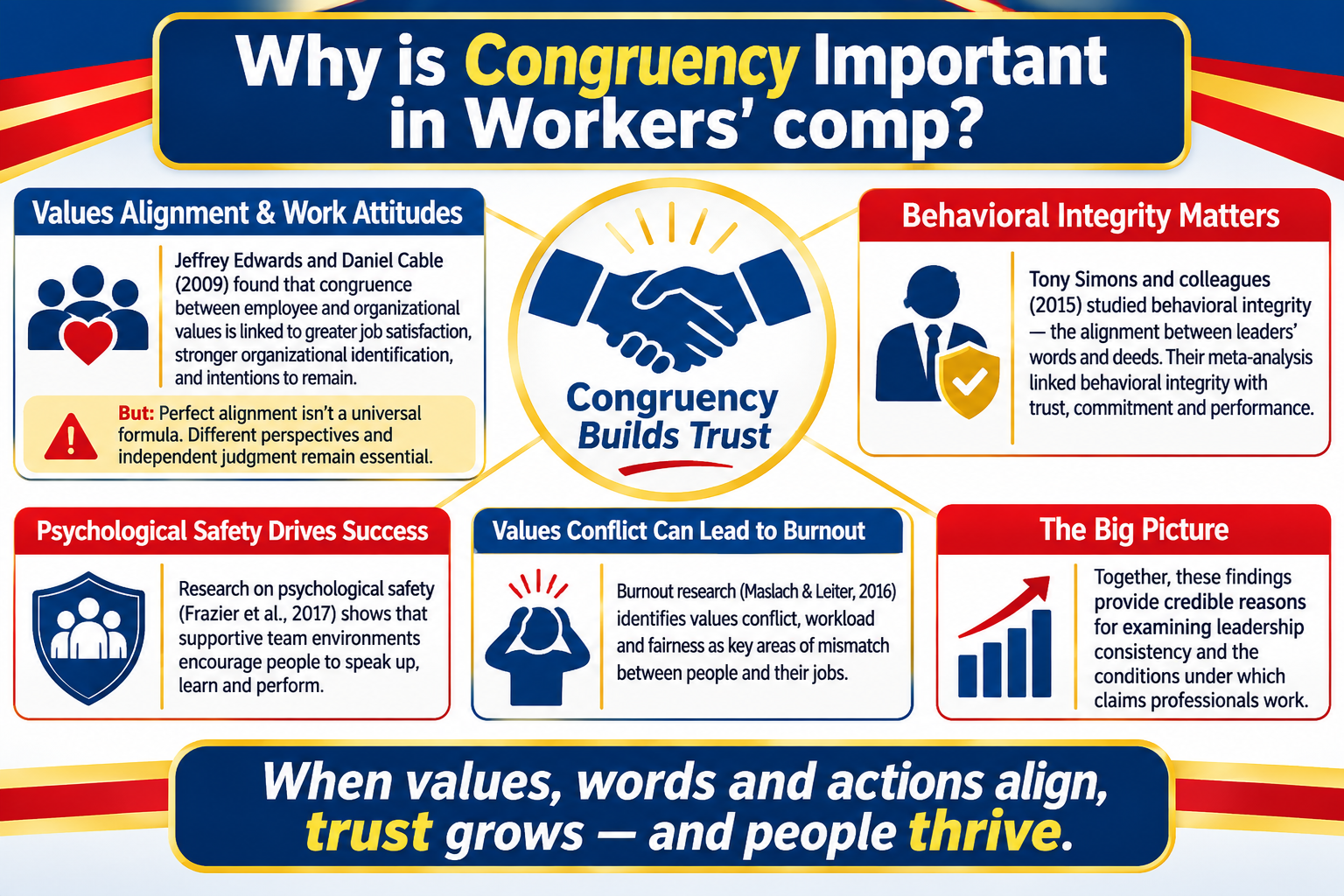
Jeffrey Edwards and Daniel Cable (2009) examined how congruence between employee and organizational values relates to work attitudes. Trust helped explain associations with job satisfaction, organizational identification and intentions to remain. Their research also cautioned against treating perfect values alignment as a universal formula. Different perspectives and independent judgment remain essential in complex work. Congruence becomes useful when employees understand the commitments guiding decisions and see them reflected in practice.
Tony Simons and colleagues (2015) studied behavioral integrity, or the perceived alignment between leaders' words and deeds. Their meta-analysis associated behavioral integrity with trust, commitment and performance. Research on psychological safety also connects supportive team environments with speaking up, learning and performance (Frazier et al., 2017). Burnout research identifies values conflict, workload and fairness among important areas of mismatch between people and their jobs (Maslach & Leiter, 2016). Together, the findings establish credible reasons for examining leadership consistency and the conditions under which claims professionals work.
From Internal Experience to External Experience
Workers' compensation research helps explain why the human experience of a claim deserves attention. In a study involving 996 Ontario injured workers, Orchard and colleagues (2021) found an association between poor informational and interpersonal treatment by case managers and greater psychological distress eighteen months after injury. In Australia, Collie and colleagues (2019) surveyed 10,946 injured workers across ten compensation schemes. Nearly one-quarter reported a negative or neutral claims experience. Positive experiences were associated with return-to-work status after adjustment for several worker and claim characteristics. Neither study evaluated the influence of leadership alignment on recovery.
A claim moves through a series of human decisions before an injured worker receives an answer. A leader establishes expectations and allocates authority. An adjuster interprets the guidance while coordinating with employers, clinicians and other stakeholders. The injured worker receives the decision along with its explanation, timing and tone. Each interaction can reinforce clarity or introduce confusion. The proposed connection between internal organizational alignment and external claims experience remains an important research question.
Four Leadership Signals
The framework begins with four signals: what leaders say, measure, reward and tolerate. Words establish the promise of respectful treatment and sound decisions. Measures show which activities remain visible when workloads increase. Rewards identify the judgments and behaviors considered worthy of recognition. Tolerated conduct reveals whether professional standards survive pressure. Alignment requires leaders to examine all four signals together.
Consider a department where employees are encouraged to raise concerns about incomplete medical information. An adjuster who identifies a missing record should know where to request review and how the delay will be assessed. The supervisor can recognize appropriate escalation while still expecting timely documentation. The worker can receive an accurate explanation without being promised a decision before the information arrives. Each step turns an abstract commitment into a behavior another person can observe. A pattern of consistent actions gives the promise credibility.
A Framework Leaders Can Test
I define The Congruency Effect as the cumulative influence of alignment or misalignment among organizational values, leadership behavior and performance systems on claims professionals and injured workers. The proposed sequence begins with leadership signals and moves through adjuster experience, team climate and injured-worker interactions. The final question concerns whether injured-worker experiences are associated with recovery and return-to-work outcomes. Established research supports individual parts of the sequence. The full pathway has not been tested from beginning to end in a claims organization. For now, the framework remains an applied proposition open to empirical testing.
Organizations can begin measuring the proposed links with tools already available. Ask employees whether leaders follow through on commitments and whether they can raise a concern without retaliation or embarrassment. Examine workload and values mismatch through established organizational assessment methods. Invite injured workers to evaluate whether communication was understandable, respectful and timely. Compare survey responses with claims information such as disability duration and return-to-work status while accounting for injury severity and jurisdiction. Patterns can guide improvement while preserving the distinction between association and causation.
Where Alignment Becomes Real
A useful first step is to examine one recurring claims decision from beginning to end. Choose a situation involving a delayed answer, disputed work capacity or a difficult benefit explanation. Compare organizational commitments with employees' instructions and the injured worker's reported experience. Identify which leader actions helped professionals respond responsibly and which created avoidable conflict. Make a specific change to the workflow or decision authority. Follow up with employees and injured workers to assess whether communication improved.
Workers' compensation will always involve legal duties, medical uncertainty and competing interests. Leaders cannot control every outcome or remove every difficult conversation. They can make expectations understandable and give employees credible support for acting on stated values. Adjusters can communicate with honesty while exercising judgment within their authority. Injured workers can receive clearer explanations even when a decision is unwelcome. An injured worker may never read an organization's values statement. The claims experience reveals whether its commitments reach the people the system serves.
Research Referenced
Collie, A., Sheehan, L., Lane, T. J., Gray, S., & Grant, G. (2019). Injured worker experiences of insurance claim processes and return to work: A national, cross-sectional study. BMC Public Health, 19, 927. https://doi.org/10.1186/s12889-019-7251-x
Edwards, J. R., & Cable, D. M. (2009). The value of value congruence. Journal of Applied Psychology, 94(3), 654–677. https://doi.org/10.1037/a0014891
Frazier, M. L., Fainshmidt, S., Klinger, R. L., Pezeshkan, A., & Vracheva, V. (2017). Psychological safety: A meta-analytic review and extension. Personnel Psychology, 70(1), 113–165. https://doi.org/10.1111/peps.12183
Maslach, C., & Leiter, M. P. (2016). Understanding the burnout experience: Recent research and its implications for psychiatry. World Psychiatry, 15(2), 103–111. https://doi.org/10.1002/wps.20311
Orchard, C., Carnide, N., Smith, P. M., & Mustard, C. (2021). The association between case manager interactions and serious mental illness following a physical workplace injury or illness: A cross-sectional analysis of workers' compensation claimants in Ontario. Journal of Occupational Rehabilitation, 31, 895–902. https://doi.org/10.1007/s10926-021-09974-7
Simons, T., Leroy, H., Collewaert, V., & Masschelein, S. (2015). How leader alignment of words and deeds affects followers: A meta-analysis of behavioral integrity research. Journal of Business Ethics, 132, 831–844. https://doi.org/10.1007/s10551-014-2332-3


AI best practices california case file caselaw case management case management focus claims compensability compliance compliance corner courts do you know the rule employers exclusive remedy florida fraud glossary check Healthcare hr homeroom insurance insurers iowa kentucky leadership NCCI new jersey new york ohio pennsylvania Safety safety at work state info tech technology the case manager violence WDYT what do you think women's history women's history month workers' comp 101 workers' recovery Workplace Safety Workplace Violence
Read Also
About The Author
About The Author
-
Claire Muselman
Meet Dr. Claire C. Muselman, the Chief Operating Officer at WorkersCompensation.com, where she blends her vast academic insight and professional innovation with a uniquely positive energy. As the President of DCM, Dr. Muselman is renowned for her dynamic approach that reshapes and energizes the workers' compensation industry. Dr. Muselman's academic credentials are as remarkable as her professional achievements. Holding a Doctor of Education in Organizational Leadership from Grand Canyon University, she specializes in employee engagement, human behavior, and the science of leadership. Her diverse background in educational leadership, public policy, political science, and dance epitomizes a multifaceted approach to leadership and learning. At Drake University, Dr. Muselman excels as an Assistant Professor of Practice and Co-Director of the Master of Science in Leadership Program. Her passion for teaching and commitment to innovative pedagogy demonstrate her dedication to cultivating future leaders in management, leadership, and business strategy. In the industry, Dr. Muselman actively contributes as an Ambassador for the Alliance of Women in Workers’ Compensation and plays key roles in organizations such as Kids Chance of Iowa, WorkCompBlitz, and the Claims and Litigation Management Alliance, underscoring her leadership and advocacy in workers’ compensation. A highly sought-after speaker, Dr. Muselman inspires professionals with her engaging talks on leadership, self-development, and risk management. Her philosophy of empathetic and emotionally intelligent leadership is at the heart of her message, encouraging innovation and progressive change in the industry. "Empowerment is key to progress. By nurturing today's professionals with empathy and intelligence, we're crafting tomorrow's leaders." - Dr. Claire C. Muselman
More by This Author
- Nov 16, 2026
- Claire Muselman
- Nov 15, 2026
- Claire Muselman
Read More
- Nov 16, 2026
- Frank Ferreri
- Nov 16, 2026
- Claire Muselman
- Nov 15, 2026
- Chris Parker
- Nov 15, 2026
- Claire Muselman
- Nov 13, 2026
- Claire Muselman
- Nov 13, 2026
- Frank Ferreri