


Share This Article:
The Human Side of Alignment
Article 7 of 8
At the end of a difficult claims review, an adjuster agrees to three requests. An employer requests a return-to-work update. An injured worker wants to know if treatment will be approved. A supervisor asks for help clearing another colleague's backlog. The adjuster promises everything to avoid disappointing anyone. By Friday, two commitments remain unfinished and expectations have soured.
Claims organizations often praise employees who are responsive, accommodating and willing to help. Their contributions strengthen relationships and move complicated work forward. Problems arise when saying yes becomes an unspoken requirement, even without enough time or authority. A professional can appear cooperative while withholding a concern about an unrealistic deadline or a questionable decision. The cost appears in missed expectations and hidden concerns. The central issue is how an organization responds when someone needs to say no, ask for help or deliver difficult news.
When Helping Stops Being Voluntary
“People-pleasing” is familiar language, although it is not a single established scientific construct. Research provides more precise ways to examine the behavior. Psychologists Heidi Fritz and Vicki Helgeson (1998) studied unmitigated communion, an excessive focus on other people's needs at the expense of one's own. Their research linked the pattern with self-neglect and psychological distress. The findings concern individual tendencies rather than workers' compensation adjusters, but they distinguish healthy concern for others from continually sacrificing personal limits.
Workplace research identifies a related organizational pressure. Mark Bolino and colleagues (2010) studied 245 employees and examined expectations to perform organizational citizenship behaviors, the helpful actions people undertake beyond formal job requirements. Greater pressure to be a “good soldier” was associated with job stress, work–family conflict, work–leisure conflict and intentions to quit, even after accounting for other job demands. Extra help can be valuable and fulfilling. Difficulty begins when a supposedly voluntary contribution becomes the price of being considered committed.
Information Lost to Agreement
In a claims department, excessive accommodation can hide meaningful disagreement. An adjuster may know a proposed return-to-work date depends on missing medical clarification yet avoid challenging an enthusiastic supervisor. A team member may promise an injured worker a response without knowing whether the reviewing party can meet the deadline. A manager may postpone giving candid feedback to an employee whose communication has generated repeated complaints. Each choice briefly avoids discomfort. The underlying problem remains, and the next person inherits the uncertainty.
Organizational psychologist Elizabeth Wolfe Morrison (2023) reviewed a decade of research on employee voice and silence. Employee silence involves deliberately withholding potentially useful concerns, ideas or information about problems. Employees may stay quiet when speaking up seems unsafe or futile. Silence is not necessarily agreement. In workers' compensation, leaders should treat repeated expressions of agreement as a reason to invite specific questions about what may be missing, rather than proof a plan is sound.
The Price of Being the Reliable One
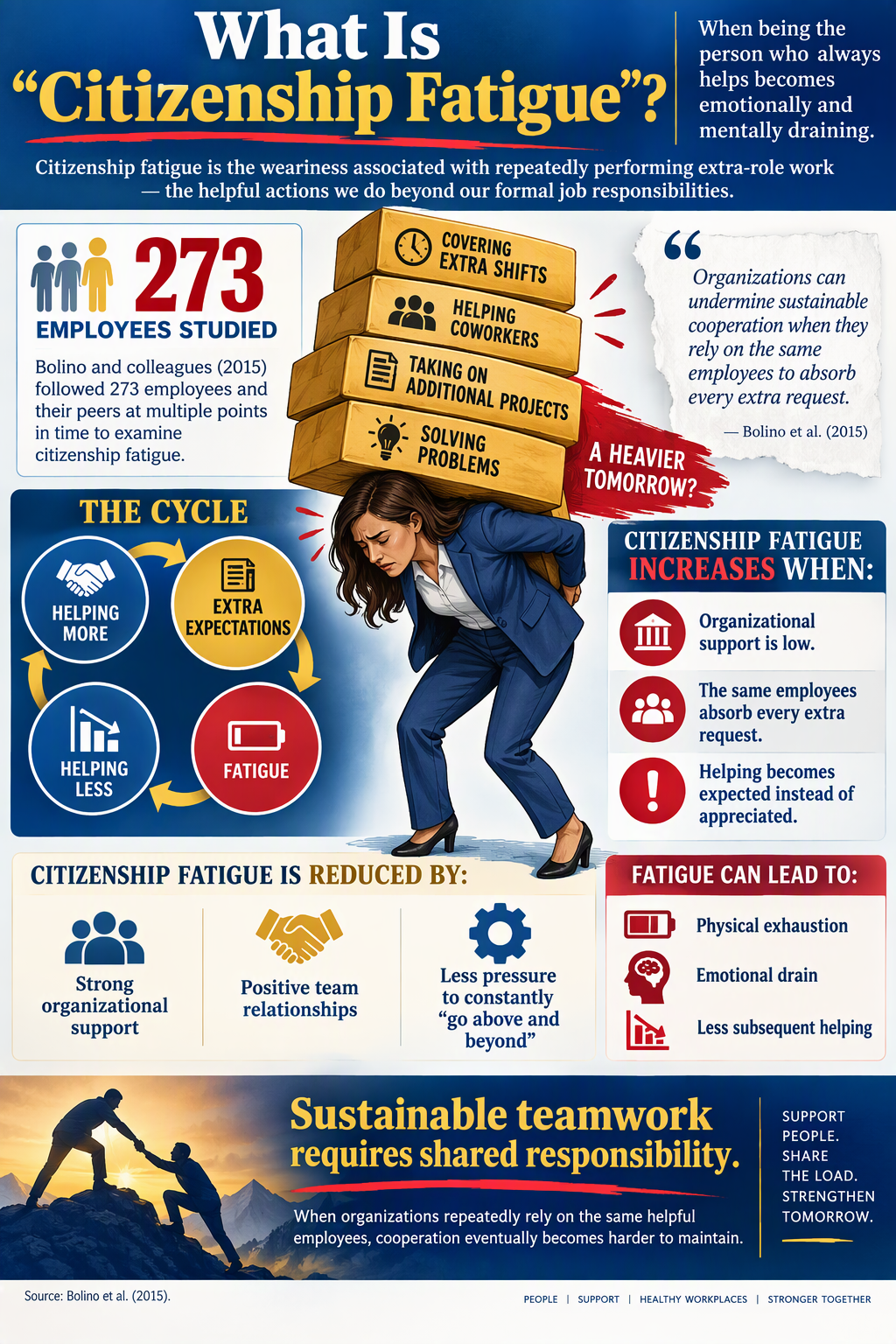
Being the person who always helps can also become exhausting. Bolino and colleagues (2015) followed 273 employees and their peers at multiple points in time to study citizenship fatigue, the weariness associated with repeatedly performing extra-role work. The connection between helping and fatigue was stronger when organizational support was low, while better team relationships and less citizenship pressure changed the pattern. Fatigue was associated with less subsequent helping. The findings suggest organizations can undermine sustainable cooperation when they rely on the same employees to absorb every extra request.
The claims application is a practical inference rather than an established causal finding. Consider the adjuster who consistently accepts urgent files, covers absent colleagues and responds to every request immediately. Leaders may praise the service while overlooking mounting constraints. Eventually, responsiveness may decline and colleagues may wonder why a previously dependable teammate is struggling. A more useful managerial question concerns whether the workload became unsustainable long before the first visible problem. Capacity should be discussed before an employee must demonstrate exhaustion to be heard.
Make Honesty Easier than Agreement
Leaders can reduce over-accommodation by treating a realistic commitment as more valuable than an enthusiastic promise. During a case review, ask what remains outside the adjuster's authority, which deadlines depend on third parties and what would need to change for the plan to work. Make it acceptable to answer, “I can provide an update by Thursday, but the treatment decision is still under review.” The statement communicates care without manufacturing certainty. An injured worker deserves a dependable next step more than reassurance nobody can honor.
Supervisors also have to model respectful disagreement. When a team member questions an expected return-to-work date, the leader can ask for the underlying medical or job-duty information before interpreting the concern as resistance. When employees decline additional assignments, managers can examine priorities and redistribute work rather than rewarding the person who never objects. Feedback should identify the issue plainly and provide a path for improvement. Kindness remains visible through clarity, follow-through and fair treatment, including during conversations people would rather avoid.
What Responsible Care Looks Like
Workers' compensation requires human consideration and disciplined decision-making. Adjusters are not responsible for satisfying every request, removing every frustration or providing answers before the evidence permits them. They are responsible for communicating accurately, exercising sound judgment and following appropriate escalation processes within their roles. Leaders are responsible for creating conditions in which professional limits can be expressed without penalty. The goal is reliable service built on commitments people have the capacity and authority to fulfill.
Agreement can make a difficult moment more comfortable while making the next decision harder. Organizations discover the cost when concerns surface late, promises cannot be kept and the people who help most feel unable to continue. Research on citizenship pressure, fatigue and employee silence gives leaders a reason to take those patterns seriously, although their direct effects on claims outcomes remain untested. A responsible culture makes room for honest limits and respectful disagreement. In workers' compensation, a clear answer delivered with care serves people better than an agreeable promise without a workable plan.
Research Referenced
Bolino, M. C., Hsiung, H.-H., Harvey, J., & LePine, J. A. (2015). “Well, I'm tired of tryin'!” Organizational citizenship behavior and citizenship fatigue. Journal of Applied Psychology, 100(1), 56–74. https://doi.org/10.1037/a0037583
Bolino, M. C., Turnley, W. H., Gilstrap, J. B., & Suazo, M. M. (2010). Citizenship under pressure: What's a “good soldier” to do? Journal of Organizational Behavior, 31(6), 835–855. https://doi.org/10.1002/job.635
Fritz, H. L., & Helgeson, V. S. (1998). Distinctions of unmitigated communion from communion: Self-neglect and overinvolvement with others. Journal of Personality and Social Psychology, 75(1), 121–140. https://doi.org/10.1037/0022-3514.75.1.121
Morrison, E. W. (2023). Employee voice and silence: Taking stock a decade later. Annual Review of Organizational Psychology and Organizational Behavior, 10, 79–107. https://doi.org/10.1146/annurev-orgpsych-120920-054654


AI best practices california case file caselaw case management case management focus claims compensability compliance compliance corner courts do you know the rule employers exclusive remedy florida fraud glossary check Healthcare hr homeroom insurance insurers iowa kentucky leadership NCCI new jersey new york ohio pennsylvania Safety safety at work state info tech technology the case manager violence WDYT what do you think women's history women's history month workers' comp 101 workers' recovery Workplace Safety Workplace Violence
Read Also
About The Author
About The Author
-
Claire Muselman
Meet Dr. Claire C. Muselman, the Chief Operating Officer at WorkersCompensation.com, where she blends her vast academic insight and professional innovation with a uniquely positive energy. As the President of DCM, Dr. Muselman is renowned for her dynamic approach that reshapes and energizes the workers' compensation industry. Dr. Muselman's academic credentials are as remarkable as her professional achievements. Holding a Doctor of Education in Organizational Leadership from Grand Canyon University, she specializes in employee engagement, human behavior, and the science of leadership. Her diverse background in educational leadership, public policy, political science, and dance epitomizes a multifaceted approach to leadership and learning. At Drake University, Dr. Muselman excels as an Assistant Professor of Practice and Co-Director of the Master of Science in Leadership Program. Her passion for teaching and commitment to innovative pedagogy demonstrate her dedication to cultivating future leaders in management, leadership, and business strategy. In the industry, Dr. Muselman actively contributes as an Ambassador for the Alliance of Women in Workers’ Compensation and plays key roles in organizations such as Kids Chance of Iowa, WorkCompBlitz, and the Claims and Litigation Management Alliance, underscoring her leadership and advocacy in workers’ compensation. A highly sought-after speaker, Dr. Muselman inspires professionals with her engaging talks on leadership, self-development, and risk management. Her philosophy of empathetic and emotionally intelligent leadership is at the heart of her message, encouraging innovation and progressive change in the industry. "Empowerment is key to progress. By nurturing today's professionals with empathy and intelligence, we're crafting tomorrow's leaders." - Dr. Claire C. Muselman
More by This Author
- Nov 13, 2026
- Claire Muselman
- Nov 13, 2026
- Claire Muselman
Read More
- Nov 15, 2026
- Chris Parker
- Nov 13, 2026
- Claire Muselman
- Nov 13, 2026
- Frank Ferreri
- Nov 13, 2026
- Claire Muselman
- Nov 12, 2026
- Claire Muselman
- Nov 10, 2026
- Frank Ferreri