


Share This Article:
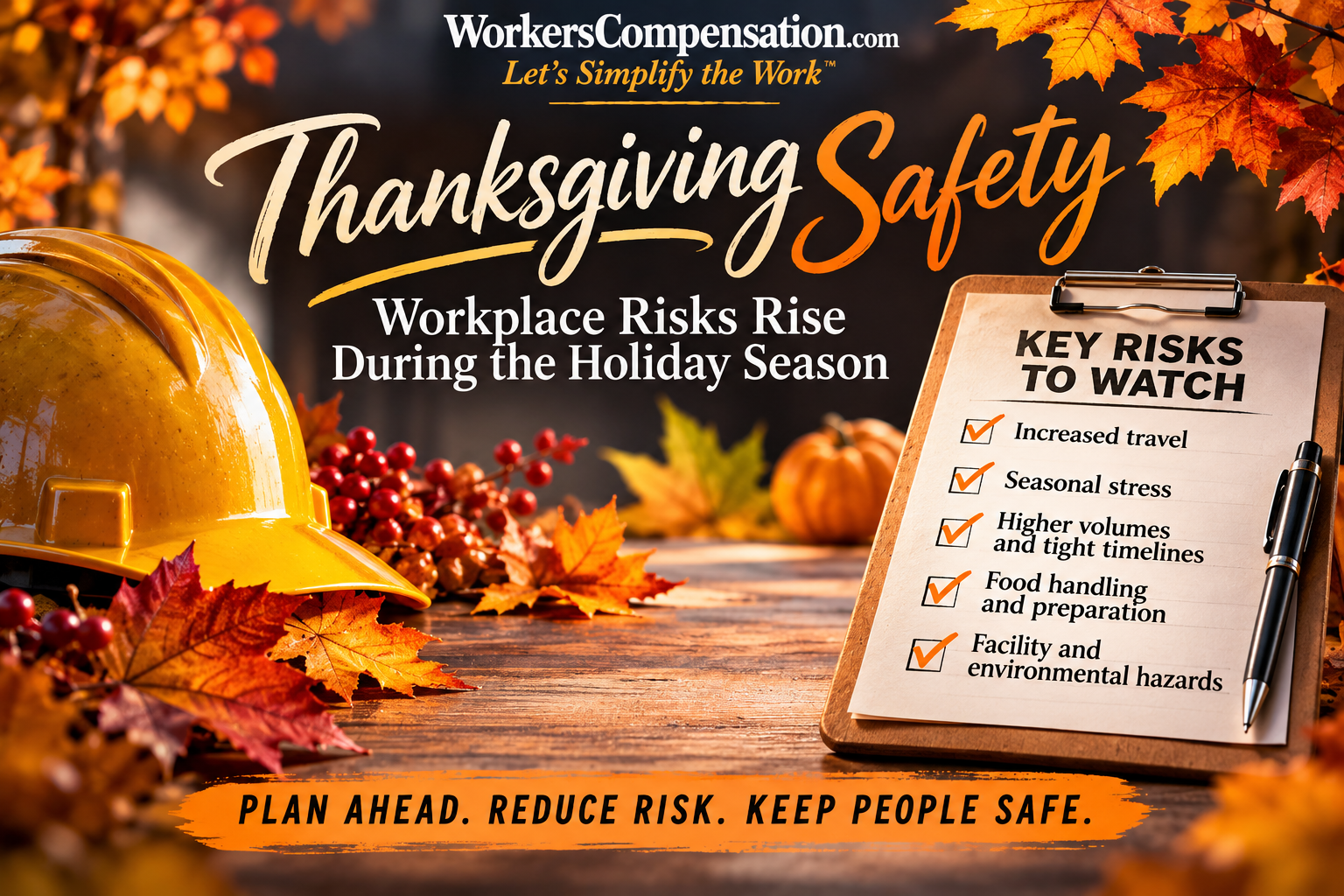
Before Everyone Leaves: How Pre-Holiday Time Pressure Changes Workplace Injury Risk
19 Nov, 2026 Claire Muselman
Stuffed with Safety
The week before Thanksgiving has a particular rhythm. Employees want to finish projects before taking time off. Supervisors need orders completed, schedules covered, and customers served. Holiday travel, childcare, and family obligations compete for attention while unfinished work accumulates. A warehouse employee may take on a coworker's assignment, a technician may defer a repair, and a manager may ask the team for one final push. No national study establishes a pre-Thanksgiving spike in occupational injuries. Research does show how rushing, distraction, unfamiliar methods, and production pressure can combine to change the conditions in which workplace injuries occur.
Risks Hidden Inside Hurry
In a case-crossover study of 1,166 workers who sustained acute hand injuries, Gary Sorock and colleagues examined short-term exposures immediately preceding injury. Workers reporting that they were rushed had approximately 2.4 times the injury risk associated with periods without rushing. Distraction was associated with 5.3 times the risk, unusual work methods with 10.5 times, and equipment or materials behaving unexpectedly with 11 times. These estimates concern acute hand injuries, not all workplace injuries or Thanksgiving specifically. Their relative sizes reveal an important prevention opportunity: the most consequential changes may occur when deadline pressure leads employees to improvise, divide attention, or continue working with unreliable equipment.
An approaching holiday makes those changes plausible across many operations. When coworkers leave early, remaining employees may inherit unfamiliar assignments or handle more work per person. When a deadline becomes nonnegotiable, routine inspections and maintenance can appear expendable. Workers also face a well-established speed-accuracy tradeoff: faster decisions often involve less information gathering before action. Safety procedures compete with production demands when employees believe completing the assignment is the only outcome being measured. Supervisors can reduce exposure by identifying unfamiliar tasks, preserving critical checks, and addressing equipment problems before the final production push.
Deadlines, an Organizational Exposure
Production pressure begins well before an employee decides to hurry. Judson Caskey and N. Bugra Ozel examined workplace injury and illness data alongside firms' financial performance. Companies that narrowly met or exceeded analysts' earnings expectations had injury and illness rates approximately 5–15% higher than companies that missed expectations or exceeded them comfortably. The observational findings do not prove that financial targets caused individual injuries. They do show an association between organizational performance pressure and worker safety outcomes. Pre-holiday schedules deserve the same scrutiny because leaders determine targets, staffing, maintenance windows, and how much work must be completed before employees leave.
The cognitive burden extends beyond the production schedule. Holiday travel, hosting responsibilities, and family arrangements occupy mental resources even when employees remain physically present at work. Research on work-family conflict has linked family demands intruding into work with lower safety compliance, although the study did not examine Thanksgiving specifically. An employee thinking through a childcare change while operating equipment may have less attention available for unexpected cues. Predictable schedules, realistic workloads, and support for family responsibilities can help employees stay engaged with the work in front of them. Those choices belong in operational planning because attention is part of safe performance.
The Injury Log Goes Quiet
Pressure also affects what an organization learns about injuries. Tahira Probst and Maja Graso found that employees perceiving greater production pressure reported more accidents while also showing lower accident-reporting tendencies. A quiet injury log during an intense week therefore cannot automatically be interpreted as evidence of safer operations. Employees may work through a strain, postpone mentioning a cut, or wait until after vacation to seek care. For workers' compensation teams, delayed notification can complicate prompt treatment, investigation, documentation, and return-to-work coordination. The date an injury is reported may differ from the date it occurred, particularly when employees feel that raising a concern will disrupt a deadline.
Workers' compensation generally operates without requiring proof that an employer was negligent, although coverage and benefits depend on applicable state law and the circumstances of employment. An employee's haste while performing assigned work does not ordinarily eliminate the possibility of a compensable injury. The more useful questions concern what changed before the incident: Was the employee covering an unfamiliar job? Had staffing declined? Was equipment malfunctioning? Were production expectations discouraging breaks or reporting? Answering those questions can help employers prevent recurrence while giving claims professionals a clearer picture of the exposure. A reporting process that remains accessible and free from retaliation during peak periods is part of an effective response.
Protect the Work Before the Break
The strongest pre-holiday interventions address work design. Leaders can adjust completion targets, staff unfamiliar assignments appropriately, protect critical procedures from interruption, and resolve equipment issues before production accelerates. They can also tell employees which tasks may safely wait until after the holiday and make it clear that reporting an injury takes priority over meeting a deadline. Thanksgiving provides a predictable planning horizon, giving organizations time to prepare for absences and increased demand. A holiday deadline becomes hazardous when the system asks workers to compensate for unrealistic expectations through shortcuts and improvisation. When leaders design the deadline, they also influence the risk employees carry into it.
Research Referenced
Caskey, J., & Ozel, N. B. (2017). Earnings expectations and employee safety. Journal of Accounting and Economics, 63(1), 121–141.
Cullen, J. C., & Hammer, L. B. (2007). Developing and testing a theoretical model linking work-family conflict to employee safety. Journal of Occupational Health Psychology, 12, 266–278.
Probst, T. M., & Graso, M. (2013). Pressure to produce = pressure to reduce accident reporting? Accident Analysis & Prevention, 59, 580–587.
Sorock, G. S., et al. (2004). A case-crossover study of transient risk factors for occupational acute hand injury. Occupational and Environmental Medicine, 61(4), 305–311.


AI best practices california case file caselaw case management case management focus claims compensability compliance compliance corner courts do you know the rule employers exclusive remedy florida fraud glossary check Healthcare hr homeroom insurance insurers iowa kentucky leadership NCCI new jersey new york ohio pennsylvania Safety safety at work state info tech technology the case manager violence WDYT what do you think women's history women's history month workers' comp 101 workers' recovery Workplace Safety Workplace Violence
Read Also
About The Author
About The Author
-
Claire Muselman
Meet Dr. Claire C. Muselman, the Chief Operating Officer at WorkersCompensation.com, where she blends her vast academic insight and professional innovation with a uniquely positive energy. As the President of DCM, Dr. Muselman is renowned for her dynamic approach that reshapes and energizes the workers' compensation industry. Dr. Muselman's academic credentials are as remarkable as her professional achievements. Holding a Doctor of Education in Organizational Leadership from Grand Canyon University, she specializes in employee engagement, human behavior, and the science of leadership. Her diverse background in educational leadership, public policy, political science, and dance epitomizes a multifaceted approach to leadership and learning. At Drake University, Dr. Muselman excels as an Assistant Professor of Practice and Co-Director of the Master of Science in Leadership Program. Her passion for teaching and commitment to innovative pedagogy demonstrate her dedication to cultivating future leaders in management, leadership, and business strategy. In the industry, Dr. Muselman actively contributes as an Ambassador for the Alliance of Women in Workers’ Compensation and plays key roles in organizations such as Kids Chance of Iowa, WorkCompBlitz, and the Claims and Litigation Management Alliance, underscoring her leadership and advocacy in workers’ compensation. A highly sought-after speaker, Dr. Muselman inspires professionals with her engaging talks on leadership, self-development, and risk management. Her philosophy of empathetic and emotionally intelligent leadership is at the heart of her message, encouraging innovation and progressive change in the industry. "Empowerment is key to progress. By nurturing today's professionals with empathy and intelligence, we're crafting tomorrow's leaders." - Dr. Claire C. Muselman
More by This Author
Read More
- Nov 19, 2026
- Chris Parker
- Nov 19, 2026
- Frank Ferreri
- Nov 18, 2026
- Claire Muselman
- Nov 18, 2026
- Anne Llewellyn
- Nov 16, 2026
- Claire Muselman
- Nov 16, 2026
- Frank Ferreri