


Share This Article:
Summer Safety Series
Welcome to The Science Behind Workplace Injuries: 30 Days of Summer Safety, where we explore the environmental hazards, human physiology, behavioral science, and organizational decisions shaping workplace safety. This article is part of our July series examining the science behind workplace injuries and the factors influencing workplace safety during the summer months.
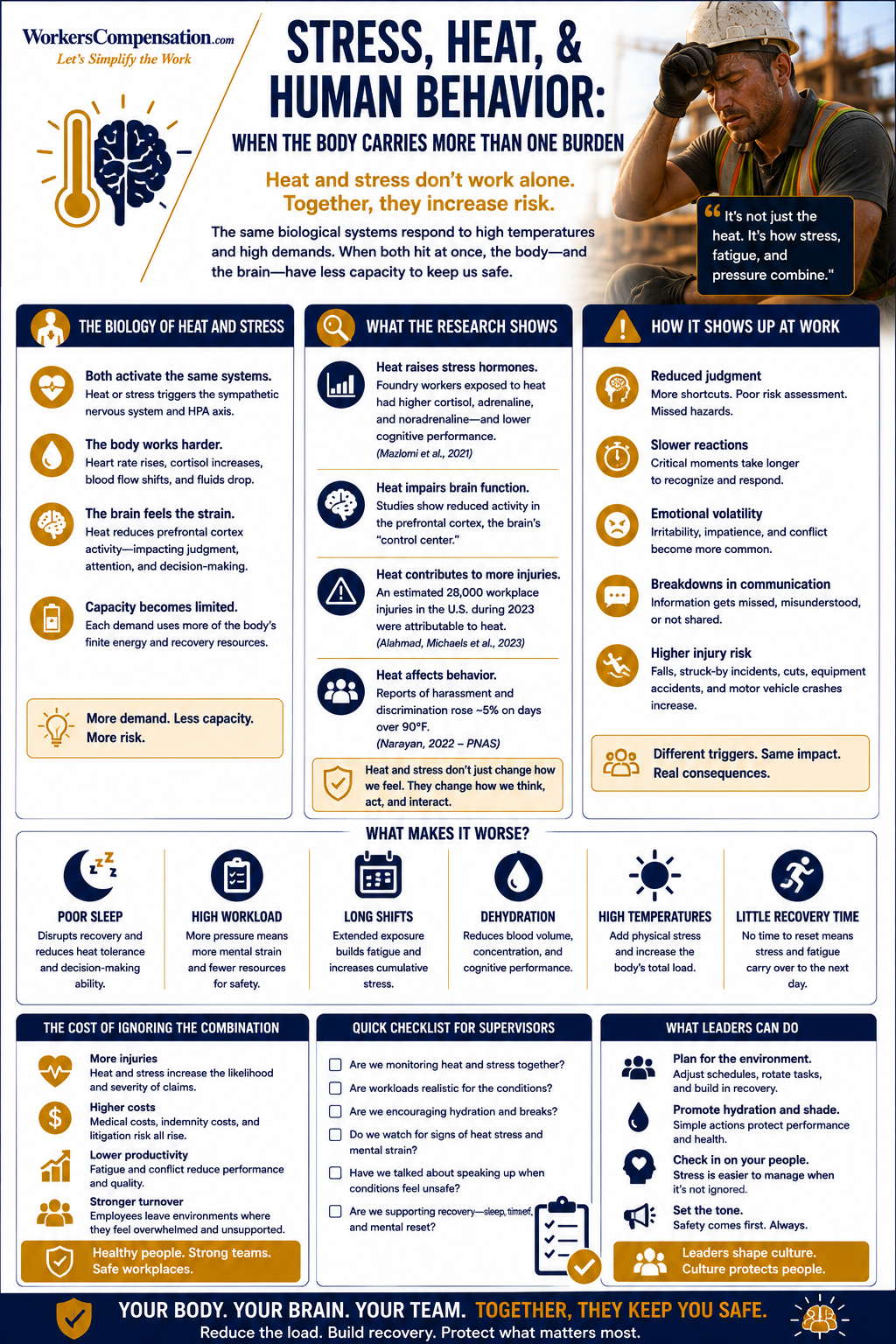
Most people think of stress and heat as two separate workplace challenges. One feels emotional. The other feels physical. Human physiology makes far less distinction. Whether the body responds to rising temperatures, a demanding workload, production pressure, conflict, or an approaching deadline, many of the same biological systems become activated. Heart rate increases. Cortisol rises. Adrenaline is released. Attention narrows. The body prepares to respond. Understanding those shared pathways helps explain why heat influences far more than body temperature and why stress often becomes a hidden contributor to workplace injuries.
Heat places immediate demands on the cardiovascular system. Blood is redirected toward the skin to release heat while sweating reduces plasma volume. The heart works harder to maintain blood pressure and circulate oxygen throughout the body. At the same time, psychological stress activates the hypothalamic-pituitary-adrenal axis and the sympathetic nervous system, releasing cortisol, adrenaline, and noradrenaline. Although the triggers differ, both forms of stress draw upon many of the same physiological systems. The body responds by increasing its overall workload.
Researchers continue discovering how those responses influence the brain. Mazlomi, Golbabaei, Mahmoud Khani, and their research team found foundry workers exposed to occupational heat demonstrated significantly higher cortisol, adrenaline, and noradrenaline levels than workers outside the hot environment. Hormone levels increased alongside heat exposure while cognitive performance declined. Heat was influencing more than comfort. It was changing the biology supporting attention, judgment, and decision-making.
Modern neuroscience reaches similar conclusions. Studies using functional near-infrared spectroscopy, electroencephalography, and cerebral blood flow imaging consistently show heat reduces activity within the prefrontal cortex, the region responsible for executive function, working memory, response inhibition, and complex decision-making. Interestingly, simple reaction-time tasks often remain relatively stable while higher-order thinking becomes less efficient. Employees may feel capable of continuing routine work while becoming less effective at recognizing changing hazards, solving unexpected problems, or making complex decisions. Physiology changes before performance visibly declines.
One of the most important occupational health studies published in recent years reinforces that conclusion. Barrak Alahmad, David Michaels, and researchers from the Harvard T.H. Chan School of Public Health and George Washington University estimated approximately 28,000 workplace injuries in the United States during 2023 were attributable to heat exposure. Many of those injuries were not diagnosed as heat illness. They included falls, cuts, equipment incidents, and other traumatic injuries where heat quietly influenced human performance before the event occurred. Heat often contributes to injuries without becoming the official diagnosis as we highlighted earlier in this series.
Heat also influences human behavior in ways many organizations never consider. Ayushi Narayan's 2022 study published in the Proceedings of the National Academy of Sciences analyzed more than 800,000 Equal Employment Opportunity complaints across over 12,000 United States Postal Service locations. On days when temperatures exceeded 90 degrees Fahrenheit, reports of workplace harassment and discrimination increased by approximately five percent compared with days between 60 and 70 degrees. Heat influenced more than physical performance. It influenced patience, emotional regulation, and interpersonal behavior.
Researchers have observed similar patterns for decades. Craig Anderson's work examining heat and aggression consistently demonstrated violent behavior increases during hotter years, hotter seasons, and hotter days. More recently, Tiihonen and colleagues found ambient temperature explained a meaningful portion of the variation in violent crime, supporting the growing body of evidence that environmental heat influences impulsivity and behavioral regulation. Most workplaces will never experience violence. Many experience frustration, impatience, communication breakdowns, and conflict that quietly influence decision-making throughout the workday.
Sleep adds another important layer to the conversation. Chronic stress, inadequate recovery, and disrupted sleep all place additional demands on the same physiological systems responsible for regulating heat. Keramidas and Botonis reviewed the scientific literature and concluded sleep deprivation impairs the body's ability to regulate temperature during environmental heat exposure. Sawka, Gonzalez, and Pandolf similarly demonstrated sleep deprivation reduced heat tolerance during exercise. Each additional demand consumes another portion of the body's available capacity. The challenge rarely comes from one source of stress. It develops when several sources begin interacting at the same time.
Workers' compensation professionals increasingly recognize heat as a contributing factor rather than simply a diagnosis. The Workers Compensation Research Institute found heat-related illness claims increase dramatically once temperatures exceed 90 degrees, although researchers also identified higher rates of traumatic injuries including fractures, lacerations, dislocations, and contusions during periods of elevated heat. The injury may not be classified as heat-related. Heat may still have influenced the human performance leading to the event. Understanding contributing factors often provides greater insight than focusing exclusively on the final diagnosis.
Leadership creates opportunities to interrupt this cycle before performance begins to decline. Acclimatization programs, thoughtful scheduling, hydration practices, shaded recovery areas, realistic production expectations, and supervisor training all reduce physiological strain. Equally important, leaders who recognize workload, emotional stress, fatigue, and environmental conditions as interacting influences are better equipped to support safe decision-making. OSHA's proposed Heat Injury and Illness Prevention Standard, the revised National Emphasis Program, and expanding state heat regulations all reflect the growing scientific consensus that prevention begins long before someone experiences heat illness.
Stress and heat remind us workplace safety is never influenced by one factor alone. Every employee arrives at work carrying a unique combination of physical demands, environmental conditions, sleep quality, emotional experiences, workload, and recovery. The body responds to all of them together. Organizations create safer workplaces when they stop asking which stressor matters most and begin recognizing how those stressors accumulate. Understanding total physiological load allows leaders to protect not only the body, but also the remarkable cognitive capacity people rely on every day to work safely.
Tomorrow in The Science Behind Workplace Injuries - Situational Awareness: The Skill That Prevents Workplace Injuries. Every employee sees the world through the filter of attention. Situational awareness determines which signals the brain notices, which hazards it ignores, and how quickly people recognize changing conditions. Tomorrow, we explore the neuroscience of awareness and why noticing the right thing at the right time remains one of the most valuable skills in workplace safety.


AI best practices california case file caselaw case management case management focus claims compensability compliance compliance corner courts do you know the rule employers exclusive remedy florida fraud glossary check Healthcare hr homeroom insurance insurers iowa kentucky leadership NCCI new jersey new york ohio pennsylvania Safety safety at work state info tech technology the case manager violence WDYT what do you think women's history women's history month workers' comp 101 workers' recovery Workplace Safety Workplace Violence
Read Also
About The Author
About The Author
-
Claire Muselman
Meet Dr. Claire C. Muselman, the Chief Operating Officer at WorkersCompensation.com, where she blends her vast academic insight and professional innovation with a uniquely positive energy. As the President of DCM, Dr. Muselman is renowned for her dynamic approach that reshapes and energizes the workers' compensation industry. Dr. Muselman's academic credentials are as remarkable as her professional achievements. Holding a Doctor of Education in Organizational Leadership from Grand Canyon University, she specializes in employee engagement, human behavior, and the science of leadership. Her diverse background in educational leadership, public policy, political science, and dance epitomizes a multifaceted approach to leadership and learning. At Drake University, Dr. Muselman excels as an Assistant Professor of Practice and Co-Director of the Master of Science in Leadership Program. Her passion for teaching and commitment to innovative pedagogy demonstrate her dedication to cultivating future leaders in management, leadership, and business strategy. In the industry, Dr. Muselman actively contributes as an Ambassador for the Alliance of Women in Workers’ Compensation and plays key roles in organizations such as Kids Chance of Iowa, WorkCompBlitz, and the Claims and Litigation Management Alliance, underscoring her leadership and advocacy in workers’ compensation. A highly sought-after speaker, Dr. Muselman inspires professionals with her engaging talks on leadership, self-development, and risk management. Her philosophy of empathetic and emotionally intelligent leadership is at the heart of her message, encouraging innovation and progressive change in the industry. "Empowerment is key to progress. By nurturing today's professionals with empathy and intelligence, we're crafting tomorrow's leaders." - Dr. Claire C. Muselman
More by This Author
Read More
- Oct 10, 2026
- Claire Muselman
- Oct 10, 2026
- Frank Ferreri
- Oct 10, 2026
- Claire Muselman
- Oct 10, 2026
- Chris Parker
- Oct 08, 2026
- Claire Muselman