


Share This Article:
Summer Safety Series
Welcome to The Science Behind Workplace Injuries: 30 Days of Summer Safety, where we explore the environmental hazards, human physiology, behavioral science, and organizational decisions shaping workplace safety. This article is part of our July series examining the science behind workplace injuries and the factors influencing workplace safety during the summer months.
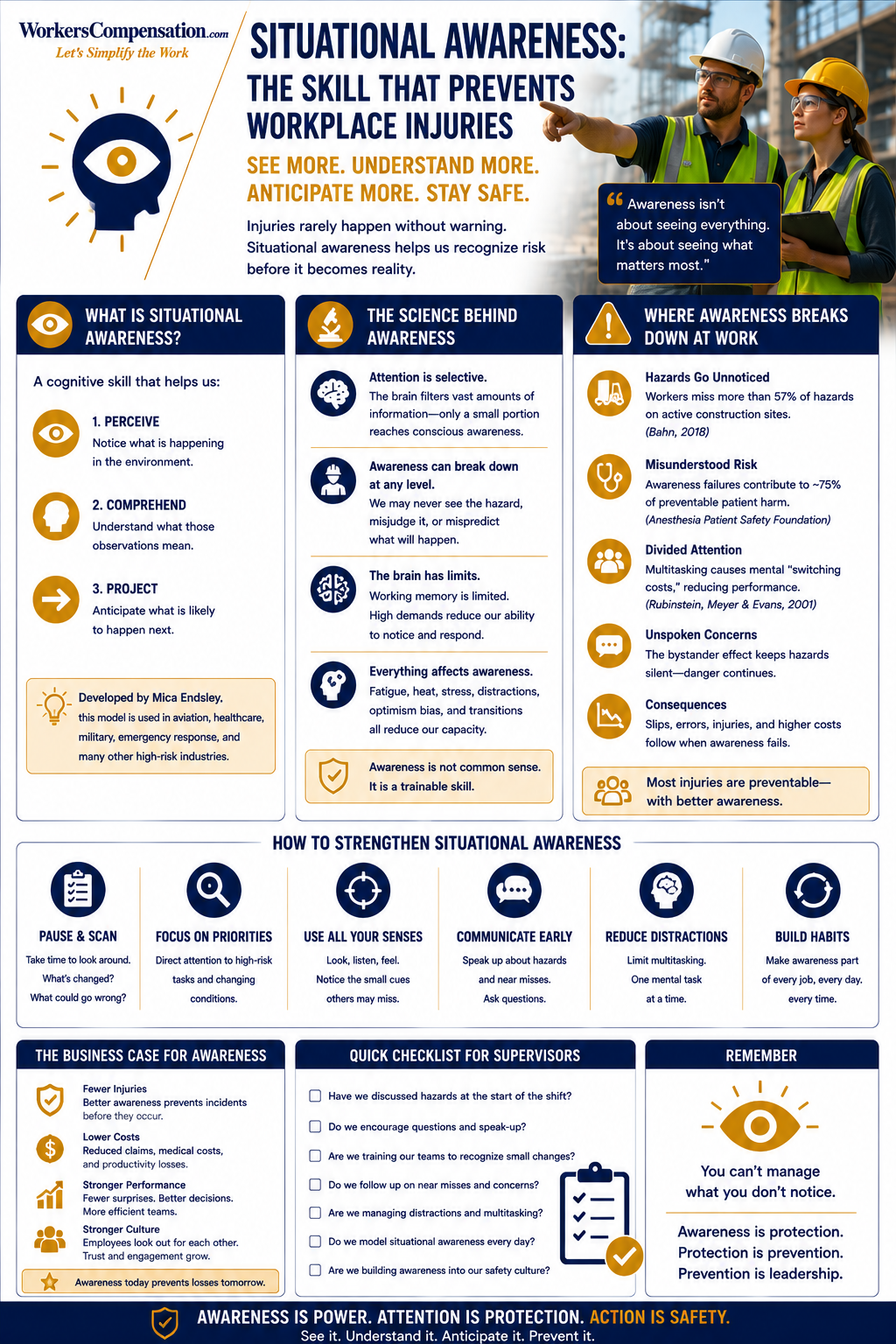
Every employee sees the same workplace. Not every employee notices the same workplace. The difference between employee awareness determines whether someone recognizes a hazard before it becomes an injury.
Situational awareness is one of the most extensively studied concepts in human factors research. Psychologist Mica Endsley defined it as the ability to perceive what is happening in the environment, understand what those observations mean, and anticipate what is likely to happen next. Those three stages—perception, comprehension, and projection—form the foundation of effective decision-making across aviation, healthcare, emergency response, manufacturing, construction, and countless other high-risk industries. Situational awareness is not common sense. It is a trainable cognitive skill.
The concept sounds straightforward until we consider how the brain processes information. Human attention is remarkably powerful, although it is also remarkably selective. The brain continuously filters enormous amounts of sensory information, allowing only a small portion to reach conscious awareness. Attention and working memory become the limiting factors. If a hazard is never perceived, it cannot be understood. If it cannot be understood, it cannot be anticipated. Situational awareness begins long before a decision is ever made.
Research demonstrates how challenging that process can become. Mica Endsley's framework has been applied across dozens of industries because failures can occur at every stage. An employee may never notice the forklift approaching. Another may see it without recognizing the collision risk. Someone else may understand the danger while failing to anticipate where the forklift will move next. Different errors can produce the same outcome. Looking beyond the final event helps investigators understand which stage of situational awareness broke down.
Construction research illustrates the challenge. Bahn's study found workers failed to recognize more than fifty-seven percent of hazards present on active jobsites. The issue was not motivation. The hazards simply went unnoticed. Healthcare researchers report similar findings. The Anesthesia Patient Safety Foundation estimates situational awareness breakdowns contribute to approximately three-quarters of preventable patient harm. Different industries perform different work. The underlying cognitive processes remain remarkably similar.
Neuroscience helps explain why. The frontoparietal control network, dorsal attention network, and ventral attention network continuously work together to focus attention, filter distractions, and redirect awareness when unexpected events occur. Working memory, however, remains limited. As competing demands increase, perception begins to suffer. The brain cannot consciously monitor everything at once. Situational awareness depends on directing attention toward the information that matters most rather than attempting to notice everything.
Everything we have explored throughout this series influences situational awareness. Fatigue reduces attention. Heat alters executive function. Stress narrows focus. Optimism bias changes risk perception. Automaticity shifts familiar tasks onto autopilot. Mental fatigue consumes cognitive capacity. Transitions divide attention. The bystander effect influences whether people speak up after recognizing a hazard. Each topic affects a different part of the same cognitive system. Situational awareness represents where all those influences come together.
One of the clearest demonstrations of selective attention came from Daniel Simons and Christopher Chabris' famous "Invisible Gorilla" experiment. Participants concentrating on counting basketball passes frequently failed to notice a person wearing a gorilla suit walking directly through the scene. Years later, Jeremy Wolfe, Trafton Drew, and Melissa Võ found experienced radiologists overlooked a gorilla image embedded within CT scans despite looking directly at it. The lesson extends far beyond psychology laboratories. People frequently miss important information because their attention is already committed elsewhere.
Multitasking introduces another common misconception. Neuroscience consistently demonstrates the brain does not perform multiple attention-demanding tasks simultaneously. Instead, it rapidly switches between them, creating measurable performance costs with every transition. Joshua Rubinstein, David Meyer, and Jeffrey Evans demonstrated those switching costs consume valuable time and mental resources. OSHA reaches the same practical conclusion. Divided attention reduces the quality of both tasks because neither receives the brain's full capacity.
Workers' compensation investigations often identify the physical event causing an injury. Situational awareness encourages a broader question. Was the hazard never perceived? Was it recognized but misunderstood? Was the future risk incorrectly anticipated? Those questions shift investigations from assigning blame toward understanding how human performance interacts with the surrounding work system. Better questions produce better prevention strategies.
Leadership creates the conditions where situational awareness can flourish. Job hazard analyses encourage employees to pause before beginning work. High-engagement hazard recognition training strengthens perception skills. Near-miss reporting expands organizational learning. Fatigue risk management protects cognitive capacity. Psychological safety encourages employees to share concerns before hazards become injuries. Great safety cultures recognize situational awareness is not an individual responsibility alone. It is an organizational capability that grows through thoughtful system design.
People can only respond to the hazards they recognize, understand, and anticipate, highlighted by the concept of situational awareness. The most effective organizations develop more than knowledgeable employees. They develop observant employees. Curiosity strengthens situational awareness because it encourages people to slow down, ask better questions, and notice what familiarity often overlooks. The safest workplaces are rarely the ones with the fewest hazards. They are the ones where people become remarkably skilled at seeing them.
Tomorrow in The Science Behind Workplace Injuries - Road Construction: Why Familiar Work Zones Continue to Produce Serious Injuries. Road work is a familiar sight of summer and is also a hazardous environment for workers and drivers alike. Tomorrow, we explore how speed, attention, visual perception, and human decision-making intersect in work zones and why familiar roads can create unfamiliar risks.


AI best practices california case file caselaw case management case management focus claims compensability compliance compliance corner courts do you know the rule employers exclusive remedy florida fraud glossary check Healthcare hr homeroom insurance insurers iowa kentucky leadership NCCI new jersey new york ohio pennsylvania Safety safety at work state info tech technology the case manager violence WDYT what do you think women's history women's history month workers' comp 101 workers' recovery Workplace Safety Workplace Violence
Read Also
About The Author
About The Author
-
Claire Muselman
Meet Dr. Claire C. Muselman, the Chief Operating Officer at WorkersCompensation.com, where she blends her vast academic insight and professional innovation with a uniquely positive energy. As the President of DCM, Dr. Muselman is renowned for her dynamic approach that reshapes and energizes the workers' compensation industry. Dr. Muselman's academic credentials are as remarkable as her professional achievements. Holding a Doctor of Education in Organizational Leadership from Grand Canyon University, she specializes in employee engagement, human behavior, and the science of leadership. Her diverse background in educational leadership, public policy, political science, and dance epitomizes a multifaceted approach to leadership and learning. At Drake University, Dr. Muselman excels as an Assistant Professor of Practice and Co-Director of the Master of Science in Leadership Program. Her passion for teaching and commitment to innovative pedagogy demonstrate her dedication to cultivating future leaders in management, leadership, and business strategy. In the industry, Dr. Muselman actively contributes as an Ambassador for the Alliance of Women in Workers’ Compensation and plays key roles in organizations such as Kids Chance of Iowa, WorkCompBlitz, and the Claims and Litigation Management Alliance, underscoring her leadership and advocacy in workers’ compensation. A highly sought-after speaker, Dr. Muselman inspires professionals with her engaging talks on leadership, self-development, and risk management. Her philosophy of empathetic and emotionally intelligent leadership is at the heart of her message, encouraging innovation and progressive change in the industry. "Empowerment is key to progress. By nurturing today's professionals with empathy and intelligence, we're crafting tomorrow's leaders." - Dr. Claire C. Muselman
More by This Author
Read More
- Oct 10, 2026
- Claire Muselman
- Oct 10, 2026
- Frank Ferreri
- Oct 10, 2026
- Claire Muselman
- Oct 10, 2026
- Chris Parker
- Oct 08, 2026
- Claire Muselman