


Share This Article:
Fall Into Safety
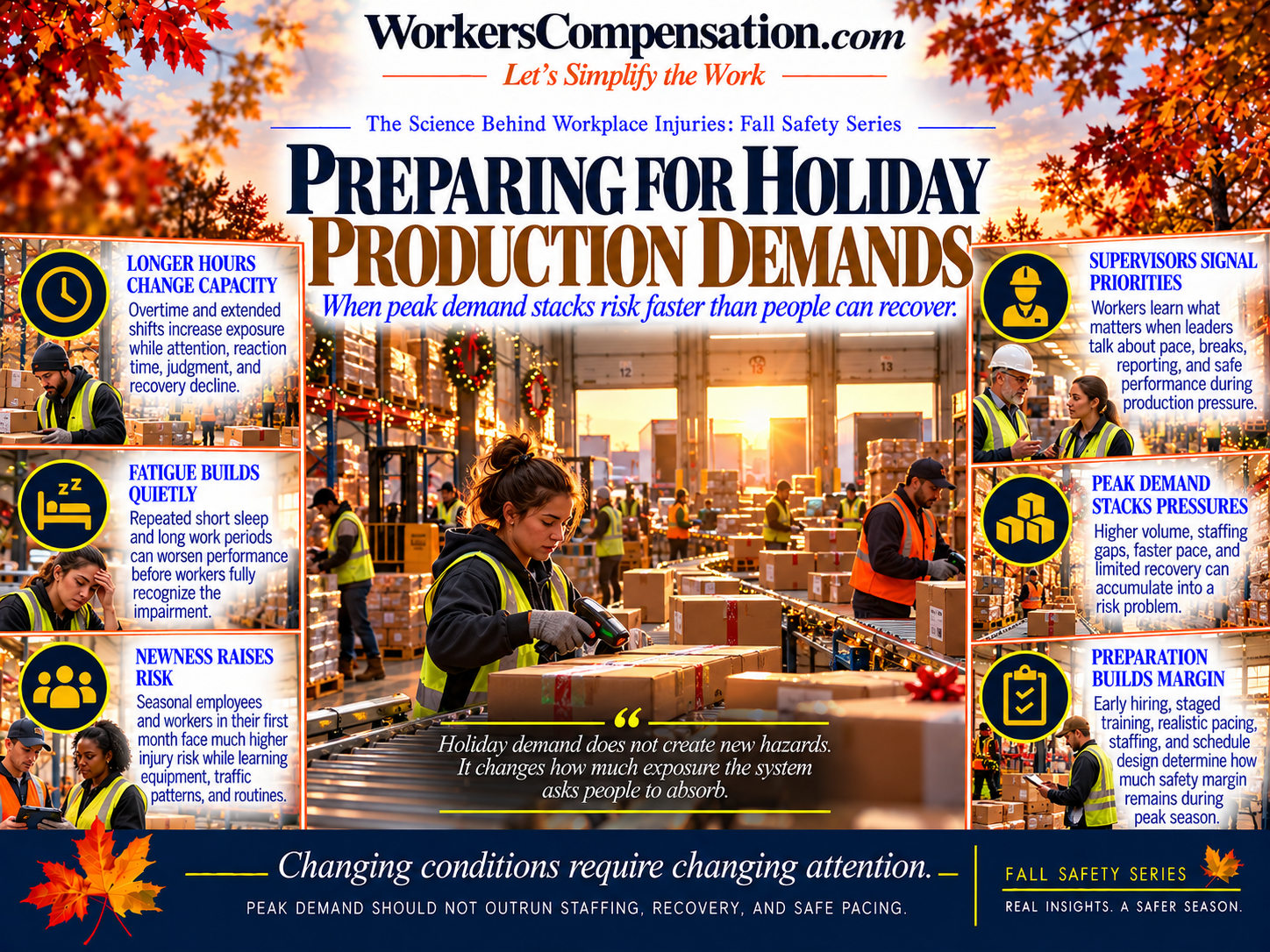
Welcome to The Science Behind Workplace Injuries: Fall Safety Series, where we explore how seasonal conditions interact with human physiology, behavior, and workplace systems. Yesterday, we examined hunting season and the importance of recognizing when outside conditions change the environment in which people work. Today, the seasonal change comes from inside the organization as holiday demand begins to accelerate. National injury data do not show a universal November or December injury spike, making the familiar claim that the holidays are simply more dangerous at work inaccurate. The stronger story appears in warehousing, fulfillment, parcel delivery, retail, and seasonal manufacturing, where peak demand can concentrate longer hours, new employees, faster pace, and reduced recovery into the same few weeks. Holiday production does not necessarily create new hazards. It changes how much exposure the existing system asks people to absorb.
Peak Demand Stacks Risk
Longer hours provide one of the clearest examples. Allard Dembe and colleagues followed 10,793 U.S. workers and found jobs with overtime schedules were associated with a 61% higher injury hazard rate after accounting for factors including age, occupation, industry, and time spent at risk. Working at least 12 hours per day was associated with a 37% increase, while working at least 60 hours per week was associated with a 23% increase. The important finding is the dose: adding work hours does more than increase the number of hours in which an injury could occur. As exposure continues, human capacity changes. Attention, reaction time, judgment, physical recovery, and the ability to compensate for unexpected conditions do not remain constant simply because production needs do.
Holiday peaks can also concentrate fatigue across multiple days. Hans Van Dongen and colleagues demonstrated that restricting sleep to six hours per night for two weeks produced progressively worsening cognitive performance even as participants' subjective feelings of sleepiness stopped increasing at the same rate. People became increasingly impaired without becoming equally aware of that impairment. That distinction matters during extended production periods because asking workers to report when they are “too tired” depends on self-assessment precisely when self-assessment becomes less reliable. Scheduling, protected recovery time, appropriate breaks, and limits on consecutive extended shifts create controls that do not require an exhausted person to correctly diagnose their own declining performance.
Peak Season Also Manufactures Newness
Holiday hiring adds another established risk factor at the same time workload is rising. Curtis Breslin and Peter Smith found workers in their first month on the job were more than four times as likely to experience a lost-time claim as workers with more than one year of tenure, a pattern observed across age groups. New workers are learning equipment, traffic patterns, lifting demands, production routines, communication norms, and where hazards appear within the work itself. Tasks that experienced workers perform with relatively automatic pattern recognition can require substantial conscious attention from someone still learning the environment. When organizations add large numbers of employees shortly before peak volume, they combine the period of greatest inexperience with the period of greatest operational pressure.
Temporary workers add another layer because research has identified gaps in experience screening, task-specific training, and control over how work is performed. The useful question is not whether seasonal employees are sufficiently careful. The better question is whether the system gives someone who arrived three weeks ago the same conditions for safe performance as someone who has performed the work for three years. Earlier hiring, staged task assignments, deliberate ramp-up periods, and realistic performance expectations allow workers to build competence before volume reaches its highest level. Newness is predictable, which means organizations can plan when and how employees experience it.
Production Pressure Teaches People What Matters
Peak season also creates a powerful test of safety culture because workers pay attention to what leaders reward when goals compete. A supervisor can say safety is the priority while simultaneously emphasizing hourly rates, missed targets, staffing gaps, and the need to move faster. Employees learn the organization's true hierarchy from those daily interactions. Dov Zohar and Tal Polachek demonstrated the importance of those messages in a randomized field study in which supervisors received feedback on how they incorporated safety into routine production conversations. Changes in supervisory communication were followed by improvements in safety climate, safety behavior, and independently measured safety audit performance.
That makes frontline leadership especially important during a holiday rush. Supervisors can acknowledge production demands while reinforcing breaks, reporting, safe pacing, and appropriate support for new employees. Leaders can also monitor indicators that appear before injury counts do: overtime concentration, consecutive days worked, the proportion of new employees in an area, first-aid visits, near misses, and restricted-duty cases. A quiet injury log during peak does not necessarily mean the system is performing well. Research on seasonal reporting suggests some injuries, particularly conditions that develop gradually, may be recognized or reported after the year-end rush has passed.
Preparation Determines How Much Margin Remains
The most useful holiday safety decisions happen before holiday volume arrives. Staffing levels determine how much overtime existing employees absorb. Hiring dates determine whether new employees learn during normal operations or during peak production. Schedule design determines whether recovery remains possible across consecutive shifts, while equipment and job design determine how much physical demand each additional hour creates. By December, many of those decisions have already been made.
Holiday production demands reveal how much margin an organization built into its system before pressure arrived. When volume increases, every operation will feel the demand. The difference is whether that demand lands on a system with adequate staffing, experienced workers, recovery time, realistic pacing, and supervisors who continue to communicate safety when production matters most. Risk grows when multiple manageable pressures are allowed to accumulate at the same time. Prevention begins by deciding how many of those pressures the system will permit to stack.
Tomorrow in The Science Behind Workplace Injuries: Fall Safety Series — Seasonal Employees Before the Holiday Rush. We will look more closely at why injury risk is highest early in job tenure and what organizations can do differently when seasonal workers arrive just as operations accelerate.
Research Referenced
Breslin, F. C., & Smith, P. (2006). Trial by fire: A multivariate examination of the relation between job tenure and work injuries. Occupational and Environmental Medicine, 63(1), 27–32. doi:10.1136/oem.2005.021006
Dembe, A. E., Erickson, J. B., Delbos, R. G., & Banks, S. M. (2005). The impact of overtime and long work hours on occupational injuries and illnesses: New evidence from the United States. Occupational and Environmental Medicine, 62(9), 588–597. doi:10.1136/oem.2004.016667
Van Dongen, H. P. A., Maislin, G., Mullington, J. M., & Dinges, D. F. (2003). The cumulative cost of additional wakefulness: Dose-response effects on neurobehavioral functions and sleep physiology from chronic sleep restriction and total sleep deprivation. Sleep, 26(2), 117–126. doi:10.1093/sleep/26.2.117
Zohar, D., & Polachek, T. (2014). Discourse-based intervention for modifying supervisory communication as leverage for safety climate and performance improvement: A randomized field study. Journal of Applied Psychology, 99(1), 113–124. doi:10.1037/a0034096


AI best practices california case file caselaw case management case management focus claims compensability compliance compliance corner courts do you know the rule employers exclusive remedy florida fraud glossary check Healthcare hr homeroom insurance insurers iowa kentucky leadership NCCI new jersey new york ohio pennsylvania Safety safety at work state info tech technology the case manager violence WDYT what do you think women's history women's history month workers' comp 101 workers' recovery Workplace Safety Workplace Violence
Read Also
About The Author
About The Author
-
Claire Muselman
Meet Dr. Claire C. Muselman, the Chief Operating Officer at WorkersCompensation.com, where she blends her vast academic insight and professional innovation with a uniquely positive energy. As the President of DCM, Dr. Muselman is renowned for her dynamic approach that reshapes and energizes the workers' compensation industry. Dr. Muselman's academic credentials are as remarkable as her professional achievements. Holding a Doctor of Education in Organizational Leadership from Grand Canyon University, she specializes in employee engagement, human behavior, and the science of leadership. Her diverse background in educational leadership, public policy, political science, and dance epitomizes a multifaceted approach to leadership and learning. At Drake University, Dr. Muselman excels as an Assistant Professor of Practice and Co-Director of the Master of Science in Leadership Program. Her passion for teaching and commitment to innovative pedagogy demonstrate her dedication to cultivating future leaders in management, leadership, and business strategy. In the industry, Dr. Muselman actively contributes as an Ambassador for the Alliance of Women in Workers’ Compensation and plays key roles in organizations such as Kids Chance of Iowa, WorkCompBlitz, and the Claims and Litigation Management Alliance, underscoring her leadership and advocacy in workers’ compensation. A highly sought-after speaker, Dr. Muselman inspires professionals with her engaging talks on leadership, self-development, and risk management. Her philosophy of empathetic and emotionally intelligent leadership is at the heart of her message, encouraging innovation and progressive change in the industry. "Empowerment is key to progress. By nurturing today's professionals with empathy and intelligence, we're crafting tomorrow's leaders." - Dr. Claire C. Muselman
More by This Author
Read More
- Oct 10, 2026
- Frank Ferreri
- Oct 10, 2026
- Claire Muselman
- Oct 10, 2026
- Chris Parker
- Oct 08, 2026
- Claire Muselman
- Oct 08, 2026
- Frank Ferreri
- Oct 08, 2026
- Claire Muselman