


Share This Article:
Fall Into Safety
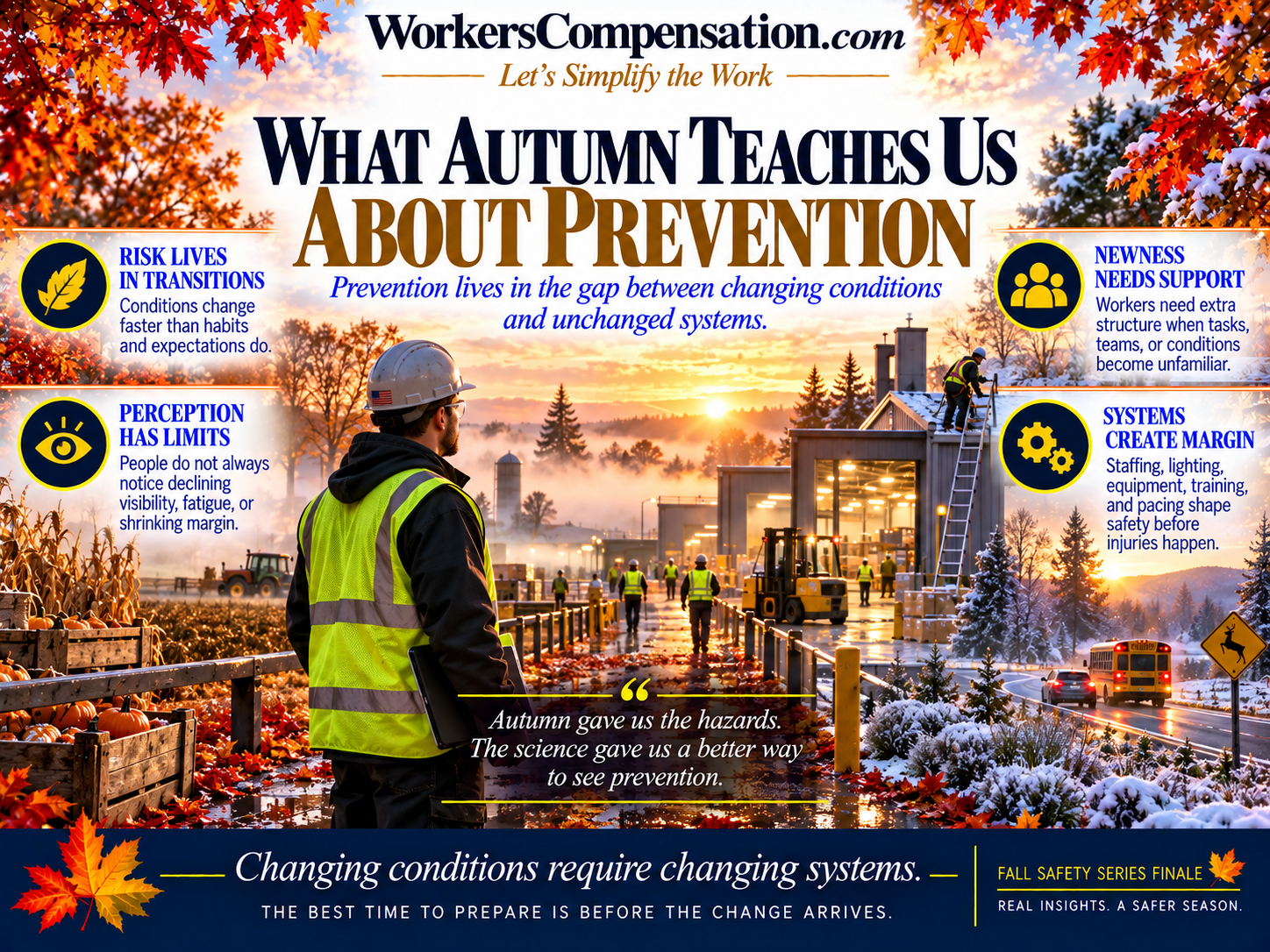
For the past 30 articles, The Science Behind Workplace Injuries: Fall Safety Series has explored wet leaves, frost, fog, wind, cold rain, darkness, glare, respiratory illness, harvest, grain bins, farm equipment, tree trimming, deer collisions, hunting season, holiday production, seasonal workers, heating systems, roofs, ladders, mood, temperature, fatigue, school zones, and winter preparation. The hazards have been remarkably different. The larger lesson connecting them is remarkably consistent. Autumn changes several conditions within a short period of time, while human expectations, habits, and organizational systems require time to adjust. Prevention lives inside that gap.
Risk Lives in Transitions
A workplace can appear unchanged while the conditions surrounding the work have shifted. The same parking lot becomes darker at shift change. The same walkway develops frost. The same route now overlaps with school traffic or deer movement. The same production system adds seasonal employees and longer hours. The same outdoor task requires colder hands to perform it. Autumn makes these transitions visible because so many occur within several weeks, but the prevention lesson extends far beyond the season.
Human beings adapt to changing environments, although adaptation is neither immediate nor complete. We adjust gait when we expect slippery surfaces. Drivers alter speed when weather becomes visibly hazardous. Experience teaches workers where hazards exist and how work is actually performed. Problems emerge when conditions change before expectations do. Prevention becomes more effective when organizations identify those transitions in advance and create margin while people recalibrate. The relevant question shifts from whether workers should have known better to what changed around them and whether the system anticipated that change.
Human Perception Has Predictable Limits
Many articles in this series revealed another pattern: people do not always perceive declining capability accurately. Drivers can remain confident at night while their ability to recognize pedestrians has deteriorated. Pedestrians routinely overestimate how visible they are to drivers. Workers may become accustomed to demanding schedules while objective performance continues to decline. Familiar tasks can feel safe because they have been completed repeatedly without consequence, even when the margin for error is shrinking.
These are features of human performance that belong in safety design. If a hazard depends on every person accurately recognizing a subtle change, remembering a warning, resisting production pressure, and making the optimal decision at exactly the right moment, the system is asking human attention to carry too much of the control. The strongest interventions reduce that dependence. In a cluster-randomized trial involving food-service workers, Jennifer Bell and colleagues found that providing slip-resistant footwear at no cost substantially reduced workers’ compensation claims caused by slipping. The intervention changed what happened when a worker encountered a slippery surface. Prevention became part of the environment surrounding the person.
Newness Deserves More Support
Autumn also reminds us that newness takes many forms. A seasonal employee is new to the job. An experienced employee can be new to a task. A familiar roadway can become functionally new when darkness arrives during the commute. The first cold morning changes dexterity. Harvest changes pace and equipment movement. Holiday production changes workload. New conditions temporarily reduce the value of routines built under different circumstances.
The workers’ compensation evidence around job tenure makes this especially clear. Curtis Breslin and Peter Smith found that workers in their first month on a job were more than four times as likely to experience a lost-time claim as workers with more than a year of tenure, even after accounting for factors including age, sex, occupation, and industry. Newness creates a period when knowledge, expectations, and experience are still being built. Organizations can respond with closer supervision, lower-hazard initial assignments, stronger orientation, clearer feedback, and permission to ask questions before uncertainty becomes improvisation. The same logic applies whenever work conditions change enough to make yesterday's experience less reliable.
Prevention is Built into Conditions
Safety training remains important. People need knowledge, skills, expectations, and opportunities to practice. A systematic review by Lynda Robson and colleagues found strong evidence that occupational safety and health training improves worker safety behaviors. Evidence that training alone reduces injuries and illnesses was insufficient. The finding places training in its proper role: it prepares people to work within a safety system, while the system still determines many of the conditions under which those people must perform.
Those conditions include staffing, scheduling, equipment, lighting, surfaces, maintenance, route design, footwear, workload, and supervisory behavior. They also include the messages workers receive when safety competes with production. Michael Christian and colleagues found in a meta-analysis that group safety climate had the strongest association with accidents and injuries among the factors they examined. Prevention is therefore expressed through everyday operational decisions. Workers learn what matters by watching which deadlines move, which hazards get repaired, which equipment gets purchased, which shortcuts receive attention, and what leaders do when conditions become difficult.
Autumn Gives Us a Model for Prevention
The most useful lesson from autumn is its predictability. We know daylight will shorten. Temperatures will fall. Harvest will arrive. Schools will reopen. Holiday demand will build. Seasonal employees will enter workplaces. Winter will follow. Organizations do not control those transitions, but they control many of the conditions through which workers experience them.
That principle applies throughout the year. Equipment changes. Teams change. Production changes. People age, learn, fatigue, recover, and encounter unfamiliar situations. Weather moves. Technology evolves. Organizations restructure. Every transition creates a temporary gap between the conditions people expect and the conditions they actually face. Safety improves when leaders learn to look for that gap before an injury reveals it.
Thirty articles about autumn ultimately lead us back to the same place: workplace injuries rarely emerge from a single hazard or a single decision. They develop through interactions among human biology, behavior, environment, equipment, workload, and organizational systems. Prevention becomes more powerful when we remain curious about those interactions and intervene where we have the greatest leverage. Changing conditions require changing systems, and the best time to prepare for change is while there is still time to shape what happens next.
Thank you for joining me for all 30 articles in The Science Behind Workplace Injuries: Fall Safety Series. The season gave us the hazards. The science gave us something more valuable: a better way to see prevention.
Research Referenced
Bell, J. L., Collins, J. W., & Chiou, S. (2019). Effectiveness of a no-cost-to-workers, slip-resistant footwear program for reducing slipping-related injuries in food service workers: A cluster randomized trial. Scandinavian Journal of Work, Environment & Health, 45(2), 194–202. doi:10.5271/sjweh.3790
Breslin, F. C., & Smith, P. (2006). Trial by fire: A multivariate examination of the relation between job tenure and work injuries. Occupational and Environmental Medicine, 63(1), 27–32. doi:10.1136/oem.2005.021006
Christian, M. S., Bradley, J. C., Wallace, J. C., & Burke, M. J. (2009). Workplace safety: A meta-analysis of the roles of person and situation factors. Journal of Applied Psychology, 94(5), 1103–1127. doi:10.1037/a0016172
Robson, L. S., Stephenson, C. M., Schulte, P. A., et al. (2012). A systematic review of the effectiveness of occupational health and safety training. Scandinavian Journal of Work, Environment & Health, 38(3), 193–208. doi:10.5271/sjweh.3259


AI best practices california case file caselaw case management case management focus claims compensability compliance compliance corner courts do you know the rule employers exclusive remedy florida fraud glossary check Healthcare hr homeroom insurance insurers iowa kentucky leadership NCCI new jersey new york ohio pennsylvania Safety safety at work state info tech technology the case manager violence WDYT what do you think women's history women's history month workers' comp 101 workers' recovery Workplace Safety Workplace Violence
Read Also
About The Author
About The Author
-
Claire Muselman
Meet Dr. Claire C. Muselman, the Chief Operating Officer at WorkersCompensation.com, where she blends her vast academic insight and professional innovation with a uniquely positive energy. As the President of DCM, Dr. Muselman is renowned for her dynamic approach that reshapes and energizes the workers' compensation industry. Dr. Muselman's academic credentials are as remarkable as her professional achievements. Holding a Doctor of Education in Organizational Leadership from Grand Canyon University, she specializes in employee engagement, human behavior, and the science of leadership. Her diverse background in educational leadership, public policy, political science, and dance epitomizes a multifaceted approach to leadership and learning. At Drake University, Dr. Muselman excels as an Assistant Professor of Practice and Co-Director of the Master of Science in Leadership Program. Her passion for teaching and commitment to innovative pedagogy demonstrate her dedication to cultivating future leaders in management, leadership, and business strategy. In the industry, Dr. Muselman actively contributes as an Ambassador for the Alliance of Women in Workers’ Compensation and plays key roles in organizations such as Kids Chance of Iowa, WorkCompBlitz, and the Claims and Litigation Management Alliance, underscoring her leadership and advocacy in workers’ compensation. A highly sought-after speaker, Dr. Muselman inspires professionals with her engaging talks on leadership, self-development, and risk management. Her philosophy of empathetic and emotionally intelligent leadership is at the heart of her message, encouraging innovation and progressive change in the industry. "Empowerment is key to progress. By nurturing today's professionals with empathy and intelligence, we're crafting tomorrow's leaders." - Dr. Claire C. Muselman
More by This Author
Read More
- Oct 21, 2026
- Frank Ferreri
- Oct 20, 2026
- Claire Muselman
- Oct 20, 2026
- Chris Parker
- Oct 19, 2026
- Claire Muselman
- Oct 19, 2026
- Anne Llewellyn
- Oct 19, 2026
- Chriss Swaney