


Share This Article:
Fall Into Safety
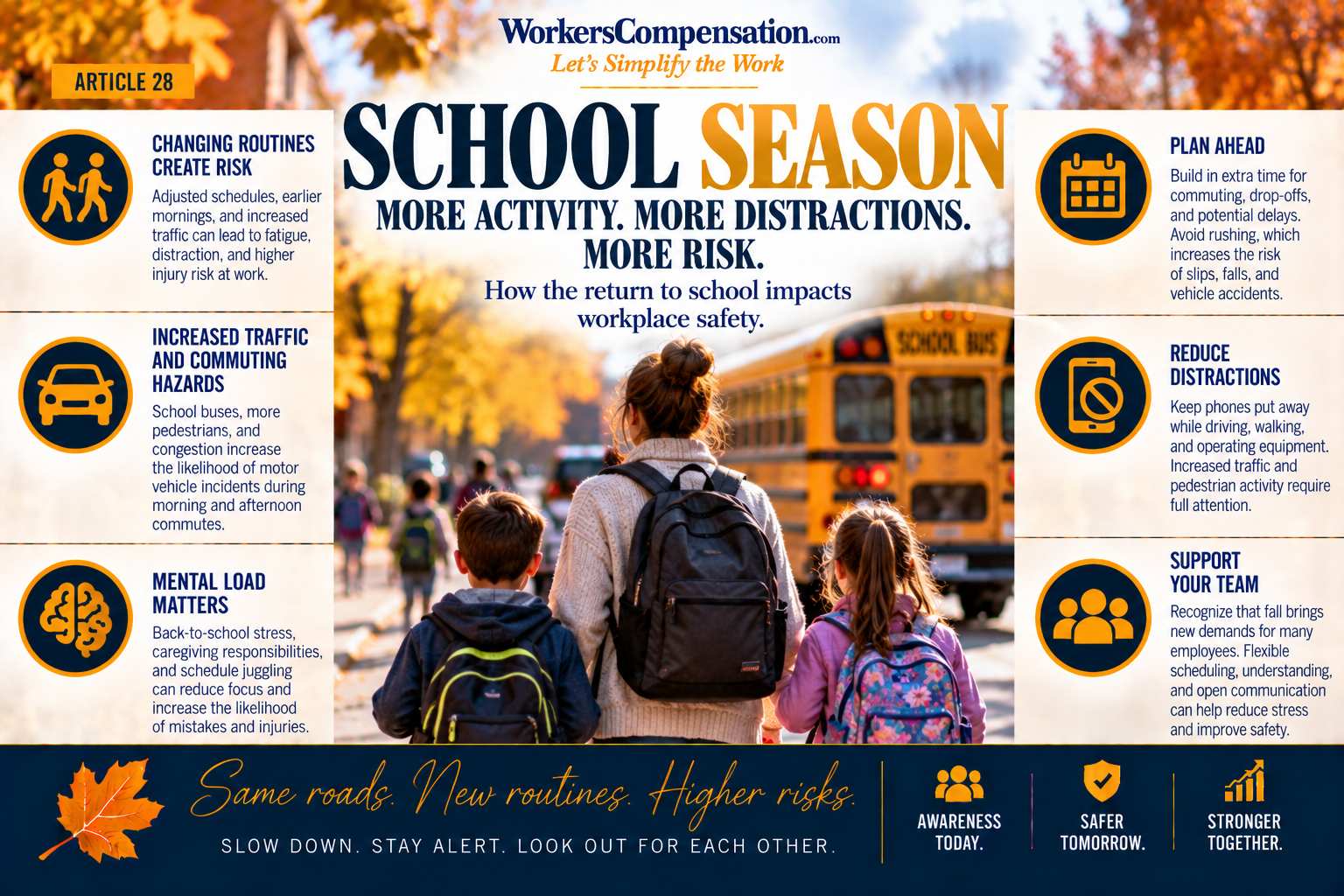
Welcome to The Science Behind Workplace Injuries: Fall Safety Series, where we explore how seasonal conditions interact with human physiology, behavior, and workplace systems. Yesterday, we examined how fourth-quarter demands can accumulate until available human capacity begins to shrink. The return of school changes another familiar system: the road. Buses resume frequent stops, crossing guards return to intersections, children move through crosswalks, parents queue near schools, and reduced speed limits become active again. National crash data do not show a broad spike in traffic deaths simply because school begins. The exposure is more precise. School traffic concentrates people, vehicles, and unpredictable movement into particular places during particular minutes of the day, creating a risk that organizations can anticipate.
The Risk Is Concentrated in Time and Place
School-transportation crashes represent a small share of fatal crashes nationally, but their timing reveals where attention belongs. NHTSA data from 2014 through 2023 show that school-age pedestrian deaths associated with school-transportation crashes cluster around the morning arrival and afternoon dismissal periods, particularly 7:00–7:59 a.m. and 3:00–3:59 p.m. Those same windows place bus drivers, crossing guards, school employees, delivery drivers, utility crews, service technicians, public works employees, and other people driving for work into environments with unusually dense pedestrian and vehicle movement. A delivery route that passes a school at 1:30 p.m. encounters a different roadway than the same route at 3:15.
Human attention is influenced by expectation. Drivers respond more quickly to events they anticipate than to genuine surprises because perception and response require time before braking begins. After a summer without active school zones, drivers again encounter buses stopping, crossing guards entering roadways, reduced speed limits, bicycles, and children appearing from between parked vehicles. Research has not established a special “first week of school” crash effect, so we should not invent one. The human-performance principle is still useful: familiar roads can change faster than expectations do. Routing and scheduling can reduce that mismatch by identifying school corridors and their active periods before employees encounter them.
Speed Determines What Happens After the Mistake
Speed becomes especially important when vehicles and pedestrians share limited space. Brian Tefft examined U.S. pedestrian crash data and estimated that the average risk of death for a struck pedestrian reached approximately 10% around 24 mph, 25% around 33 mph, and 50% around 41 mph. Exact probabilities vary with pedestrian age, vehicle characteristics, and crash circumstances, but the relationship is steep. A relatively small increase in impact speed can produce a substantial increase in injury severity.
Speed also determines how much roadway disappears before a driver can respond. During perception and reaction, the vehicle continues traveling at its original speed; braking distance then increases rapidly as speed rises. A distracted glance, an unexpected pedestrian, or a delayed recognition of a crossing guard consumes distance that cannot be recovered. School-zone speed limits therefore function as injury-severity controls in addition to traffic rules. Stronger evidence for enforcement has emerged as well. Aaron Stagoff-Belfort and colleagues studied the staggered deployment of approximately 2,000 New York City speed cameras and found collisions declined about 30% and injuries about 16% cumulatively during the seven months following camera activation. The study involved an urban environment, so results should not be assumed identical everywhere, but it demonstrates how changing the driving environment can change behavior and outcomes.
Autumn Changes What Drivers Can See
As the school year progresses, the same arrival and dismissal routines begin occurring under different light conditions. John Sullivan and Michael Flannagan used daylight-saving transitions as a natural experiment, comparing similar clock times under different ambient light. Pedestrian crashes were particularly sensitive to darkness, showing substantially greater risk under dark conditions in some scenarios. Darkness affects recognition more severely than drivers often perceive because steering and lane keeping can remain relatively comfortable while the ability to identify a person ahead has already deteriorated. A driver can feel capable while possessing less useful information about pedestrians.
Visibility is equally easy for pedestrians and workers to misjudge. Joanne Wood and colleagues studied retroreflective configurations worn by road workers at night and found that markings positioned on moving joints to convey biological motion allowed workers to be recognized at roughly three times the distance achieved with a standard reflective vest alone. The visual system recognizes the pattern of human movement, providing the driver with information that a bright patch of material cannot communicate as effectively. For crossing guards, public works employees, roadside crews, and others working near moving vehicles, visibility should mean being recognizable as a person early enough for a driver to respond.
Predictable Exposure Can Be Designed Around
For employers with workers on the road, school zones belong in fleet safety planning. Dispatch systems can identify routes crossing school corridors. Nonurgent deliveries and service calls can be scheduled outside arrival and dismissal when practical. Telematics can identify speeding in reduced-speed zones, while phone policies can address the glance-down tasks that compete with the broad visual scanning these environments require. Organizations employing crossing guards or assigning school staff to traffic duty can include those workers in formal hazard assessments, training, high-visibility apparel programs, footwear selection, and seasonal surface maintenance.
Workers’ compensation adds another reason to manage the exposure carefully. Motor vehicle events represent a relatively small portion of lost-time claims while producing disproportionately high costs because the injuries can be severe, involve multiple body parts, and create long claim durations. Crossing guards present an additional reminder that frequency and severity may come from different hazards: surveillance data indicate vehicle strikes dominate fatalities, while slips, trips, and falls account for much of their nonfatal injury burden. A complete prevention strategy has to consider both.
School returning does not transform every road into a high-risk environment. It creates recurring periods when specific roads ask more of human perception, reaction time, and judgment. Those periods become increasingly challenging as autumn changes available daylight. Their predictability is an advantage. When risk is concentrated in time and place, prevention can be concentrated there too.
Tomorrow in The Science Behind Workplace Injuries: Fall Safety Series — Winter Starts in the Fall. We will examine why organizations that wait for winter weather to begin winter preparation have already surrendered some of their best opportunities for prevention.
Research Referenced
Stagoff-Belfort, A., Ben-Menachem, J., & Beck, B. (2025). Can speed cameras make streets safer? Quasi-experimental evidence from New York City. Proceedings of the National Academy of Sciences, 122(50), e2520328122. doi:10.1073/pnas.2520328122
Sullivan, J. M., & Flannagan, M. J. (2002). The role of ambient light level in fatal crashes: Inferences from daylight saving time transitions. Accident Analysis & Prevention, 34(4), 487–498. doi:10.1016/S0001-4575(01)00046-X
Tefft, B. C. (2013). Impact speed and a pedestrian’s risk of severe injury or death. Accident Analysis & Prevention, 50, 871–878. doi:10.1016/j.aap.2012.07.022
Wood, J. M., Marszalek, R., Lacherez, P., & Tyrrell, R. A. (2014). Configuring retroreflective markings to enhance the night-time conspicuity of road workers. Accident Analysis & Prevention, 70, 209–214. doi:10.1016/j.aap.2014.03.018


AI best practices california case file caselaw case management case management focus claims compensability compliance compliance corner courts do you know the rule employers exclusive remedy florida fraud glossary check Healthcare hr homeroom insurance insurers iowa kentucky leadership NCCI new jersey new york ohio pennsylvania Safety safety at work state info tech technology the case manager violence WDYT what do you think women's history women's history month workers' comp 101 workers' recovery Workplace Safety Workplace Violence
Read Also
About The Author
About The Author
-
Claire Muselman
Meet Dr. Claire C. Muselman, the Chief Operating Officer at WorkersCompensation.com, where she blends her vast academic insight and professional innovation with a uniquely positive energy. As the President of DCM, Dr. Muselman is renowned for her dynamic approach that reshapes and energizes the workers' compensation industry. Dr. Muselman's academic credentials are as remarkable as her professional achievements. Holding a Doctor of Education in Organizational Leadership from Grand Canyon University, she specializes in employee engagement, human behavior, and the science of leadership. Her diverse background in educational leadership, public policy, political science, and dance epitomizes a multifaceted approach to leadership and learning. At Drake University, Dr. Muselman excels as an Assistant Professor of Practice and Co-Director of the Master of Science in Leadership Program. Her passion for teaching and commitment to innovative pedagogy demonstrate her dedication to cultivating future leaders in management, leadership, and business strategy. In the industry, Dr. Muselman actively contributes as an Ambassador for the Alliance of Women in Workers’ Compensation and plays key roles in organizations such as Kids Chance of Iowa, WorkCompBlitz, and the Claims and Litigation Management Alliance, underscoring her leadership and advocacy in workers’ compensation. A highly sought-after speaker, Dr. Muselman inspires professionals with her engaging talks on leadership, self-development, and risk management. Her philosophy of empathetic and emotionally intelligent leadership is at the heart of her message, encouraging innovation and progressive change in the industry. "Empowerment is key to progress. By nurturing today's professionals with empathy and intelligence, we're crafting tomorrow's leaders." - Dr. Claire C. Muselman
More by This Author
Read More
- Oct 19, 2026
- Anne Llewellyn
- Oct 19, 2026
- Chriss Swaney
- Oct 18, 2026
- Claire Muselman
- Oct 17, 2026
- Claire Muselman
- Oct 17, 2026
- Frank Ferreri
- Oct 16, 2026
- Claire Muselman