


Share This Article:
Fall Into Safety
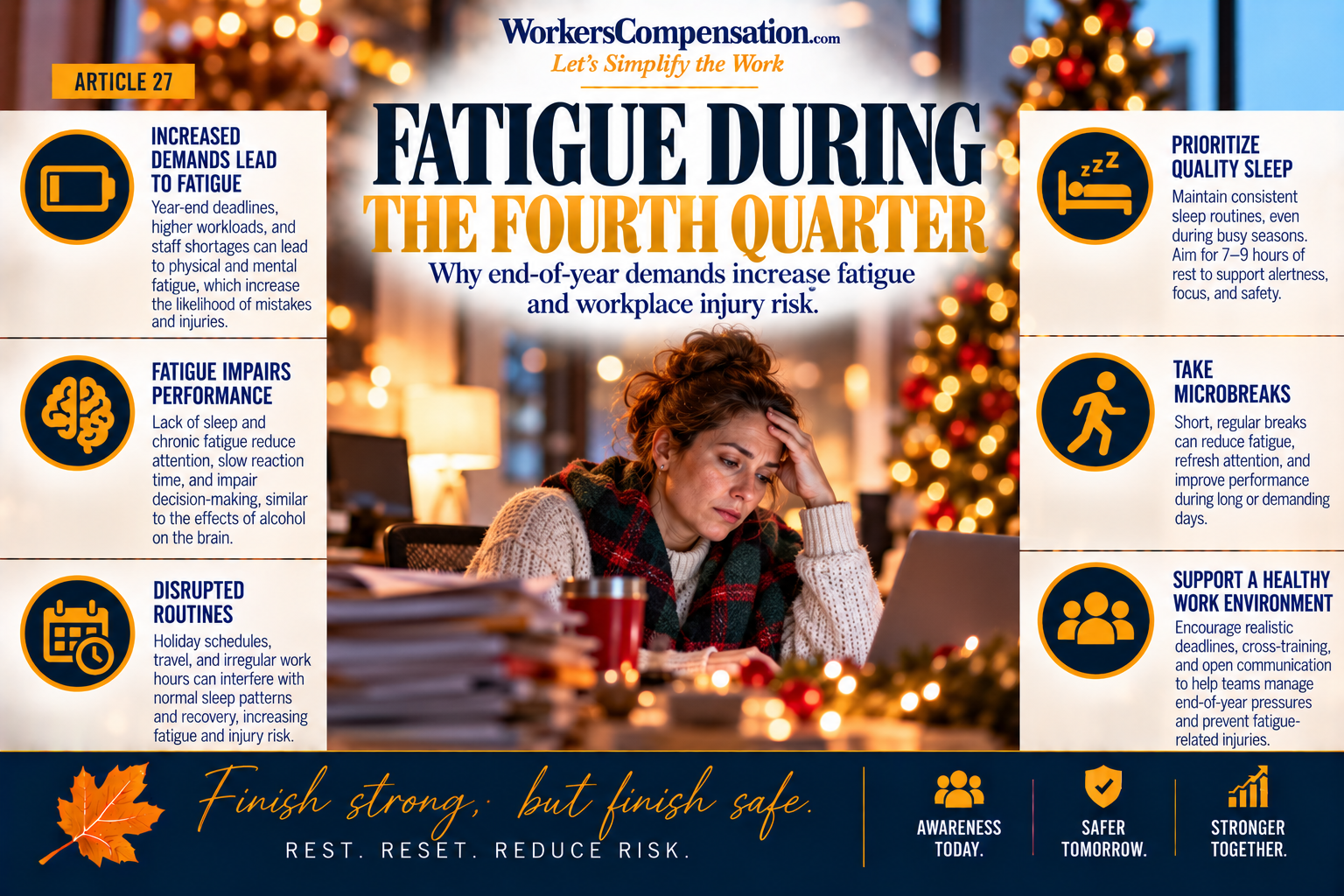
Welcome to The Science Behind Workplace Injuries: Fall Safety Series, where we explore how seasonal conditions interact with human physiology, behavior, and workplace systems. Yesterday, we examined how cooler temperatures can change physical performance before workers feel significantly cold. Fatigue during the fourth quarter requires similar precision. There is no established physiological condition called “fourth-quarter fatigue,” and national occupational injury rates do not peak in autumn. What changes for many workplaces is the accumulation of demand. Harvest, holiday production, retail and parcel volume, year-end deadlines, overtime, seasonal hiring, and earlier darkness can converge during the same several weeks. The calendar does not make people tired. Work design can.
Fatigue Accumulates Before People Recognize It
Sleep loss is one of the better-established human-performance factors associated with occupational injury. Katrin Uehli and colleagues combined 27 observational studies involving more than 268,000 participants and found workers reporting sleep problems had 1.62 times the injury risk of workers without sleep problems. The researchers estimated that approximately 13% of work injuries in the studied populations were attributable to sleep problems. The estimate does not mean fatigue causes exactly 13% of workplace injuries, and the underlying studies cannot establish causation in every case. It does establish a meaningful relationship between inadequate sleep and the capacity people bring into work.
The behavioral problem becomes more interesting when people are asked to judge their own impairment. Hans Van Dongen and colleagues restricted healthy adults to four, six, or eight hours in bed for 14 consecutive days. Objective cognitive performance deteriorated progressively among the sleep-restricted groups, including increasing lapses of attention. Subjective sleepiness followed a different pattern: people initially felt sleepier, but those ratings began leveling off while measured deficits continued accumulating. Someone can sincerely report feeling adapted to a demanding schedule while performance continues to decline. Fatigue management therefore cannot depend entirely on waiting for workers to announce that they are too tired to work safely.
Hours Matter Most at the Extremes
The relationship between working hours and injury is more nuanced than the familiar warning that all overtime is dangerous. Dagfinn Matre and colleagues reviewed 22 studies and found increased safety-incident risk among people working more than 12 hours per day. The pooled estimate for more than 55 hours per week also suggested elevated risk, although its confidence interval included no effect, and the researchers rated the overall certainty of evidence as low. General overtime showed a weaker and statistically nonsignificant relationship in the pooled analysis. The evidence points us toward the accumulation and extremes of exposure instead of treating every additional hour as equally hazardous.
Time on task can also matter inside a single shift. Philip Tucker, Simon Folkard, and Ian Macdonald examined accident records from a large engineering company and divided continuous two-hour work periods into half-hour segments. Accident risk during the final half-hour was approximately twice the risk during the first half-hour. After a break, the pattern began again. A rest break therefore does more than provide comfort; it interrupts the accumulation of risk associated with continuous work. During peak periods, eliminating or delaying breaks to preserve production can remove one of the mechanisms that helps workers restore capacity.
Q4 Can Stack Demands on the Same Worker
Fourth-quarter operations become more complicated when fatigue overlaps with other predictable changes. Peak production can require longer schedules while seasonal hiring places more first-month employees into unfamiliar environments. Delivery drivers and workers on foot may complete the same routes in darkness after the November clock change. Harvest operations can combine long workdays with roadway exposure and equipment movement. Warehouses and retail environments can add volume, temporary workers, unfamiliar layouts, and production pressure simultaneously. None of those exposures is created by autumn, but Q4 can concentrate them.
Fatigue can also change the mechanics of an injury. Laboratory research has shown that lower-extremity muscle fatigue alters gait and can impair recovery from a slip. Cognitive fatigue creates another pathway through brief lapses in attention, slower responses, and reduced flexibility when conditions change. The critical failure may last only a moment: a forklift enters an aisle, a vehicle brakes ahead, a worker misses a step edge, or a load shifts unexpectedly. Routine performance can remain adequate for long periods while the reserve needed for an unexpected event has already diminished. Peak operations place value on that reserve because changing conditions require workers to respond, not simply repeat.
The Schedule Is Part of the Safety System
Many fatigue controls are organizational decisions made before the worker ever feels tired. Staffing determines whether increased volume is absorbed by additional people or additional hours. Scheduling determines consecutive workdays, turnaround time between shifts, night work, and opportunities for recovery. Break design determines whether production pressure can erase rest periods precisely when demand is highest. Onboarding decisions determine whether experienced employees are simultaneously carrying peak workload and supervising large numbers of new workers.
Those decisions can also be measured before an injury occurs. Hours per employee, consecutive days worked, shifts exceeding 12 hours, time between shifts, missed breaks, overtime concentration, and the percentage of employees within their first 30 days provide a different picture of operational strain than injury counts alone. Fatigue itself is rarely coded as the cause of a workers’ compensation claim. The claim records the fall, overexertion injury, caught-between event, or vehicle crash. Organizations that want to understand whether fatigue contributes to their losses have to look upstream at the work conditions preceding the event.
Fourth-quarter fatigue is therefore less about the season and more about accumulation. Sleep debt accumulates across nights. Risk can accumulate during uninterrupted work. Long schedules can accumulate across a week, while peak volume, newness, darkness, and year-end pressure accumulate across an operation. Each layer may remain manageable by itself. The safety challenge appears when the organization continues adding demands while the worker's available capacity continues shrinking. When risk accumulates over time, prevention has to interrupt the accumulation before performance reveals the cost.
Tomorrow in The Science Behind Workplace Injuries: Fall Safety Series — School Zones Return. We will examine how the return of school traffic changes roadway exposure for workers, fleets, pedestrians, and communities, and why predictable changes in traffic patterns deserve attention before they become familiar again.
Research Referenced
Matre, D., Skogstad, M., Sterud, T., Nordby, K.-C., Knardahl, S., Christensen, J. O., & Lie, J.-A. S. (2021). Safety incidents associated with extended working hours: A systematic review and meta-analysis. Scandinavian Journal of Work, Environment & Health, 47(6), 415–424. doi:10.5271/sjweh.3958
Tucker, P., Folkard, S., & Macdonald, I. (2003). Rest breaks and accident risk. The Lancet, 361(9358), 680. doi:10.1016/S0140-6736(03)12566-4
Uehli, K., Mehta, A. J., Miedinger, D., Hug, K., Schindler, C., Holsboer-Trachsler, E., Leuppi, J. D., & Künzli, N. (2014). Sleep problems and work injuries: A systematic review and meta-analysis. Sleep Medicine Reviews, 18(1), 61–73. doi:10.1016/j.smrv.2013.01.004
Van Dongen, H. P. A., Maislin, G., Mullington, J. M., & Dinges, D. F. (2003). The cumulative cost of additional wakefulness: Dose-response effects on neurobehavioral functions and sleep physiology from chronic sleep restriction and total sleep deprivation. Sleep, 26(2), 117–126. doi:10.1093/sleep/26.2.117


AI best practices california case file caselaw case management case management focus claims compensability compliance compliance corner courts do you know the rule employers exclusive remedy florida fraud glossary check Healthcare hr homeroom insurance insurers iowa kentucky leadership NCCI new jersey new york ohio pennsylvania Safety safety at work state info tech technology the case manager violence WDYT what do you think women's history women's history month workers' comp 101 workers' recovery Workplace Safety Workplace Violence
Read Also
About The Author
About The Author
-
Claire Muselman
Meet Dr. Claire C. Muselman, the Chief Operating Officer at WorkersCompensation.com, where she blends her vast academic insight and professional innovation with a uniquely positive energy. As the President of DCM, Dr. Muselman is renowned for her dynamic approach that reshapes and energizes the workers' compensation industry. Dr. Muselman's academic credentials are as remarkable as her professional achievements. Holding a Doctor of Education in Organizational Leadership from Grand Canyon University, she specializes in employee engagement, human behavior, and the science of leadership. Her diverse background in educational leadership, public policy, political science, and dance epitomizes a multifaceted approach to leadership and learning. At Drake University, Dr. Muselman excels as an Assistant Professor of Practice and Co-Director of the Master of Science in Leadership Program. Her passion for teaching and commitment to innovative pedagogy demonstrate her dedication to cultivating future leaders in management, leadership, and business strategy. In the industry, Dr. Muselman actively contributes as an Ambassador for the Alliance of Women in Workers’ Compensation and plays key roles in organizations such as Kids Chance of Iowa, WorkCompBlitz, and the Claims and Litigation Management Alliance, underscoring her leadership and advocacy in workers’ compensation. A highly sought-after speaker, Dr. Muselman inspires professionals with her engaging talks on leadership, self-development, and risk management. Her philosophy of empathetic and emotionally intelligent leadership is at the heart of her message, encouraging innovation and progressive change in the industry. "Empowerment is key to progress. By nurturing today's professionals with empathy and intelligence, we're crafting tomorrow's leaders." - Dr. Claire C. Muselman
More by This Author
Read More
- Oct 17, 2026
- Claire Muselman
- Oct 17, 2026
- Frank Ferreri
- Oct 16, 2026
- Claire Muselman
- Oct 14, 2026
- Claire Muselman
- Oct 14, 2026
- Frank Ferreri
- Oct 13, 2026
- Claire Muselman