


Share This Article:
Fall Into Safety
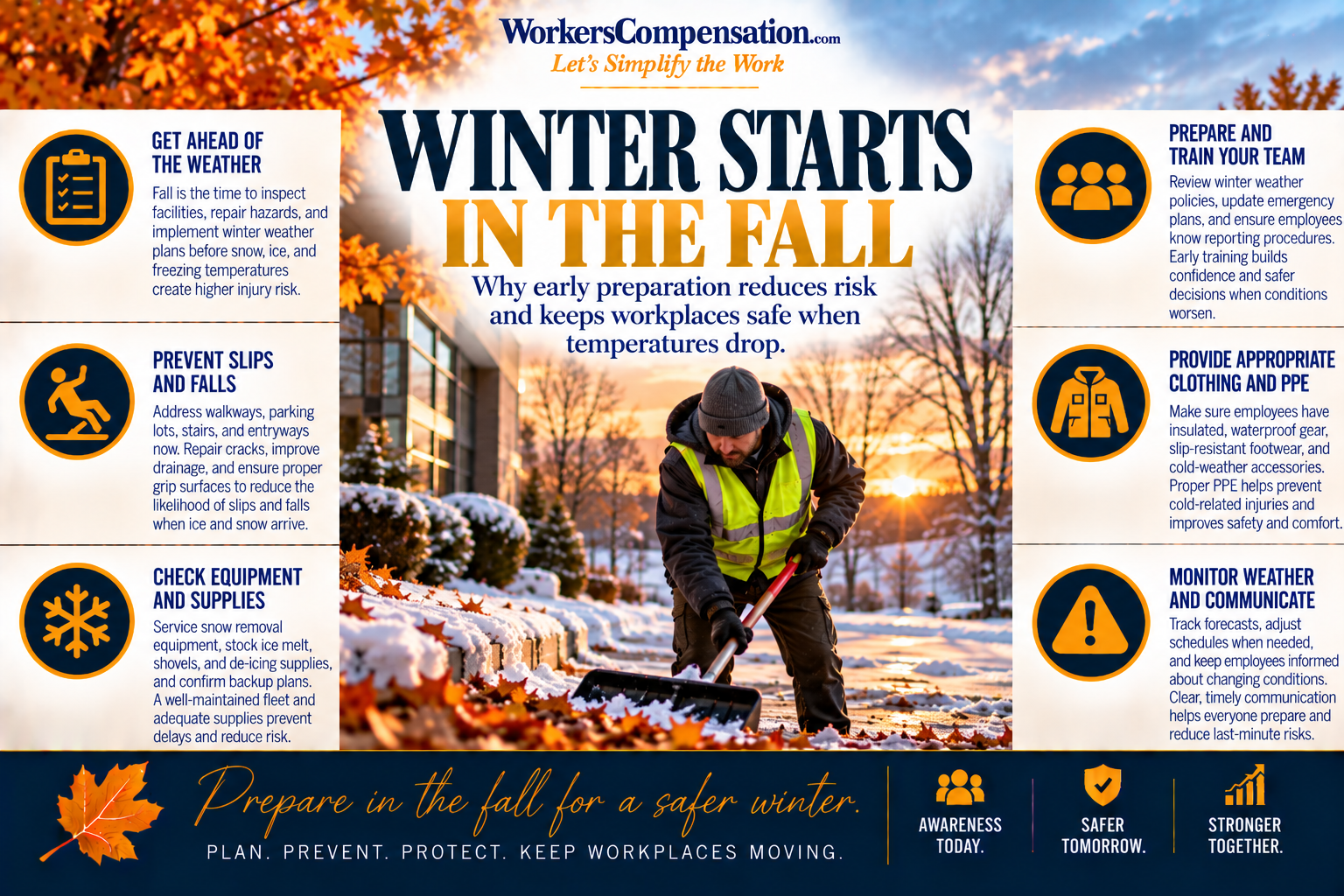
Welcome to The Science Behind Workplace Injuries: Fall Safety Series, where we explore how seasonal conditions interact with human physiology, behavior, and workplace systems. Yesterday, we examined how school zones concentrate roadway exposure into predictable places and times. As we approach the end of this series, the transition to winter brings many of these ideas together. Winter does not begin organizationally when the first major snowstorm arrives. It begins when employers decide who will clear the parking lot, whether exterior lighting works, where de-icer is stored, what footwear employees have, when outdoor work will occur, and how operations will change when conditions deteriorate. By the time winter produces the injury, many of the conditions surrounding that injury have already been established.
Winter Risk Is Built Before Winter Peaks
National injury data provide useful perspective. Eric Lundstrom and colleagues examined occupational injuries treated in U.S. emergency departments from 2012 through 2019 and found that most injury categories peaked during July or August. Falls, slips, and trips followed a different seasonal pattern, reaching their highest rate in January. Winter is therefore not universally the most dangerous season for work. It creates a particular concentration of fall exposure, and autumn provides the lead time to address the conditions that produce those events.
Some of the earliest changes arrive before snow. Daylight contracts, temperatures begin crossing freezing overnight, and workers encounter wet surfaces, frost, cold rain, and darker commutes. The November return to standard time abruptly changes evening light exposure as well. Amber Woods and colleagues examined fatal crashes surrounding the clock changes and found pedestrian and bicyclist fatal crashes increased 13% during the five weeks following the fall transition while fatal crashes involving vehicle occupants decreased. The change redistributed risk between road users because the light changed. For organizations with employees walking parking lots, delivering products, working roadside, or ending shifts after dark, winter preparation includes visibility before it includes snow.
Human Adaptation Needs a Head Start
Early-season conditions can also arrive before behavior has recalibrated. Research on the first snowy day of the season has found higher fatal-crash rates than on subsequent snowy days, while laboratory research shows that people alter their gait when they anticipate a slippery surface. They shorten their stride, change foot placement, and reduce the friction required to remain upright. Human beings are capable of adapting remarkably well to changing conditions once the brain recognizes what environment it is operating in.
Autumn creates the period when environmental change can outpace that recognition. The first frosted walkway may still look like yesterday's pavement. The first dark commute follows months of driving the same route in daylight. The first freezing morning can arrive while winter footwear remains at home and surface-treatment supplies remain in storage. Experience eventually changes expectations, but an organization does not need to wait for experience to do the teaching. Weather triggers, site inspections, specific alerts, lighting checks, and pre-positioned equipment can give workers information before exposure requires them to discover the change themselves.
Preparation Requires Organizational Lead Time
Winter controls often require more time than the weather provides. Snow-removal contracts have to be negotiated. De-icer and traction materials have to be purchased and placed where people can reach them. Exterior lighting needs to be inspected while repairs can still be completed easily. Footwear programs require selection, ordering, fitting, and distribution. Fleet vehicles need maintenance and winter equipment. Roofs and drainage systems need inspection. Supervisors need authority to delay starts, change routes, suspend outdoor work, or modify operations when conditions cross predetermined thresholds.
Evidence suggests those system-level investments can affect actual injury outcomes. Jennifer Bell and colleagues evaluated a comprehensive slip, trip, and fall prevention program across three hospitals. The program combined hazard assessments, housekeeping changes, preventive products and procedures, exterior ice and snow removal, flooring modifications, awareness efforts, and slip-resistant footwear for selected employees. Workers’ compensation claim rates for slips, trips, and falls declined substantially after implementation. Because the intervention had multiple components and lacked a separate control group, the reduction cannot be assigned to one specific measure. The study still demonstrates something valuable: organizations can change the conditions surrounding falls, and those changes can appear in claim outcomes.
A broader systematic review by Johnny Dyreborg and colleagues reached a similar conclusion across occupational safety interventions. Group- and organizational-level approaches generally performed better than interventions focused only on individual workers, particularly when multifaceted programs incorporated engineering or other higher-level controls. Winter preparation follows that logic. A reminder to “walk carefully” leaves the hazard in place. Repairing drainage, improving lighting, treating surfaces before workers arrive, changing schedules, selecting appropriate equipment, and defining weather-response procedures change the environment in which the worker has to perform.
The Calendar Can Become a Prevention Tool
Workers’ compensation data usually document the end of the story: the fractured wrist, back injury, vehicle collision, shoulder injury, or lost-time fall. Prevention asks organizations to move backward through that story until they reach decisions they can still change. A January parking-lot fall may begin with an October snow-removal contract. A December roadside incident may connect to exterior lighting or scheduling decisions made before the clock changed. A winter maintenance injury may reflect equipment that was never purchased because preparation began after the weather arrived.
Autumn gives organizations something winter often does not: margin. There is time to inspect, purchase, repair, schedule, train, contract, and decide. Once ice forms, snow falls, or darkness arrives during the workday, those same decisions become reactive and constrained. Seasonal readiness becomes stronger when the calendar itself functions as a control, triggering preparation before exposure intensifies.
Winter will eventually test the systems an organization has built. The work completed during autumn determines how much workers will have to compensate when conditions become harder. Prevention gains leverage when organizations act while they still have choices. When a hazard is predictable before it is present, preparation belongs before exposure.
Tomorrow in The Science Behind Workplace Injuries: Fall Safety Series — What Autumn Teaches Us About Prevention. We will close the series by bringing together the larger lessons hidden across 30 different hazards and asking what a season of transition can teach us about the way workplace injuries actually happen.
Research Referenced
Bell, J. L., Collins, J. W., Wolf, L., Grönqvist, R., Chiou, S., Chang, W.-R., Sorock, G. S., Courtney, T. K., Lombardi, D. A., & Evanoff, B. (2008). Evaluation of a comprehensive slip, trip and fall prevention programme for hospital employees. Ergonomics, 51(12), 1906–1925. doi:10.1080/00140130802248092
Dyreborg, J., Lipscomb, H. J., Nielsen, K., et al. (2022). Safety interventions for the prevention of accidents at work: A systematic review. Campbell Systematic Reviews, 18(2), e1234.
Lundstrom, E. W., Hendricks, S. A., Marsh, S. M., Groth, C. P., Smith, G. S., & Bhandari, R. (2023). Temporal trends in occupational injuries treated in US emergency departments, 2012–2019. Injury Epidemiology, 10, 13. doi:10.1186/s40621-023-00423-y
Woods, A. N., Weast, R. A., & Monfort, S. S. (2025). Daylight saving time and fatal crashes: The impact of changing light conditions. Journal of Safety Research, 93, 200–205. doi:10.1016/j.jsr.2025.02.010


AI best practices california case file caselaw case management case management focus claims compensability compliance compliance corner courts do you know the rule employers exclusive remedy florida fraud glossary check Healthcare hr homeroom insurance insurers iowa kentucky leadership NCCI new jersey new york ohio pennsylvania Safety safety at work state info tech technology the case manager violence WDYT what do you think women's history women's history month workers' comp 101 workers' recovery Workplace Safety Workplace Violence
Read Also
- Oct 20, 2026
- Chris Parker
- Oct 19, 2026
- Claire Muselman
About The Author
About The Author
-
Claire Muselman
Meet Dr. Claire C. Muselman, the Chief Operating Officer at WorkersCompensation.com, where she blends her vast academic insight and professional innovation with a uniquely positive energy. As the President of DCM, Dr. Muselman is renowned for her dynamic approach that reshapes and energizes the workers' compensation industry. Dr. Muselman's academic credentials are as remarkable as her professional achievements. Holding a Doctor of Education in Organizational Leadership from Grand Canyon University, she specializes in employee engagement, human behavior, and the science of leadership. Her diverse background in educational leadership, public policy, political science, and dance epitomizes a multifaceted approach to leadership and learning. At Drake University, Dr. Muselman excels as an Assistant Professor of Practice and Co-Director of the Master of Science in Leadership Program. Her passion for teaching and commitment to innovative pedagogy demonstrate her dedication to cultivating future leaders in management, leadership, and business strategy. In the industry, Dr. Muselman actively contributes as an Ambassador for the Alliance of Women in Workers’ Compensation and plays key roles in organizations such as Kids Chance of Iowa, WorkCompBlitz, and the Claims and Litigation Management Alliance, underscoring her leadership and advocacy in workers’ compensation. A highly sought-after speaker, Dr. Muselman inspires professionals with her engaging talks on leadership, self-development, and risk management. Her philosophy of empathetic and emotionally intelligent leadership is at the heart of her message, encouraging innovation and progressive change in the industry. "Empowerment is key to progress. By nurturing today's professionals with empathy and intelligence, we're crafting tomorrow's leaders." - Dr. Claire C. Muselman
More by This Author
Read More
- Oct 20, 2026
- Chris Parker
- Oct 19, 2026
- Claire Muselman
- Oct 19, 2026
- Anne Llewellyn
- Oct 19, 2026
- Chriss Swaney
- Oct 18, 2026
- Claire Muselman
- Oct 17, 2026
- Claire Muselman