


Share This Article:
Fall Into Safety
Welcome to The Science Behind Workplace Injuries: Fall Safety Series, where we explore how seasonal conditions interact with human physiology, behavior, and workplace systems. Yesterday, we examined how the autumn clock change alters the relationship between work schedules and available daylight. Today, another seasonal transition begins building inside workplaces as respiratory illnesses become more common. Flu activity typically begins increasing during autumn, although its seasonal peak often arrives later in winter. That makes fall an important prevention window for examining what happens when people become sick and continue working.
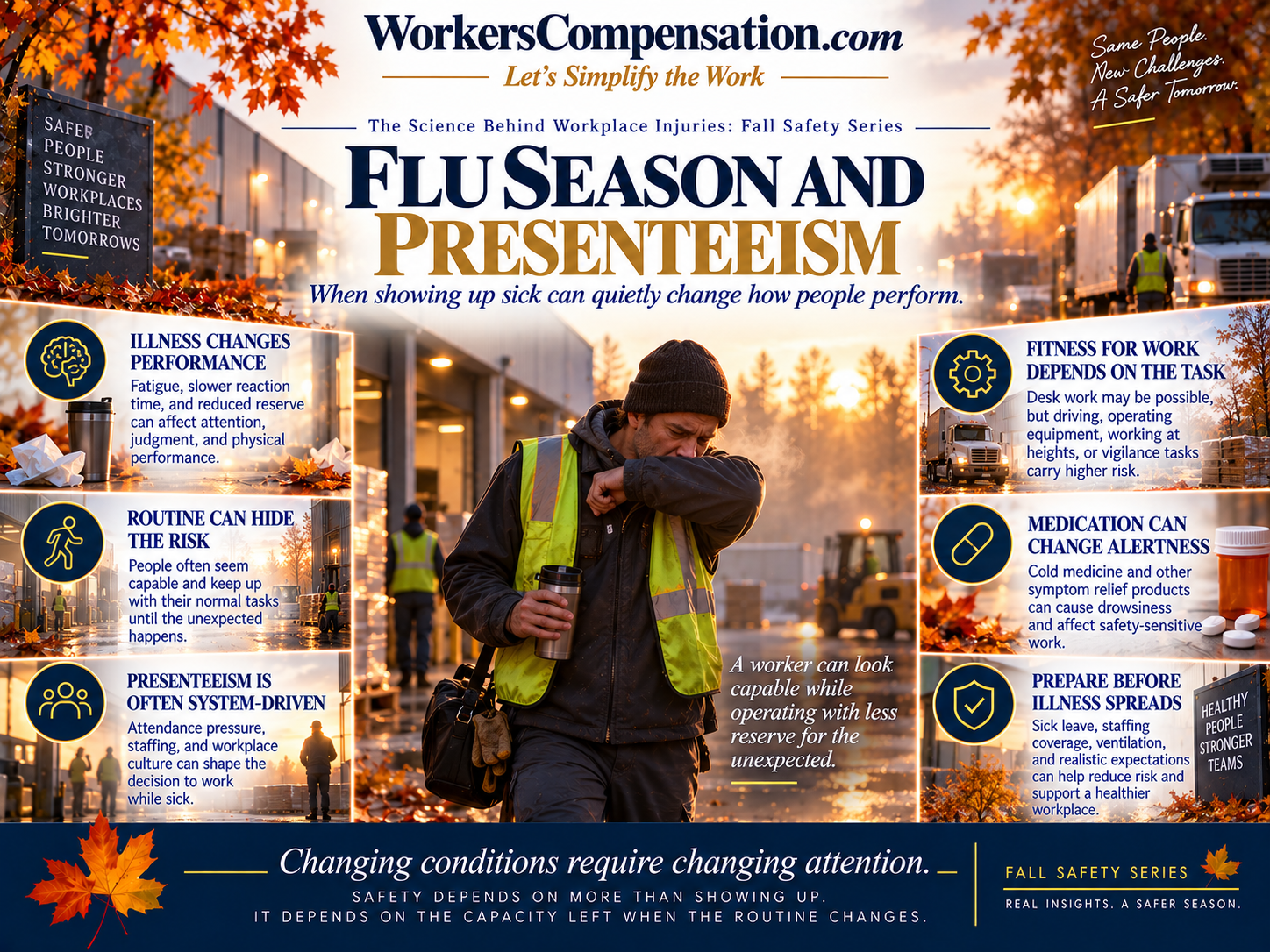
Presenteeism describes working while ill, and the behavior creates a complicated safety question. A person with a cold may still be capable of answering email, participating in a meeting, driving a vehicle, operating equipment, or completing a familiar task. Capability, however, is only part of human performance. Safe work also depends on attention, reaction speed, judgment, and the ability to respond when something unexpected happens. Respiratory illness can affect those abilities before performance looks obviously impaired.
Illness Changes More Than How We Feel
The fatigue and reduced motivation that accompany illness are part of a biological response sometimes called sickness behavior. When the immune system detects infection, inflammatory signaling communicates with the brain and produces familiar experiences such as sleepiness, reduced energy, diminished motivation, and withdrawal. These responses help redirect energy toward immune activity and recovery. The same biological process can influence the cognitive resources available for work.
The safety implications become clearer when researchers measure performance instead of symptoms. Andrew Smith and Samantha Jamson studied young adults with common colds using simulated driving and collision-detection tasks. Participants with colds detected fewer potential collisions, made more divided-attention errors, responded more slowly to unexpected events, and spent more time following other vehicles too closely. Several routine driving skills, including lane control and speed management, remained relatively unaffected. The illness changed specific aspects of performance without making the person universally incapable of driving.
That distinction matters in occupational safety because many serious incidents develop during moments that depart from routine. Equipment behaves unexpectedly. A pedestrian enters a travel path. A load shifts. A coworker moves into an exposure zone. Traffic stops suddenly. A familiar task becomes complicated by one additional variable. Human performance depends on having enough cognitive and physical reserve to recognize the change and respond quickly.
A worker can therefore feel capable because most of the shift still feels normal. Familiar tasks continue to happen successfully, reinforcing the belief that performance remains intact. The reduced safety margin becomes visible when the work demands something extra. Impairment can hide in the margins of performance long before it becomes obvious in routine behavior.
Showing Up Sick is Often a Systems Decision
Presenteeism is easy to interpret as an individual choice. The research shows a more complicated pattern. Mariella Miraglia and Gary Johns analyzed 109 samples representing more than 175,000 workers and found that working while ill was associated with strict absence policies, job insecurity, high job demands, stress, and limited job and personal resources. Their analysis also found associations with positive attitudes such as job satisfaction, engagement, and commitment. Dedicated employees can be especially willing to work through illness because they care deeply about their responsibilities.
That creates an important leadership question. Employees make attendance decisions inside systems that communicate what absence will cost them. Lost wages provide one signal. Attendance points, staffing shortages, workload waiting for their return, concern about burdening coworkers, and fear of appearing unreliable provide others. A handbook can say employees should stay home when sick while everyday workplace behavior communicates that dependable people show up anyway.
Leadership behavior adds another signal. Carolin Dietz and colleagues followed leaders and employees over 22 months and found that leader presenteeism predicted subsequent employee presenteeism, which in turn predicted later sick leave. Employees watch what leaders actually do with their own health. A supervisor who works through obvious illness can unintentionally establish a stronger norm than the written attendance policy. People learn what an organization values by observing which behaviors receive approval, recognition, and repetition.
Respiratory-illness preparation is a culture issue as well as a health issue. Employees need to know when staying home is appropriate, when a different task may be safer, and how absence will be covered. Supervisors need enough staffing flexibility to support those decisions without shifting an impossible burden onto everyone else. Policies work best when the operational system makes following them realistic.
Fitness for Work Depends on the Task
Illness does not create the same safety implications for every job. Mild respiratory symptoms during independent desk work create a different exposure than the same symptoms during commercial driving, work at heights, equipment operation, emergency response, or a task requiring continuous vigilance. Fitness for duty is therefore best considered in relation to the demands of the work being performed. The relevant question becomes whether the worker has the capacity required for this task under these conditions.
Medication belongs in that conversation. Many over-the-counter cold and allergy products contain ingredients capable of causing sedation or reducing alertness. Workers may think primarily about whether medication controls their symptoms without considering whether the treatment changes their ability to drive, operate machinery, or perform other safety-sensitive work. Combination products can make this particularly difficult because multiple active ingredients may appear under a single product name. Medication education should become part of seasonal safety communication wherever safety-sensitive tasks are performed.
The workers' compensation data cannot tell us how frequently illness contributes to workplace injuries. Injury reports rarely capture whether someone had a respiratory illness or had taken cold medication before an event. OSHA recordkeeping also specifically excludes the common cold and flu from the category of work-related illnesses under ordinary circumstances. A worker's illness can therefore influence the conditions surrounding an injury without appearing anywhere in the injury data.
Other occupational evidence gives us reason to keep asking the question. Abay Asfaw, Regina Pana-Cryan, and Roger Rosa analyzed approximately 38,000 U.S. workers and found that workers with access to paid sick leave had 28 percent lower odds of reporting a nonfatal occupational injury after adjustment for other measured characteristics. The study was observational, so it cannot establish that paid sick leave itself prevented those injuries. Workplaces offering paid leave may differ in safety culture, job design, resources, and other meaningful ways. The association remains important because it shows that attendance systems and injury outcomes deserve to be studied together.
Autumn Gives Organizations Time to Prepare
Respiratory-virus season does not arrive on one morning. Activity builds, which gives organizations time to prepare before illness becomes widespread. Fall is the opportunity to review sick-leave practices, staffing coverage, ventilation, vaccination access, return-to-work guidance, and expectations surrounding contagious illness. Safety-sensitive operations can also establish a process for evaluating whether illness or medication affects fitness for a particular task. These conversations are easier to have before a supervisor is trying to fill an unexpected opening at the beginning of a shift.
Incident reviews can become more informative as well. Asking whether the injured worker was ill, unusually fatigued, or using a medication that could affect alertness adds context without assigning blame. The purpose is to identify conditions surrounding performance that traditional investigations may overlook. Over time, those questions may reveal patterns that current occupational injury databases cannot capture. Better measurement creates better opportunities for prevention.
Leaders also have an opportunity to change the social meaning of staying home when contagious or significantly impaired. When leaders model appropriate absence, support employees who use available leave, and create realistic coverage plans, they reduce the pressure to prove commitment through attendance. That matters because presenteeism can emerge from dedication as easily as fear. A strong work ethic still operates inside a human body with finite physiological capacity.
Respiratory illness illustrates another recurring lesson in workplace safety. Human performance can change while outward behavior still looks familiar. A worker can arrive, participate, complete routine tasks, and appear capable while operating with less reserve for the moment that requires rapid recognition and response. Safety depends on more than whether someone can perform the routine, and it depends on the capacity they have left when the routine changes.
Tomorrow in The Science Behind Workplace Injuries: Fall Safety Series — Respiratory Viruses in the Workplace. We will move from the performance effects of individual illness to the environment that allows respiratory viruses to spread, including shared air, close contact, ventilation, and the workplace conditions that can turn one infection into a crew-level exposure.
Research Referenced
Asfaw, A., Pana-Cryan, R., & Rosa, R. (2012). Paid sick leave and nonfatal occupational injuries. American Journal of Public Health, 102(9), e59–e64. doi:10.2105/AJPH.2011.300482
Dietz, C., Zacher, H., Scheel, T., Otto, K., & Rigotti, T. (2020). Leaders as role models: Effects of leader presenteeism on employee presenteeism and sick leave. Work & Stress, 34(3), 300–322. doi:10.1080/02678373.2020.1728420
Miraglia, M., & Johns, G. (2016). Going to work ill: A meta-analysis of the correlates of presenteeism and a dual-path model. Journal of Occupational Health Psychology, 21(3), 261–283. doi:10.1037/ocp0000015
Smith, A. P., & Jamson, S. (2012). An investigation of the effects of the common cold on simulated driving performance and detection of collisions: A laboratory study. BMJ Open, 2, e001047. doi:10.1136/bmjopen-2012-001047


AI best practices california case file caselaw case management case management focus claims compensability compliance compliance corner courts do you know the rule employers exclusive remedy florida fraud glossary check Healthcare hr homeroom insurance insurers iowa kentucky leadership NCCI new jersey new york ohio pennsylvania Safety safety at work state info tech technology the case manager violence WDYT what do you think women's history women's history month workers' comp 101 workers' recovery Workplace Safety Workplace Violence
Read Also
About The Author
About The Author
-
Claire Muselman
Meet Dr. Claire C. Muselman, the Chief Operating Officer at WorkersCompensation.com, where she blends her vast academic insight and professional innovation with a uniquely positive energy. As the President of DCM, Dr. Muselman is renowned for her dynamic approach that reshapes and energizes the workers' compensation industry. Dr. Muselman's academic credentials are as remarkable as her professional achievements. Holding a Doctor of Education in Organizational Leadership from Grand Canyon University, she specializes in employee engagement, human behavior, and the science of leadership. Her diverse background in educational leadership, public policy, political science, and dance epitomizes a multifaceted approach to leadership and learning. At Drake University, Dr. Muselman excels as an Assistant Professor of Practice and Co-Director of the Master of Science in Leadership Program. Her passion for teaching and commitment to innovative pedagogy demonstrate her dedication to cultivating future leaders in management, leadership, and business strategy. In the industry, Dr. Muselman actively contributes as an Ambassador for the Alliance of Women in Workers’ Compensation and plays key roles in organizations such as Kids Chance of Iowa, WorkCompBlitz, and the Claims and Litigation Management Alliance, underscoring her leadership and advocacy in workers’ compensation. A highly sought-after speaker, Dr. Muselman inspires professionals with her engaging talks on leadership, self-development, and risk management. Her philosophy of empathetic and emotionally intelligent leadership is at the heart of her message, encouraging innovation and progressive change in the industry. "Empowerment is key to progress. By nurturing today's professionals with empathy and intelligence, we're crafting tomorrow's leaders." - Dr. Claire C. Muselman
More by This Author
Read More
- Oct 01, 2026
- Chris Parker
- Oct 01, 2026
- Claire Muselman
- Oct 01, 2026
- Claire Muselman
- Sep 28, 2026
- Frank Ferreri
- Sep 28, 2026
- Claire Muselman
- Sep 28, 2026
- Anne Llewellyn