


Share This Article:
Fall Into Safety
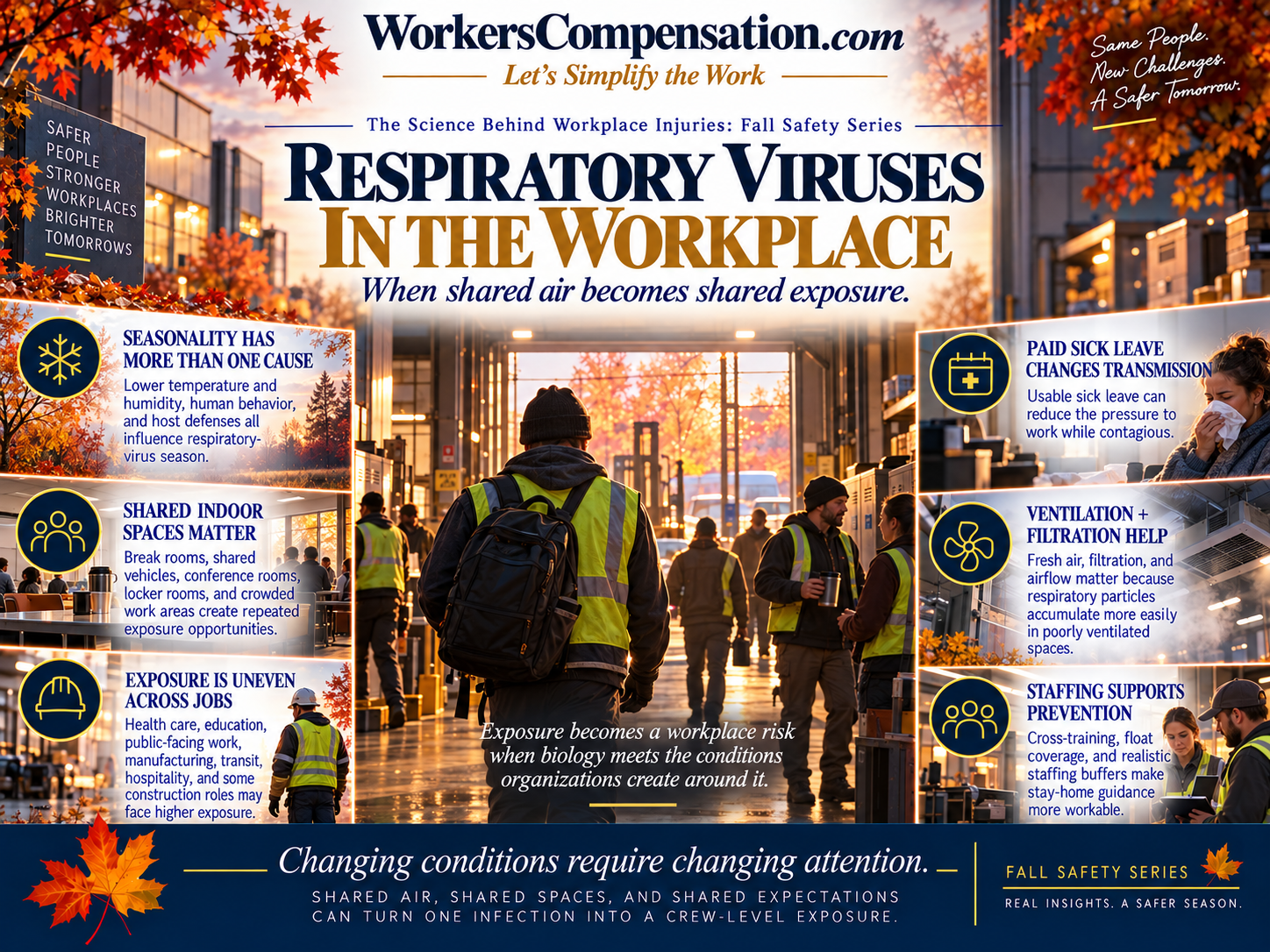
Welcome to The Science Behind Workplace Injuries: Fall Safety Series, where we explore how seasonal conditions interact with human physiology, behavior, and workplace systems. Yesterday, we examined how respiratory illness can affect a worker's attention, reaction time, and capacity to respond to unexpected events. Today, the focus moves outward. Respiratory viruses spread through workplaces shaped by shared air, close contact, staffing practices, sick-leave policies, and human behavior. Autumn matters because many of the conditions that support winter respiratory-virus transmission begin assembling before winter arrives.
Respiratory Season Has More Than One Cause
Cool weather does not directly “cause” a cold, but temperature and humidity influence both viruses and the human respiratory tract. Miyu Moriyama, Walter Hugentobler, and Akiko Iwasaki reviewed evidence showing that respiratory-virus seasonality emerges from interactions among environmental conditions, human behavior, and host defenses. Lower temperature and humidity can improve the stability or transmission of some respiratory viruses while also changing immune defenses in the airway. Heating season also changes indoor environments as outdoor air becomes colder and indoor air becomes drier.
Research on the nose adds a fascinating biological layer. Ellen Foxman and colleagues found that antiviral defenses against rhinovirus were more effective at warmer temperatures in airway cells. More recent work by Di Huang and colleagues found that cooling nasal tissue by about 5°C substantially impaired an antiviral defense involving extracellular vesicles released inside the nose. Experimental studies cannot tell us exactly how much either mechanism changes infection risk during an ordinary workday, but they demonstrate that the respiratory tract itself responds to temperature.
Human behavior changes at the same time. Windows close. People spend more time indoors. Meetings, break rooms, shared vehicles, classrooms, health-care settings, manufacturing spaces, and other occupied environments create repeated opportunities for exposure. School return adds another transmission network. Neil Johnston and colleagues documented a predictable September surge in asthma hospitalizations beginning among school-age children and appearing later in younger children and adults, with rhinovirus identified as an important driver. Fall respiratory exposure moves through households and communities as well as workplaces.
Exposure is Part of the Job for Millions of Workers
Respiratory-virus exposure is distributed unevenly across the workforce. Marissa Baker, Trevor Peckham, and Noah Seixas combined employment data with O*NET occupational-exposure information and estimated that 14.4 million U.S. workers—about 10% of the workforce—worked in occupations involving exposure to infection or disease at least weekly. Approximately 26.7 million experienced such exposure at least monthly. Health care represented a major share, but protective services, education, community and social services, administrative support, and some construction occupations also appeared among exposed groups.
Exposure can also concentrate in places we do not traditionally classify as health environments. Child-care workers encounter respiratory viruses carried by children. Police officers, firefighters, correctional officers, transit employees, hospitality workers, and retail employees interact continuously with the public. Manufacturing and processing environments can combine close worker spacing with shared transportation and break areas. Agriculture introduces additional biological exposures, including zoonotic diseases among workers handling infected animals.
OSHA records capture only a fraction of respiratory illness moving through workplaces. Ordinary colds and flu are generally excluded from OSHA recordkeeping requirements, while qualifying work-related COVID-19 cases can be recordable. The result is a substantial surveillance gap: organizations can experience significant respiratory illness without seeing the activity reflected on an OSHA log. National injury datasets also do not tell us whether an injured worker happened to be ill when an incident occurred.
Policy Can Change Transmission
One of the most compelling findings in the respiratory-virus literature comes from labor policy rather than medicine. Stefan Pichler, Katherine Wen, and Nicolas Ziebarth studied state and local paid-sick-leave mandates using U.S. data from 2010 through 2018. During the first year after mandates took effect, influenza-like illness fell by approximately 11%, or about 290 cases per 100,000 patients per week. Their difference-in-differences design provides stronger evidence of causation than a simple comparison between workplaces offering and not offering sick leave.
The mechanism makes intuitive sense. Contagious workers who can stay home without losing income have fewer opportunities to expose coworkers and customers. Workers without paid leave face a different calculation, particularly when missing a shift means missing wages. Staffing shortages, attendance-point systems, perfect-attendance incentives, and pressure from coworkers can reinforce the decision to report to work while symptomatic. Infection control therefore includes organizational design.
Access to the protection is also unequal. The research brief reports that 80% of private-industry workers had access to paid sick leave in March 2025, but access ranged from 41% among workers in the lowest wage decile to 96% among those in the highest. Service occupations also had substantially less access than management and professional occupations. The workers with frequent public contact can therefore have fewer resources for removing themselves from the workplace when contagious.
Fall is the Time to Build the Controls
Respiratory protection starts with reducing opportunities for transmission. Ventilation and filtration matter because respiratory particles accumulate more readily in poorly ventilated occupied spaces. Break rooms, shared vehicles, conference rooms, locker rooms, and other densely occupied spaces deserve particular attention. Vaccination access, respiratory hygiene, appropriate PPE in high-exposure environments, and clear stay-home guidance add additional layers.
Staffing belongs on the prevention list. A policy telling sick employees to stay home has limited value when one absence leaves an operation unable to function. Cross-training, float coverage, and realistic staffing buffers give supervisors options before illness spreads through a crew. Paid leave also has to be usable in practice, without informal penalties for employees who use the benefit appropriately.
Workers' compensation adds an important evidence gap. Common respiratory infections are generally difficult to establish as occupational diseases because exposure occurs throughout daily life and compensability varies by jurisdiction. A different question remains largely unanswered: how often does illness contribute to an otherwise compensable injury? If reduced alertness contributes to a vehicle crash, machine incident, or other injury, the resulting claim will usually be coded according to the injury. The respiratory illness influencing performance may never appear in the claims data. No national dataset currently measures the connection.
Respiratory-virus season demonstrates how thoroughly health and safety overlap. Temperature and humidity influence viral transmission and human defenses. Work design determines how closely people interact. Attendance systems influence whether contagious employees stay home. Ventilation changes what happens to infectious particles after they enter a room. Exposure becomes a workplace risk when biology meets the conditions organizations create around it.
Tomorrow in The Science Behind Workplace Injuries: Fall Safety Series — Seasonal Allergies Shift from Pollen to Mold. Autumn respiratory symptoms do not always come from infection. Falling leaves, damp organic material, indoor moisture, and mold spores create another seasonal exposure with its own effects on breathing, concentration, medication use, and work.
Research Referenced
Baker, M. G., Peckham, T. K., & Seixas, N. S. (2020). Estimating the burden of United States workers exposed to infection or disease: A key factor in containing risk of COVID-19 infection. PLOS ONE, 15(4), e0232452. doi:10.1371/journal.pone.0232452
Johnston, N. W., Johnston, S. L., Norman, G. R., Dai, J., & Sears, M. R. (2006). The September epidemic of asthma hospitalization: School children as disease vectors. Journal of Allergy and Clinical Immunology, 117(3), 557–562. doi:10.1016/j.jaci.2005.11.034
Moriyama, M., Hugentobler, W. J., & Iwasaki, A. (2020). Seasonality of respiratory viral infections. Annual Review of Virology, 7, 83–101. doi:10.1146/annurev-virology-012420-022445
Pichler, S., Wen, K., & Ziebarth, N. R. (2021). Positive health externalities of mandating paid sick leave. Journal of Policy Analysis and Management, 40(3), 715–743. doi:10.1002/pam.22284


AI best practices california case file caselaw case management case management focus claims compensability compliance compliance corner courts do you know the rule employers exclusive remedy florida fraud glossary check Healthcare hr homeroom insurance insurers iowa kentucky leadership NCCI new jersey new york ohio pennsylvania Safety safety at work state info tech technology the case manager violence WDYT what do you think women's history women's history month workers' comp 101 workers' recovery Workplace Safety Workplace Violence
Read Also
- Oct 24, 2026
- Claire Muselman
- Oct 23, 2026
- Claire Muselman
About The Author
About The Author
-
Claire Muselman
Meet Dr. Claire C. Muselman, the Chief Operating Officer at WorkersCompensation.com, where she blends her vast academic insight and professional innovation with a uniquely positive energy. As the President of DCM, Dr. Muselman is renowned for her dynamic approach that reshapes and energizes the workers' compensation industry. Dr. Muselman's academic credentials are as remarkable as her professional achievements. Holding a Doctor of Education in Organizational Leadership from Grand Canyon University, she specializes in employee engagement, human behavior, and the science of leadership. Her diverse background in educational leadership, public policy, political science, and dance epitomizes a multifaceted approach to leadership and learning. At Drake University, Dr. Muselman excels as an Assistant Professor of Practice and Co-Director of the Master of Science in Leadership Program. Her passion for teaching and commitment to innovative pedagogy demonstrate her dedication to cultivating future leaders in management, leadership, and business strategy. In the industry, Dr. Muselman actively contributes as an Ambassador for the Alliance of Women in Workers’ Compensation and plays key roles in organizations such as Kids Chance of Iowa, WorkCompBlitz, and the Claims and Litigation Management Alliance, underscoring her leadership and advocacy in workers’ compensation. A highly sought-after speaker, Dr. Muselman inspires professionals with her engaging talks on leadership, self-development, and risk management. Her philosophy of empathetic and emotionally intelligent leadership is at the heart of her message, encouraging innovation and progressive change in the industry. "Empowerment is key to progress. By nurturing today's professionals with empathy and intelligence, we're crafting tomorrow's leaders." - Dr. Claire C. Muselman
More by This Author
- Oct 24, 2026
- Claire Muselman
- Oct 23, 2026
- Claire Muselman
Read More
- Oct 24, 2026
- Claire Muselman
- Oct 23, 2026
- Claire Muselman
- Oct 21, 2026
- Claire Muselman
- Oct 21, 2026
- Frank Ferreri
- Oct 21, 2026
- Claire Muselman