


Share This Article:
Fall Into Safety
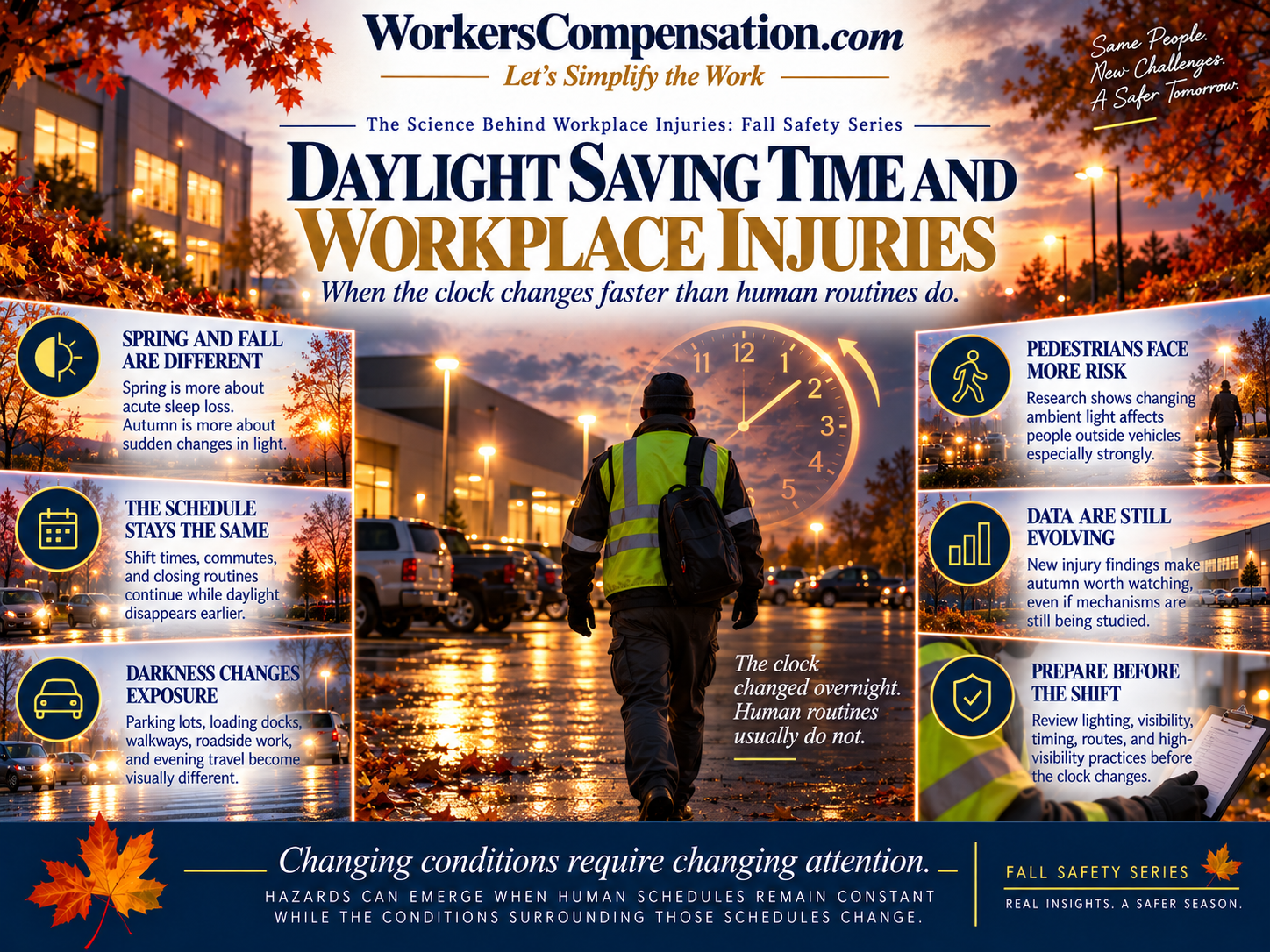
Welcome to The Science Behind Workplace Injuries: Fall Safety Series, where we explore how seasonal conditions interact with human physiology, behavior, and workplace systems. Yesterday, we examined how low-angle autumn sun can reduce contrast and interfere with the visual information drivers need to recognize hazards. The autumn clock change creates another shift in visual conditions, except this one happens almost instantly. On Friday afternoon, a worker may leave a jobsite, loading dock, office, or customer location in daylight. After the clocks change, the same worker can leave at the same clock time and encounter dusk or darkness.
Daylight saving time has become closely associated with sleep loss and workplace injuries, and the association deserves more precision than it usually receives. The frequently cited workplace injury increase occurred after the spring transition, when clocks move forward and people lose sleep opportunity. Autumn produces a different physiological and environmental transition. Sleep changes are smaller, while an hour of evening daylight abruptly disappears from the schedules people have been following for months. For fall safety, the clock matters because human schedules stay relatively fixed while the light surrounding those schedules changes.
Clock Changes Create Different Exposures
Christopher Barnes and David Wagner published one of the most frequently cited studies connecting daylight saving time with occupational injury in 2009. Using Mine Safety and Health Administration records from 1983 through 2006, they found more workplace injuries and substantially more lost workdays on the Monday after the spring transition. Their second analysis found workers slept approximately 40 fewer minutes on the Sunday night after clocks moved forward. The researchers found no comparable increase in injury frequency or severity following the autumn transition, when clocks moved back. Their results established an important relationship between sleep loss and injury while also demonstrating why spring findings should not automatically be applied to fall.
More recent sleep research supports the distinction. Moving clocks forward asks people to wake earlier relative to their biological timing, while moving them backward creates a delay the circadian system generally handles more easily. People may not receive a full additional hour of sleep when clocks fall back because established waking patterns persist, but autumn typically produces far less acute sleep loss than spring. The familiar explanation that every clock change creates a tired workforce therefore misses an important part of the physiology. Spring primarily creates an acute sleep and circadian challenge; autumn creates a substantial change in when workers encounter daylight and darkness.
That distinction matters because prevention depends on identifying the mechanism producing the exposure. Sleep education and fatigue-sensitive scheduling make sense when sleep opportunity changes. Lighting, visibility, scheduling, and traffic exposure become more important when daylight moves relative to the workday. Combining both transitions into one generic daylight-saving-time warning can direct attention toward the wrong problem. The calendar event looks similar while the conditions surrounding human performance are different.
The Clock Changes Faster Than Human Routines
The autumn transition moves one hour of daylight from the evening into the morning overnight. Work schedules usually remain exactly where they were. A crew ending at 5:00 p.m. still ends at 5:00 p.m. A delivery route still reaches its final stops at approximately the same time, employees walk through the same parking lots, and commuters follow familiar routes home. The clock has changed the relationship between those routines and the environment without requiring anyone to change the routine itself.
Transportation research makes the consequences of changing light particularly visible. John Sullivan and Michael Flannagan used daylight saving time transitions as a natural experiment to compare fatal crashes occurring at the same clock hours under different ambient light conditions. Pedestrian crash scenarios were especially sensitive to darkness, with some showing nighttime fatal-crash risk as high as seven times the daytime risk. The same person can therefore occupy the same roadway at the same clock time while experiencing a substantially different visual environment after the seasonal transition.
A newer analysis provides an even clearer picture. Amber Woods, Rebecca Weast, and Samuel Monfort examined fatal crashes in the United States from 2010 through 2019 during the five weeks before and after the spring and fall time changes. Following the autumn transition, fatal crashes involving pedestrians and bicyclists increased 13 percent while fatal crashes involving motor-vehicle occupants decreased 7.1 percent. The researchers found the pedestrian and bicyclist pattern was strongly associated with changing ambient light conditions. Darkness does not distribute risk evenly across road users; people outside vehicles appear particularly sensitive to the shift.
The occupational implications extend well beyond the commute. Utility employees, road crews, tow operators, delivery workers, police officers, parking attendants, construction crews, landscapers, agricultural workers, and others can be working on foot near traffic during the newly darkened hours. Parking lots, exterior stairs, loading areas, equipment yards, and walkways between buildings also move into darkness earlier. The transition changes exposure wherever a workplace schedule intersects with natural light.
New Injury Data Complicate the Old Story
For years, the occupational evidence appeared relatively straightforward: spring showed an injury effect in mining, while autumn generally did not. Workers' compensation research added another reason for caution. Sara Morassaei and Peter Smith examined 15 years of Ontario workers' compensation claims and found no increase in either lost-time or no-lost-time claims around the spring or autumn transitions. The evidence did not support treating either clock change as a universal workplace injury event.
New data now make the autumn picture more interesting. Barrak Alahmad, Gregory Wagner, and David Michaels analyzed timestamps from 738,828 injuries reported through OSHA's Injury Tracking Application for 2023. Their analysis found an increase in workplace injuries associated with the fall daylight-saving shift, while the spring shift did not produce a statistically significant effect. The result differs from the older mining research and represents one of the first opportunities to examine injury timing using a large national dataset of detailed OSHA case records.
The finding deserves attention and restraint. The analysis covers one reporting year and large establishments subject to OSHA's electronic case-reporting requirements. The researchers describe the work as a proof of concept for what the new dataset can reveal about when occupational injuries occur. The study identifies a temporal relationship without establishing that darkness, fatigue, weather, workload, or another mechanism caused the autumn increase. One study should change the questions we ask before it changes the conclusions we make.
Taken together, the literature gives us a more scientifically useful answer than a simple claim that daylight saving time increases workplace injuries. Occupational findings differ across datasets, industries, years, and transitions. Transportation research provides considerably clearer evidence that ambient light changes alter risk, particularly for pedestrians and bicyclists. Autumn therefore deserves attention because the transition changes an important environmental condition at the exact hours when many people remain at work, travel for work, or move through workplace property.
A Predictable Change Belongs in the Safety System
Few workplace exposures arrive with a date printed on the calendar years in advance. The autumn clock change gives organizations an opportunity to examine conditions before workers encounter them. Exterior lighting can be evaluated after sunset at the actual hours employees use parking lots, loading docks, stairs, yards, and walkways. Outdoor and roadside work can be reviewed for tasks that will suddenly occur in dusk or darkness. Fleet routes can be examined for changes in pedestrian, cyclist, wildlife, and visibility exposure during evening travel.
Timing can become a prevention tool as well. Where operations permit, organizations can move roadside, outdoor, or work-at-height activities earlier in the day as daylight contracts. Work-zone lighting and high-visibility apparel can be reviewed before the transition. Supervisors can examine whether crews ending at the same clock time are now performing shutdown, cleanup, equipment storage, or travel activities under substantially different visual conditions. These adjustments acknowledge that environmental conditions have changed even though the schedule printed on the wall has not.
Organizations can also use their own data. Injury reports already contain dates, and many organizations capture time of injury as well. Examining incidents by hour of day before and after the autumn transition could reveal patterns hidden inside annual totals. Near misses, fleet events, pedestrian incidents, parking-lot injuries, and slips or falls may become more informative when viewed against the timing of sunset. The growing availability of time-stamped occupational injury data creates an opportunity for employers, insurers, and researchers to study seasonal transitions with far greater precision.
Daylight saving time illustrates a larger lesson about human performance and prevention. People organize work around clocks while physiology and the physical environment respond to light. Twice each year, the relationship between those systems changes abruptly. Hazards can emerge when human schedules remain constant while the conditions surrounding those schedules change. When the change is predictable, organizations can prepare before familiar routines begin operating in an unfamiliar environment.
Tomorrow in The Science Behind Workplace Injuries: Fall Safety Series — Flu Season and Presenteeism. Autumn brings another predictable transition into workplaces as respiratory illness increases and employees begin making decisions about whether to work while sick. Tomorrow, we examine how illness affects attention, reaction time, physical capacity, and workplace behavior—and why a culture that celebrates showing up at any cost can create safety consequences beyond infection itself.
Research Referenced
Alahmad, B., Wagner, G. R., & Michaels, D. (2026). When do workplace injuries occur? A temporal analysis of the first reporting year of the Injury Tracking Application case data in the United States. Journal of Occupational and Environmental Medicine, 68(6), e409–e417. doi:10.1097/JOM.0000000000003648
Barnes, C. M., & Wagner, D. T. (2009). Changing to daylight saving time cuts into sleep and increases workplace injuries. Journal of Applied Psychology, 94(5), 1305–1317. doi:10.1037/a0015320
Sullivan, J. M., & Flannagan, M. J. (2002). The role of ambient light level in fatal crashes: Inferences from daylight saving time transitions. Accident Analysis & Prevention, 34(4), 487–498. doi:10.1016/S0001-4575(01)00046-X
Woods, A. N., Weast, R. A., & Monfort, S. S. (2025). Daylight saving time and fatal crashes: The impact of changing light conditions. Journal of Safety Research, 93, 200–205. doi:10.1016/j.jsr.2025.02.010


AI best practices california case file caselaw case management case management focus claims compensability compliance compliance corner courts do you know the rule employers exclusive remedy florida fraud glossary check Healthcare hr homeroom insurance insurers iowa kentucky leadership NCCI new jersey new york ohio pennsylvania Safety safety at work state info tech technology the case manager violence WDYT what do you think women's history women's history month workers' comp 101 workers' recovery Workplace Safety Workplace Violence
Read Also
About The Author
About The Author
-
Claire Muselman
Meet Dr. Claire C. Muselman, the Chief Operating Officer at WorkersCompensation.com, where she blends her vast academic insight and professional innovation with a uniquely positive energy. As the President of DCM, Dr. Muselman is renowned for her dynamic approach that reshapes and energizes the workers' compensation industry. Dr. Muselman's academic credentials are as remarkable as her professional achievements. Holding a Doctor of Education in Organizational Leadership from Grand Canyon University, she specializes in employee engagement, human behavior, and the science of leadership. Her diverse background in educational leadership, public policy, political science, and dance epitomizes a multifaceted approach to leadership and learning. At Drake University, Dr. Muselman excels as an Assistant Professor of Practice and Co-Director of the Master of Science in Leadership Program. Her passion for teaching and commitment to innovative pedagogy demonstrate her dedication to cultivating future leaders in management, leadership, and business strategy. In the industry, Dr. Muselman actively contributes as an Ambassador for the Alliance of Women in Workers’ Compensation and plays key roles in organizations such as Kids Chance of Iowa, WorkCompBlitz, and the Claims and Litigation Management Alliance, underscoring her leadership and advocacy in workers’ compensation. A highly sought-after speaker, Dr. Muselman inspires professionals with her engaging talks on leadership, self-development, and risk management. Her philosophy of empathetic and emotionally intelligent leadership is at the heart of her message, encouraging innovation and progressive change in the industry. "Empowerment is key to progress. By nurturing today's professionals with empathy and intelligence, we're crafting tomorrow's leaders." - Dr. Claire C. Muselman
More by This Author
Read More
- Oct 21, 2026
- Claire Muselman
- Oct 21, 2026
- Frank Ferreri
- Oct 21, 2026
- Claire Muselman
- Oct 21, 2026
- Frank Ferreri
- Oct 20, 2026
- Claire Muselman
- Oct 20, 2026
- Chris Parker