


Share This Article:
Fall Into Safety
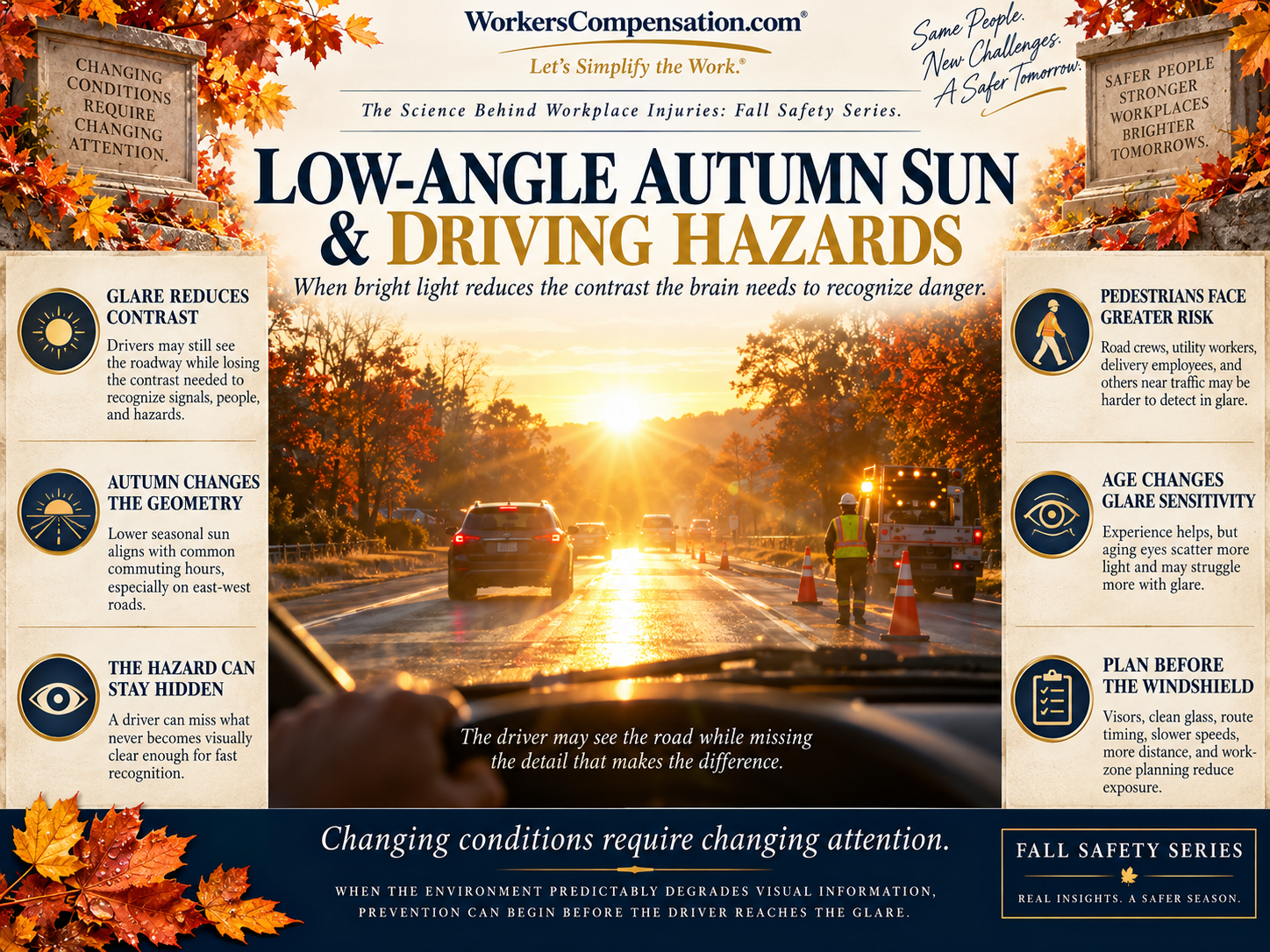
Welcome to The Science Behind Workplace Injuries: Fall Safety Series, where we explore how seasonal conditions interact with human physiology, behavior, and workplace systems. Yesterday, we examined how earlier darkness reduces the visual information available to workers and drivers. Autumn creates another visual challenge during the hours when plenty of light remains available. As the season progresses, the sun sits lower in the sky during common commuting and working hours, placing intense light directly into a driver's field of vision. Roads remain visible, traffic continues moving, and the weather may appear ideal while the visual system becomes less capable of detecting important details.
Sun glare creates an interesting safety problem because bright sunlight rarely looks like hazardous weather. Clear skies usually signal favorable driving conditions. The road is dry, precipitation is absent, and visibility may appear excellent when measured by how far someone can see. Glare changes the quality of the visual information reaching the driver without necessarily eliminating the broader view of the roadway. A driver can see the road while losing the contrast needed to recognize what is happening on it.
Glare Changes Contrast Before it Changes the View
Low-angle sunlight affects vision through a phenomenon known as disability glare. Light entering the eye scatters across the cornea, lens, and other ocular structures, creating what vision scientists call straylight. The scattered light produces a veil across the retinal image and reduces contrast between objects and their backgrounds. A gray vehicle against pavement, a pedestrian in dark clothing, a traffic signal against a bright sky, or a worker standing near the roadway can become harder to distinguish even though the driver remains able to see the larger scene. The problem involves the quality of visual information reaching the brain.
Contrast matters because driving depends on detecting differences within a complex visual field. Traffic signals, brake lights, lane markings, pedestrians, bicycles, vehicles, equipment, and roadway edges compete for recognition while the vehicle continues moving. Research on sun-glare crashes reflects the consequences of degraded visual information. Danyang Sun, Karim El-Basyouny, and Tae Kwon found that glare-related collisions in Edmonton were more likely to involve signal violations, failures to yield to pedestrians and cyclists, improper turns, and lane changes. Those errors share a common requirement: the driver must first perceive the information needed to make the correct decision.
Autumn adds geometry to the physiology. Near the equinox, sunrise occurs close to due east and sunset close to due west, placing the sun near the direction of travel on many east-west roads. As sunrise moves later through September and October, low morning sun increasingly overlaps with morning traffic. Evening travel creates the reverse exposure for westbound drivers. Sun and colleagues demonstrated that glare exposure can be modeled using road direction, time, and solar position, with collision patterns showing seasonal effects in spring and fall.
A Driver Can Miss What Never Becomes Visually Clear
Glare gives us another reason to think carefully about the phrase “driver error.” A missed signal, late brake response, unsafe turn, or failure to yield eventually appears as a decision or action. The visual information available before the action matters. When glare reduces contrast, a pedestrian or signal can remain physically present without becoming sufficiently distinct for rapid recognition. Human performance depends on information reaching the brain early enough and clearly enough for perception, interpretation, and response.
Pedestrians illustrate the consequences particularly well. Hon-Ping Ma and colleagues examined more than 100,000 pedestrians involved in crashes in Taiwan between 2003 and 2016. Pedestrians involved in glare-related crashes were more likely to die than pedestrians involved in crashes without glare. Older drivers, rural roads, heavy vehicles, and sunset conditions were among the factors associated with greater fatality risk in glare-related crashes. The findings matter for occupational safety because many workers perform their jobs outside the protection of a vehicle: flaggers, road crews, utility workers, tow operators, police officers, sanitation workers, delivery employees, and others regularly work near moving traffic.
The occupational connection deserves careful wording because no available study isolates sun glare as a cause of work-related crashes or workers' compensation claims. The transportation evidence establishes glare as a measurable road-safety hazard, while occupational surveillance establishes motor-vehicle incidents as a major source of workplace fatalities. In 2024, the Bureau of Labor Statistics recorded 1,937 fatal occupational injuries from transportation incidents among 5,070 total workplace fatalities, representing approximately 38 percent of the total. The evidence gives us two well-supported pieces of the problem without a dataset directly connecting them. Scientific precision requires us to preserve the gap while still recognizing the exposure faced by people who drive or work near traffic.
Experience Does Not Change the Optics
Age adds another dimension because glare sensitivity changes in ways a standard vision test may not capture. Thomas van den Berg and colleagues studied visual function in 2,422 European drivers and found retinal straylight increased substantially with age. Among eyes without cataracts, straylight approximately doubled by age 65 and tripled by age 77. Visual acuity and straylight also varied largely independently, meaning a person can perform well on a conventional acuity test while experiencing greater difficulty with glare. The distinction matters in an aging workforce because reading letters clearly in a well-lit examination room measures something different from detecting a low-contrast pedestrian against intense sunlight.
Driving experience cannot prevent light from scattering inside the eye. Experienced drivers may anticipate a familiar glare location, increase following distance, lower a visor, slow down, or adjust a route when possible. Those behaviors can reduce exposure or create additional response time, making experience valuable when it remains responsive to changing conditions. The underlying optical limitation remains present regardless of driving history, confidence, or skill. A capable driver operating with degraded visual information is still operating with degraded visual information.
Vehicles can add another layer to the visual environment. Sunlight reflecting from a dashboard onto the windshield can create additional veiling glare, while glass condition can influence how light scatters through the driver's view. The research base is considerably better for dashboard reflectance than for many popular windshield claims, so we should resist repeating unsupported statistics about dirty glass and crash risk. Clean glass, functioning wipers, appropriate visor use, and reduced dashboard reflectivity remain sensible controls based on the optical mechanism. Prevention becomes more credible when recommendations stay within the boundaries of what the evidence can support.
A Predictable Hazard Gives Us Time to Plan
Sun glare differs from many driving hazards because its timing and location are remarkably predictable. Organizations with regular routes can identify eastbound morning and westbound evening exposures before a driver encounters them. Fleet managers can examine whether delivery schedules, service routes, school transportation, roadside work, or equipment movement repeatedly place workers into known low-sun windows. Employers can also examine crash and near-miss records by time of day, travel direction, location, and season instead of relying solely on broad categories such as “motor vehicle accident.” Patterns become easier to prevent when organizations collect enough information to see them.
Operational expectations matter as well. Drivers often compensate for degraded visibility by slowing down and increasing the time available to process what they can see. A delivery metric, dispatch schedule, or productivity expectation that leaves no room for slower travel can work against a reasonable safety response. Roadside operations deserve similar planning because the person facing the greatest consequence may be the worker outside the vehicle rather than the driver experiencing the glare. Work-zone setup, worker positioning, high-visibility apparel, vehicle lighting, and timing can all be considered alongside the direction drivers will be facing.
Individual strategies still have a place. Sunglasses can reduce light intensity, polarized lenses can reduce reflected glare, and visors can block sunlight when the geometry permits. Drivers can increase following distance, reduce speed, anticipate known glare locations, and maintain windshields and mirrors. Those actions work best inside an organizational system that recognizes glare as an environmental exposure instead of assigning the entire problem to driver vigilance. Sun position can be predicted years in advance; organizations have an unusual opportunity to plan before the hazard reaches the windshield.
Low-angle autumn sun offers a useful lesson about the relationship between perception and safety. The driver does not need to lose the entire visual scene for performance to change. A small reduction in contrast can determine whether a pedestrian separates from the background, whether a signal becomes recognizable soon enough, or whether an approaching vehicle is detected before a turn begins. Human performance depends on the quality of the information available before a decision must be made. When the environment predictably degrades the information, prevention can begin before the driver reaches the glare.
Tomorrow in The Science Behind Workplace Injuries: Fall Safety Series — Daylight Saving Time and Workplace Injuries. The seasonal change in light affects more than vision. Moving the clock changes sleep opportunity, circadian timing, and the relationship between biological rhythms and work schedules. Tomorrow, we examine what the research actually shows about clock changes, sleep loss, workplace injuries, and why the spring and fall transitions should not be treated as physiologically equivalent.
Research Referenced
Ma, H.-P., Chen, P.-L., Chen, S.-K., Chen, L.-H., Linkov, V., & Pai, C.-W. (2019). Population-based case-control study of the effect of sun glare on pedestrian fatalities in Taiwan. BMJ Open, 9(8), e028350. doi:10.1136/bmjopen-2018-028350
Sun, D., El-Basyouny, K., & Kwon, T. J. (2018). Sun glare: Network characterization and safety effects. Transportation Research Record, 2672(16), 79–92. doi:10.1177/0361198118784143
Van den Berg, T. J. T. P., Van Rijn, L. J., Michael, R., Heine, C., Coeckelbergh, T., Nischler, C., Wilhelm, H., Grabner, G., Emesz, M., Barraquer, R. I., Coppens, J. E., & Franssen, L. (2007). Straylight effects with aging and lens extraction. American Journal of Ophthalmology, 144(3), 358–363. doi:10.1016/j.ajo.2007.05.037


AI best practices california case file caselaw case management case management focus claims compensability compliance compliance corner courts do you know the rule employers exclusive remedy florida fraud glossary check Healthcare hr homeroom insurance insurers iowa kentucky leadership NCCI new jersey new york ohio pennsylvania Safety safety at work state info tech technology the case manager violence WDYT what do you think women's history women's history month workers' comp 101 workers' recovery Workplace Safety Workplace Violence
Read Also
About The Author
About The Author
-
Claire Muselman
Meet Dr. Claire C. Muselman, the Chief Operating Officer at WorkersCompensation.com, where she blends her vast academic insight and professional innovation with a uniquely positive energy. As the President of DCM, Dr. Muselman is renowned for her dynamic approach that reshapes and energizes the workers' compensation industry. Dr. Muselman's academic credentials are as remarkable as her professional achievements. Holding a Doctor of Education in Organizational Leadership from Grand Canyon University, she specializes in employee engagement, human behavior, and the science of leadership. Her diverse background in educational leadership, public policy, political science, and dance epitomizes a multifaceted approach to leadership and learning. At Drake University, Dr. Muselman excels as an Assistant Professor of Practice and Co-Director of the Master of Science in Leadership Program. Her passion for teaching and commitment to innovative pedagogy demonstrate her dedication to cultivating future leaders in management, leadership, and business strategy. In the industry, Dr. Muselman actively contributes as an Ambassador for the Alliance of Women in Workers’ Compensation and plays key roles in organizations such as Kids Chance of Iowa, WorkCompBlitz, and the Claims and Litigation Management Alliance, underscoring her leadership and advocacy in workers’ compensation. A highly sought-after speaker, Dr. Muselman inspires professionals with her engaging talks on leadership, self-development, and risk management. Her philosophy of empathetic and emotionally intelligent leadership is at the heart of her message, encouraging innovation and progressive change in the industry. "Empowerment is key to progress. By nurturing today's professionals with empathy and intelligence, we're crafting tomorrow's leaders." - Dr. Claire C. Muselman
More by This Author
Read More
- Oct 19, 2026
- Claire Muselman
- Oct 19, 2026
- Anne Llewellyn
- Oct 19, 2026
- Chriss Swaney
- Oct 18, 2026
- Claire Muselman
- Oct 17, 2026
- Claire Muselman