


Share This Article:
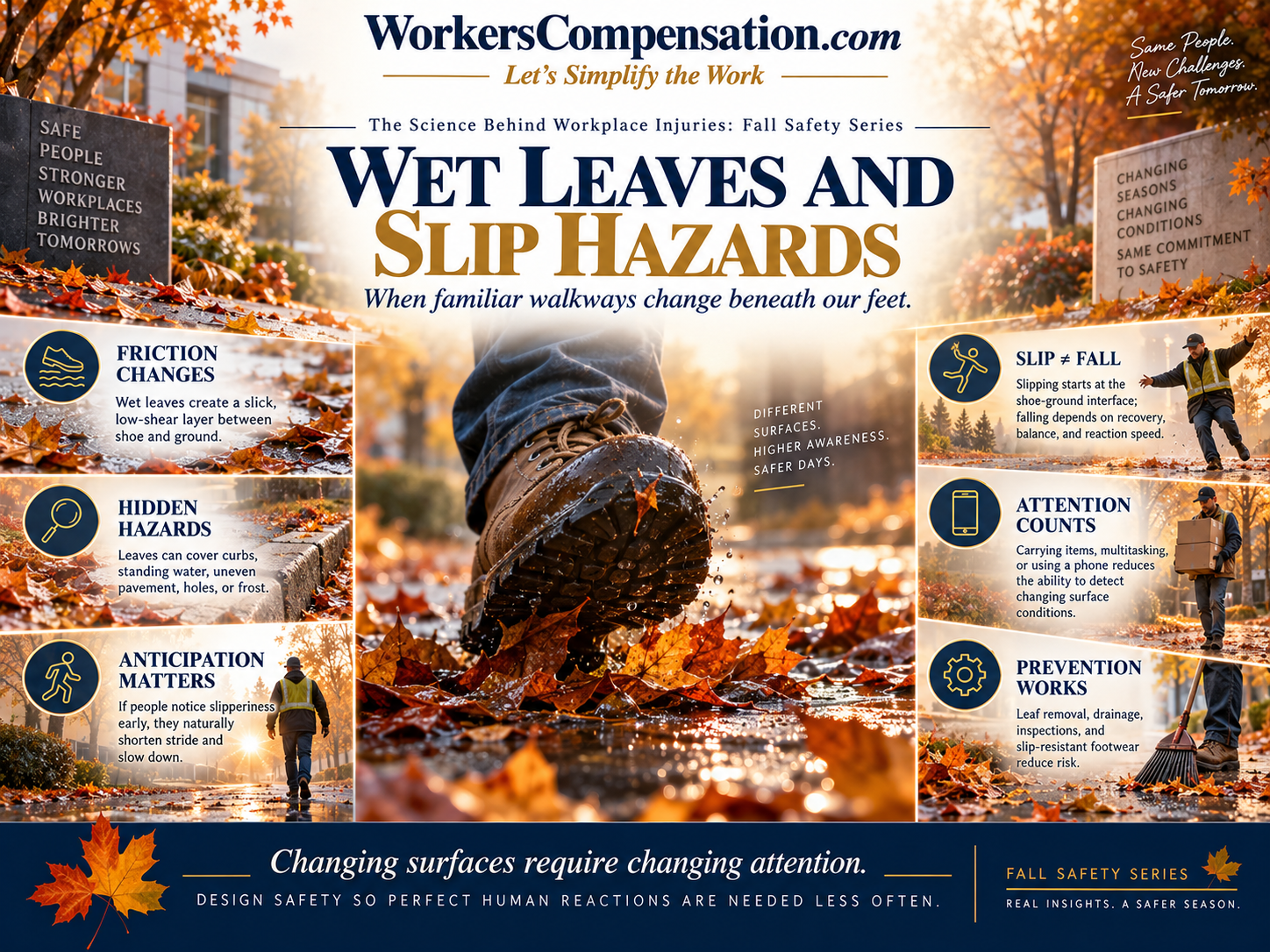
Fall Into Safety
Welcome to The Science Behind Workplace Injuries: Fall Safety Series, where we explore the environmental hazards, human physiology, behavioral science, and organizational decisions shaping workplace safety. Today, we examine one of autumn's most familiar conditions and the science occurring in the fraction of a second between an ordinary step, a slip, and a fall.
Wet leaves rarely look threatening. They collect near entrances, cover sidewalks, gather along curbs, and become part of the landscape as autumn progresses. For employees who walk the same route every day, the environment may look familiar even when the surface beneath them has changed. Friction, moisture, decomposing plant material, footwear, gait, attention, balance, and reaction speed can converge during a single step. Understanding how these factors interact helps explain why preventing a slip and preventing a slip from becoming an injury require different approaches.
What Happens Between the Shoe and the Ground
Walking depends on friction. Each step requires enough friction between the shoe and walking surface to support the forces created as the heel contacts the ground, the body moves forward, and the foot pushes away from the surface. A slip can begin when the friction required to complete that movement exceeds the friction available beneath the shoe. Wet leaves can alter that relationship by creating a low-shear layer between footwear and the walking surface.
The mechanism is more complex than water simply making pavement slippery. Research examining friction has found water can produce different effects depending on the surface, film thickness, pressure, footwear, and debris present. Fallen leaves introduce organic material that changes the interaction further. As plant material breaks down, compounds including pectin and cellulose degradation products can contribute to a slick film with low resistance to shear. A 2023 study published in Wear examining wheel–rail adhesion found measurable differences in traction among wet leaves from different tree species. Although the study examined railway surfaces rather than pedestrian walking surfaces, it demonstrates how wet organic material can alter friction. The surface we casually describe as “wet leaves” can therefore represent a complex interaction between water, organic material, pavement, footwear, and force.
Leaves can create another problem by obscuring the surface underneath them. A layer of leaves may conceal standing water, uneven pavement, holes, curbs, frost, or other changes in elevation and traction. This matters because people modify the way they walk when they expect a slippery surface. Research by Rakié Cham and Mark Redfern found anticipation of slipperiness leads people to shorten their stride, reduce walking speed, and alter foot placement before encountering the hazard. The body has a protective strategy available, although that strategy depends partly on recognizing the condition early enough to use it.
A Slip and a Fall Are Different Events
One of the most useful findings in slip-and-fall research involves separating slip initiation from recovery. Research by Thurmon Lockhart, James Smith, and Jeffrey Woldstad examining the biomechanics of slips across age groups found younger and older adults experienced similar rates of slip initiation. Age became more consequential after the slip began because older adults were less likely to successfully recover. This distinction changes how we understand the injury mechanism. Surface conditions influence whether the foot slips while neuromuscular response, strength, balance, sensory processing, and reaction speed help determine what happens next.
The recovery window is short. Research by Cham and Redfern documented rapid corrective reactions at the hip, knee, and ankle as the body attempts to arrest the slipping foot. Daniel Marigold and Aftab Patla found the other leg and arms also contribute to restoring balance following an unexpected slip. More recent research continues to demonstrate that the timing and magnitude of these early responses help distinguish people who recover from those who fall. The body has only fractions of a second to detect the change, process sensory information, generate force, reposition the limbs, and regain control of the body's center of mass.
Age can influence several components of that response. Changes in fast-twitch muscle fibers, leg power, proprioception, sensory integration, and processing speed can reduce recovery capacity. A 2024 study examining upper-body responses found older adults demonstrated delayed arm-abduction reactions compared with younger adults. Research has also connected lower-extremity strength and power with outcomes following experimentally induced slips in older adults. These findings do not suggest older workers are inherently more likely to step onto a slippery surface. They help explain why the consequences of the same environmental exposure can differ across individuals.
Attention Matters Before the Foot Lands
Walking feels automatic because much of it is. The nervous system continuously coordinates visual information, proprioception, vestibular input, muscle activity, and movement without requiring us to consciously plan every step. That efficiency allows a worker to carry packages, scan addresses, think about the next task, talk with another employee, or navigate a phone while moving. Those competing demands can matter when the walking environment changes.
Research on dual-task walking shows high cognitive load can degrade gait stability and cognitive performance at the same time. A delivery driver carrying packages across a leaf-covered walkway, a grounds worker moving equipment, or an employee reading a message while crossing a parking lot may therefore have fewer attentional resources available to detect changing surface conditions. Familiarity can add another complication because repeated exposure without an incident may reduce vigilance. Direct wet-leaf studies on habituation are limited, so the connection should be interpreted cautiously, but broader occupational research supports the role of habituation and divided attention in hazard recognition.
Designing Prevention Around Human Performance
Slips, trips, and falls remain a major source of occupational injury. Bureau of Labor Statistics data recorded 844 fatal injuries from slips, trips, and falls in 2024, making the category the second-leading cause of occupational fatalities. Same-level falls also generate substantial workers' compensation costs across industries. National surveillance systems do not identify “wet leaves” as a separate injury category, which means precise national estimates for leaf-related workplace injuries are unavailable. The broader evidence still gives organizations clear information about how slip injuries can be prevented.
Some of the clearest evidence comes from interventions that reduce reliance on perfect human attention. Jennifer Bell and NIOSH researchers conducted a cluster-randomized trial involving food-service workers and found a no-cost slip-resistant footwear program reduced slipping-related workers' compensation claims by approximately 67 percent compared with controls. OSHA's Walking-Working Surfaces standard also requires employers to keep walking surfaces clean and orderly, inspect them regularly, and correct or guard hazardous conditions. For autumn workplaces, those principles translate into timely leaf removal, drainage, walkway maintenance, appropriate footwear, and inspections that respond to weather and leaf accumulation rather than waiting for an incident.
The research also gives us a useful way to think about prevention. Environmental controls and footwear can reduce the likelihood that a slip begins. Strength, balance, reaction capacity, attention, and anticipation influence whether the body can recover once it does. Effective prevention considers both sides of that equation while placing greater responsibility on systems that reduce exposure before an employee has to react within a fraction of a second. Wet leaves offer a small seasonal example of a much larger human-performance principle: effective safety systems reduce the number of moments in which perfect human performance is required.
Tomorrow in The Science Behind Workplace Injuries: Fall Safety Series - Frost Before Winter. The first frost can arrive while routines, equipment, and expectations still reflect warmer weather. Tomorrow, we examine what happens when winter-like surface conditions arrive before people have fully adapted to the seasonal change.
Research Referenced
Bell, J. L., Collins, J. W., & Chiou, S. (2019). Effectiveness of a no-cost-to-workers, slip-resistant footwear program for reducing slipping-related injuries in food service workers: A cluster randomized trial. Scandinavian Journal of Work, Environment & Health, 45(2), 194–202. https://doi.org/10.5271/sjweh.3790
Cham, R., & Redfern, M. S. (2002). Changes in gait when anticipating slippery floors. Gait & Posture, 15(2), 159–171. https://doi.org/10.1016/S0966-6362(01)00150-3
Chen, H., Kimura, S., Ikoma, K., Ishizaka, K., et al. (2023). Evaluation test of tangential force coefficient under different types of fallen leaves. Wear, 532–533, 205072. https://doi.org/10.1016/j.wear.2023.205072
Lockhart, T. E., Smith, J. L., & Woldstad, J. C. (2005). Effects of aging on the biomechanics of slips and falls. Human Factors, 47(4), 708–729. https://doi.org/10.1518/001872005775571014


AI california case file caselaw case management case management focus claims compensability compliance compliance corner courts covid do you know the rule employers exclusive remedy florida fraud glossary check Healthcare hr homeroom insurance insurers iowa kentucky leadership NCCI new jersey new york ohio pennsylvania Safety safety at work state info tech technology the case manager violence WDYT what do you think women's history women's history month workers' comp 101 workers' recovery Workplace Safety Workplace Violence
Read Also
About The Author
About The Author
-
Claire Muselman
Meet Dr. Claire C. Muselman, the Chief Operating Officer at WorkersCompensation.com, where she blends her vast academic insight and professional innovation with a uniquely positive energy. As the President of DCM, Dr. Muselman is renowned for her dynamic approach that reshapes and energizes the workers' compensation industry. Dr. Muselman's academic credentials are as remarkable as her professional achievements. Holding a Doctor of Education in Organizational Leadership from Grand Canyon University, she specializes in employee engagement, human behavior, and the science of leadership. Her diverse background in educational leadership, public policy, political science, and dance epitomizes a multifaceted approach to leadership and learning. At Drake University, Dr. Muselman excels as an Assistant Professor of Practice and Co-Director of the Master of Science in Leadership Program. Her passion for teaching and commitment to innovative pedagogy demonstrate her dedication to cultivating future leaders in management, leadership, and business strategy. In the industry, Dr. Muselman actively contributes as an Ambassador for the Alliance of Women in Workers’ Compensation and plays key roles in organizations such as Kids Chance of Iowa, WorkCompBlitz, and the Claims and Litigation Management Alliance, underscoring her leadership and advocacy in workers’ compensation. A highly sought-after speaker, Dr. Muselman inspires professionals with her engaging talks on leadership, self-development, and risk management. Her philosophy of empathetic and emotionally intelligent leadership is at the heart of her message, encouraging innovation and progressive change in the industry. "Empowerment is key to progress. By nurturing today's professionals with empathy and intelligence, we're crafting tomorrow's leaders." - Dr. Claire C. Muselman
More by This Author
Read More
- Sep 21, 2026
- Frank Ferreri
- Sep 19, 2026
- Claire Muselman
- Sep 19, 2026
- Chris Parker
- Sep 18, 2026
- Frank Ferreri
- Sep 18, 2026
- Claire Muselman
- Sep 17, 2026
- Frank Ferreri