


Share This Article:
Fall into Safety
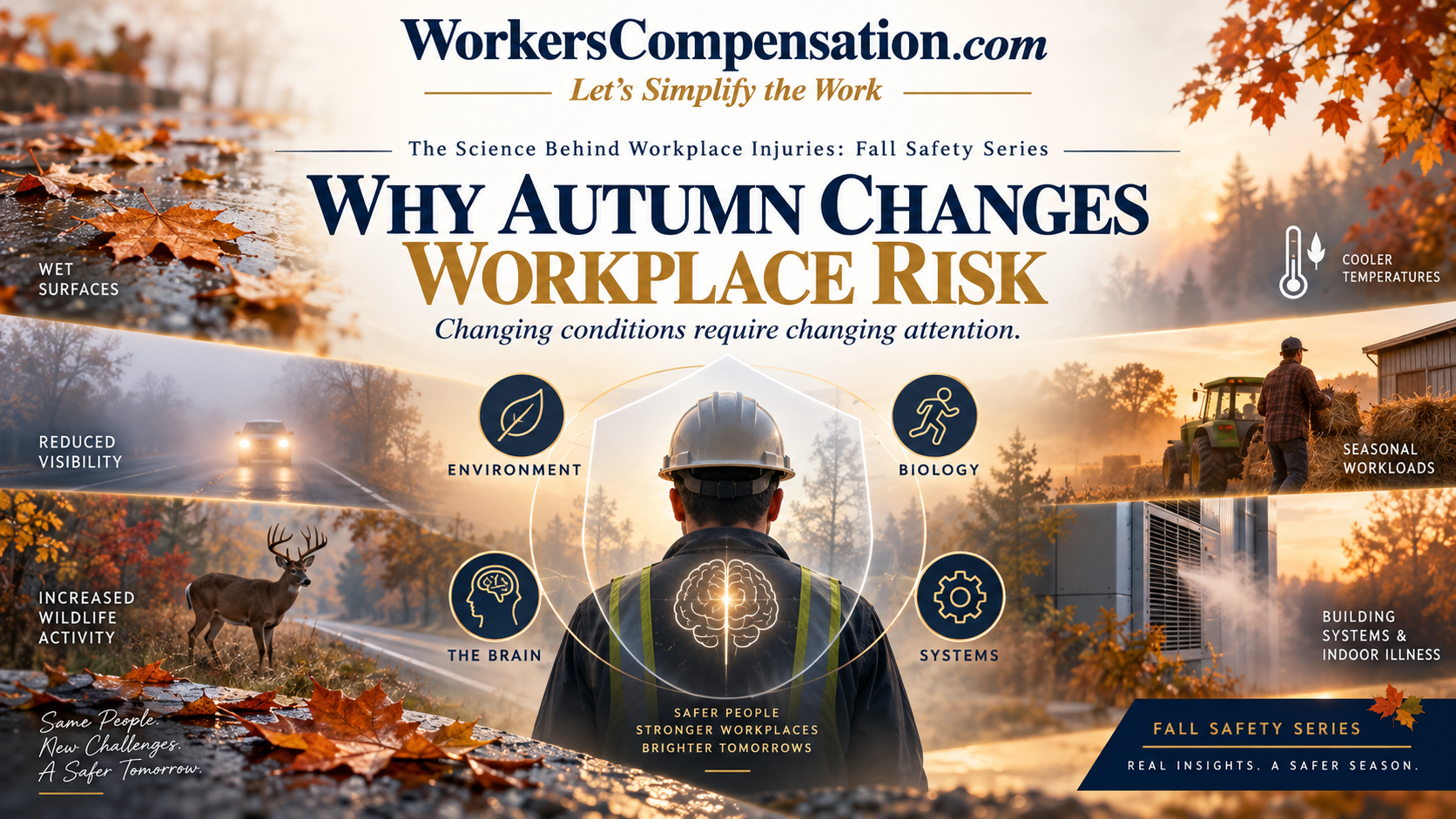
Welcome to The Science Behind Workplace Injuries: Fall Safety Series, where we explore the environmental hazards, human physiology, behavioral science, and organizational decisions shaping workplace safety. This series examines how autumn conditions influence human performance and workplace injuries while creating opportunities for organizations to prepare as risks change.
Autumn changes the environment in which people work. Temperatures fluctuate, daylight decreases, moisture changes walking surfaces, morning fog reduces visibility, leaves accumulate, wildlife activity shifts, and respiratory illnesses increase as people spend more time indoors. Work changes alongside the environment as agriculture enters harvest, outdoor industries prepare for winter, schools return to session, heating systems restart, seasonal employees arrive, and organizations approach fourth-quarter and holiday production demands. These transitions place different demands on the human body, brain, and workplace. Understanding those changes helps organizations anticipate how risk evolves throughout the season.
Autumn Changes the Conditions of Work
Workplace injury data provide a useful starting point. Twenty years of fatal occupational injury data from the U.S. Bureau of Labor Statistics found July and August experienced the highest number of workplace fatalities, while December through February experienced the lowest. September and October remained above the annual monthly average during the period studied, with October recording 10,453 fatalities compared with 8,814 in November. A separate NIOSH-funded analysis of occupational injuries treated in emergency departments between 2012 and 2019 found most injury categories peaked during July and August. Falls, slips, and trips followed a different seasonal pattern and reached their highest levels during winter. Autumn represents a period when the workplace risk profile begins changing as environmental and occupational conditions transition simultaneously.
The Brain Must Adapt to a Changing Environment
The human brain helps explain why changing conditions deserve attention. Repeated experiences allow the brain to develop predictions about familiar environments and automate behaviors requiring less conscious thought. We know the route to work, the location of the stairs, the feel of a familiar walking surface, and the normal sequence of tasks performed throughout the day. Automaticity conserves cognitive resources for information requiring greater attention. Seasonal transitions introduce new information into familiar environments, requiring existing mental models to adjust. The walkway remains familiar while wet leaves change its traction, the commute remains familiar while darkness changes visibility, and the job remains familiar while colder temperatures begin changing physical performance.
Biomechanics demonstrates how quickly the physical environment can change before human perception recognizes the difference. A 2023 study published in Wear measured traction under different types of fallen leaves and confirmed wet leaves reduce available friction between surfaces. Broader slip-resistance research has also found people only moderately accurately perceive how slippery a surface is. Walking safely requires sufficient friction between footwear and the ground while the nervous system integrates visual information, proprioception, balance, and movement. When moisture, leaves, frost, or changing temperatures alter that surface, yesterday's successful movement pattern may require adjustment. The environment can change before our expectations change with it.
Daylight creates a transition with biological and practical implications. Light is one of the primary environmental signals regulating the human circadian system and influences melatonin, sleep timing, alertness, and cognitive performance. Research examining everyday light exposure in healthy adults found relationships between light exposure, subjective sleepiness, vigilance, and reaction time. As autumn progresses, morning light arrives later while darkness begins earlier, changing the timing of those biological signals. The same seasonal shift changes visibility for employees commuting, driving for work, completing outdoor tasks, crossing parking lots, and operating equipment near the end of a shift. Light influences the internal systems regulating human performance and the external conditions in which that performance occurs.
Research surrounding Daylight Saving Time demonstrates why seasonal safety deserves continued study. Christopher Barnes and David Wagner analyzed workplace injury and sleep data and found the spring transition was associated with approximately forty minutes of lost sleep and a 5.7 percent increase in workplace injuries, while their analysis found no significant injury effect following the autumn transition. More recent research by Barrak Alahmad, Gregory Wagner, and David Michaels examined 738,828 injuries from OSHA's Injury Tracking Application and found a significant increase following the fall transition while finding no significant spring effect. The studies used different datasets, populations, time periods, and methodologies, producing different findings. These differences reinforce the need to examine how light exposure, sleep timing, visibility, and work conditions interact rather than reducing seasonal risk to a single explanation.
Work Changes with the Season
Occupational activity changes during autumn as well. Research across twelve Midwestern states found fatal agricultural injuries were most frequent during the growing and harvest seasons. Harvest concentrates machinery use, longer working hours, rural roadway exposure, fatigue, changing daylight, and time-sensitive production into the same period. Construction, roofing, utilities, landscaping, transportation, retail, warehousing, and other industries experience seasonal transitions as organizations finish outdoor projects, conduct maintenance, prepare facilities for colder weather, increase holiday production, or bring seasonal employees into the workforce. These shifts change exposure, workload, schedules, and environmental demands while employees continue performing familiar work.
Behavioral science helps explain how experience changes risk perception. Repeated exposure to a condition without a negative outcome can reduce the attention given to that condition. Optimism bias can also influence how people evaluate their likelihood of injury. Research involving construction workers found optimism bias predicted greater risk-taking behavior while a strong organizational safety climate helped reduce that relationship. Seasonal hazards require more than reminders asking employees to pay attention. Prevention requires helping people recognize when familiar environments have changed enough to require different behaviors.
Prevention Requires Anticipation
Organizations can respond before injuries occur. Fall preparation can include adjusting lighting before darkness affects work, removing leaves before walking surfaces lose traction, modifying schedules as available daylight decreases, preparing fleets for wildlife activity, managing harvest-related fatigue, inspecting heating systems, and preparing seasonal employees before production increases. Leaders can examine how work is performed at dusk, how employees transition into colder conditions, where moisture accumulates, how seasonal employees learn the work, and where workload begins increasing. Workers' compensation data can also identify patterns associated with weather, slips and falls, vehicle incidents, seasonal work, and environmental conditions. NCCI research has found cold and wet weather produces measurable increases in workers' compensation claim frequency, particularly through slips and falls, reinforcing the value of responding to conditions as they change.
Autumn gives us a season built around transition. Over the next thirty articles, we will examine the biomechanics of wet leaves, frost, fog, wind, cold rain, decreasing daylight, respiratory illness, harvest, wildlife, seasonal employment, building maintenance, fatigue, transportation, and preparation for winter. Each topic provides another opportunity to understand how environmental conditions interact with human physiology, cognition, behavior, and organizational systems. The science helps organizations recognize these transitions early and respond with greater precision. Changing conditions require changing attention, and prevention begins by noticing what has changed.
Tomorrow in The Science Behind Workplace Injuries: Fall Safety Series - Wet Leaves and Slip Hazards. Fallen leaves are familiar throughout autumn while moisture can change the friction beneath our feet. Tomorrow, we explore the biomechanics of slips, traction, gait, balance, and why our perception of a slippery surface may differ from the physical conditions beneath us.
Research Referenced
Alahmad, B., Wagner, G. R., & Michaels, D. (2026). When do workplace injuries occur? A temporal analysis of the first reporting year of the Injury Tracking Application case data in the United States. Journal of Occupational & Environmental Medicine, 68(6), e409–e417. https://doi.org/10.1097/JOM.0000000000003648
Barnes, C. M., & Wagner, D. T. (2009). Changing to daylight saving time cuts into sleep and increases workplace injuries. Journal of Applied Psychology, 94(5), 1305–1317. https://doi.org/10.1037/a0015320
Chen, H., Kimura, S., Ikoma, K., Ishizaka, K., et al. (2023). Evaluation test of tangential force coefficient under different types of fallen leaves. Wear, 532–533, 205072. https://doi.org/10.1016/j.wear.2023.205072
Coate, P., Scott, C., & Colon, D. (2024). Adverse weather and workers compensation claims. National Council on Compensation Insurance.
Didikoglu, A., Woelders, T., Bickerstaff, L., et al. (2026). Relationships between light exposure and aspects of cognitive function in everyday life. Communications Psychology, 4, 5. https://doi.org/10.1038/s44271-025-00373-9
Kesy, L., & Pegula, S. (2014). Census of fatal occupational injuries commemorates 20 years of occupational safety and health data. Beyond the Numbers: Workplace Injuries, 3(23). U.S. Bureau of Labor Statistics.
Lundstrom, E. W., Hendricks, S. A., Marsh, S. M., Groth, C. P., Smith, G. S., & Bhandari, R. (2023). Temporal trends in occupational injuries treated in US emergency departments, 2012–2019. Injury Epidemiology, 10, 15.
Man, S. S., Yu, R., Zhang, T., & Chan, A. H. S. (2022). How optimism bias and safety climate influence the risk-taking behavior of construction workers. International Journal of Environmental Research and Public Health, 19(3), 1243. https://doi.org/10.3390/ijerph19031243
Swanton, A. R., Young, T. L., & Peek-Asa, C. (2016). Characteristics of fatal agricultural injuries by production type. Journal of Agricultural Safety and Health, 22(1), 75–85. https://doi.org/10.13031/jash.22.11244


AI best practices california case file caselaw case management case management focus claims compensability compliance compliance corner courts do you know the rule employers exclusive remedy florida fraud glossary check Healthcare hr homeroom insurance insurers iowa kentucky leadership NCCI new jersey new york ohio pennsylvania Safety safety at work state info tech technology the case manager violence WDYT what do you think women's history women's history month workers' comp 101 workers' recovery Workplace Safety Workplace Violence
Read Also
About The Author
About The Author
-
Claire Muselman
Meet Dr. Claire C. Muselman, the Chief Operating Officer at WorkersCompensation.com, where she blends her vast academic insight and professional innovation with a uniquely positive energy. As the President of DCM, Dr. Muselman is renowned for her dynamic approach that reshapes and energizes the workers' compensation industry. Dr. Muselman's academic credentials are as remarkable as her professional achievements. Holding a Doctor of Education in Organizational Leadership from Grand Canyon University, she specializes in employee engagement, human behavior, and the science of leadership. Her diverse background in educational leadership, public policy, political science, and dance epitomizes a multifaceted approach to leadership and learning. At Drake University, Dr. Muselman excels as an Assistant Professor of Practice and Co-Director of the Master of Science in Leadership Program. Her passion for teaching and commitment to innovative pedagogy demonstrate her dedication to cultivating future leaders in management, leadership, and business strategy. In the industry, Dr. Muselman actively contributes as an Ambassador for the Alliance of Women in Workers’ Compensation and plays key roles in organizations such as Kids Chance of Iowa, WorkCompBlitz, and the Claims and Litigation Management Alliance, underscoring her leadership and advocacy in workers’ compensation. A highly sought-after speaker, Dr. Muselman inspires professionals with her engaging talks on leadership, self-development, and risk management. Her philosophy of empathetic and emotionally intelligent leadership is at the heart of her message, encouraging innovation and progressive change in the industry. "Empowerment is key to progress. By nurturing today's professionals with empathy and intelligence, we're crafting tomorrow's leaders." - Dr. Claire C. Muselman
More by This Author
Read More
- Oct 08, 2026
- Claire Muselman
- Oct 08, 2026
- Frank Ferreri
- Oct 08, 2026
- Claire Muselman
- Oct 07, 2026
- Frank Ferreri
- Oct 06, 2026
- Claire Muselman
- Oct 06, 2026
- Chriss Swaney