


Share This Article:
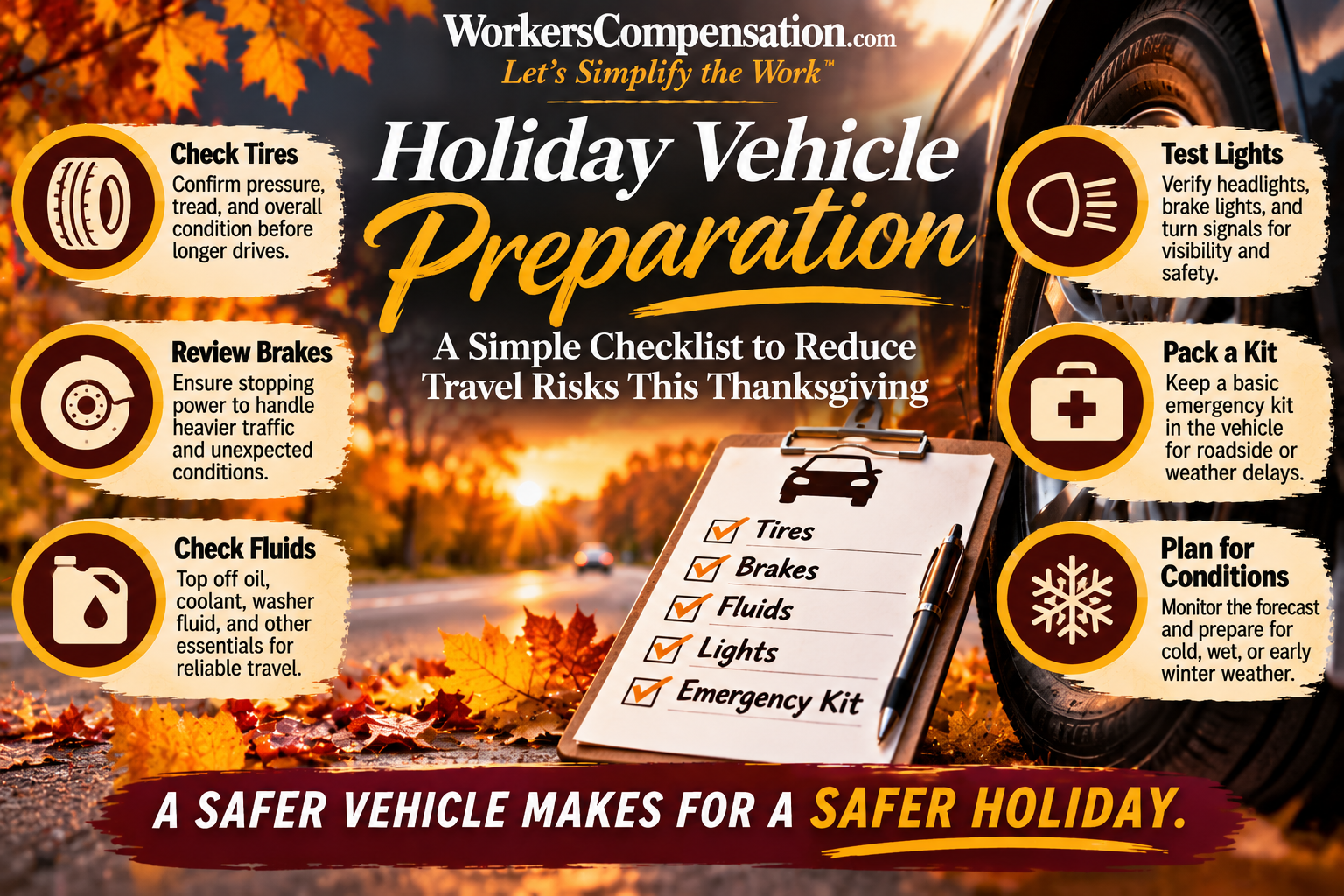
Holiday Vehicle Preparation: A Simple Checklist to Reduce Travel Risks this Thanksgiving
22 Nov, 2026 Claire Muselman
Stuffed with Safety
Thanksgiving brings millions of travelers onto American roads, including employees whose responsibilities continue throughout the holiday week. Delivery drivers complete routes, service technicians respond to calls, and traveling professionals move between business locations. Many share congested highways with families beginning their holiday journeys. Colder temperatures, wet pavement, and earlier darkness introduce additional demands on vehicles already accumulating substantial mileage. For employers and workers’ compensation professionals, vehicle condition deserves attention before a mechanical problem becomes an occupational injury.
When Vehicle Condition Becomes an Injury Risk
Mechanical problems contribute to crashes in ways that are often difficult to recognize. The National Highway Traffic Safety Administration examined crashes in its National Motor Vehicle Crash Causation Survey and assigned approximately 2% of critical pre-crash reasons to vehicles. Tires and wheels accounted for 35% of those vehicle-related findings, while brakes represented another 22%. A critical reason identifies the immediate event preceding a crash and does not establish legal fault or definitive causation. The findings also reflect older crash data and inspections that could miss internal defects. Vehicle maintenance remains important because mechanical deficiencies can reduce the driver's ability to respond safely when road conditions deteriorate.
Commercial vehicle research reveals additional concerns. The Federal Motor Carrier Safety Administration identified brake problems in 29% of large trucks involved in the injury and fatal crashes examined in its Large Truck Crash Causation Study. Trucks with brake problems were approximately 2.7 times as likely to receive a critical-reason assignment. The association does not establish that defective brakes caused every collision. It demonstrates why braking systems deserve particular attention in fleet maintenance programs. When employees operate vehicles for work, mechanical readiness becomes part of occupational risk management.
Tires, Brakes, and the Physics of Stopping
Tire condition can dramatically influence vehicle performance on wet pavement. In controlled testing, AAA found that passenger-car tires worn to 4/32 of an inch required approximately 87 additional feet to stop from 60 miles per hour on wet pavement compared with new tires. The increase represented approximately 43% more stopping distance under the tested conditions. Many states permit passenger tires to remain in service until tread reaches 2/32 of an inch. Legal minimums therefore provide limited reassurance about wet-weather performance. Employers and drivers should consider tire condition before the holiday travel period, particularly when forecasts include rain or early winter precipitation.
Tire pressure introduces another exposure. NHTSA research associated substantial underinflation with increased involvement of tire problems during crashes. Cold temperatures can lower tire pressure, making seasonal checks especially valuable. Drivers should use the manufacturer's recommended pressure on the vehicle's door-jamb label and inspect tires for uneven wear or visible damage. Brakes deserve similar attention when warning lights appear, stopping performance changes, or unusual noises develop. Mechanical warning signs should trigger evaluation before another business trip begins.
Checklist Beyond the Tires
Headlights, brake lights, and turn signals become increasingly important as daylight hours shorten. Functional lighting helps drivers recognize roadway conditions while allowing surrounding motorists to anticipate vehicle movements. Wipers, washer fluid, and defrosters preserve visibility during rain, frost, and changing temperatures. Battery condition and fluid levels also deserve attention because cold weather can expose existing weaknesses. Although evidence directly linking every maintenance item to crash reduction is limited, preventing a breakdown can reduce the likelihood of an employee becoming stranded beside moving traffic.
Emergency preparation addresses the consequences of unexpected vehicle problems. A flashlight, reflective warning equipment, first-aid supplies, phone charger, and appropriate cold-weather provisions can support a safer response. Drivers should understand how to request roadside assistance and where to wait when a vehicle becomes disabled. Exiting onto a live traffic shoulder can introduce substantial danger, particularly after dark. Employers should establish procedures that discourage employees from attempting roadside repairs in hazardous locations. The goal is to reduce exposure before a manageable mechanical problem becomes a serious injury.
Who is Responsible for the Vehicle?
Employer responsibilities depend partly on the type of vehicle involved. Federal motor carrier regulations require covered commercial carriers to systematically inspect, repair, and maintain vehicles under their control. Drivers also have specific obligations to determine whether regulated vehicles are safe to operate before driving. Ordinary passenger vehicles used for business generally do not fall under those same federal motor carrier inspection requirements. Employers can still establish maintenance policies, reporting procedures, and expectations for vehicle readiness. OSHA, NHTSA, and the Network of Employers for Traffic Safety have published voluntary guidance supporting comprehensive employer motor vehicle safety programs.
Employee-owned vehicles create a particularly important gap. A company may maintain detailed inspection records for its fleet while knowing relatively little about the personal vehicle an employee uses for client visits. Mileage reimbursement does not establish that tires, brakes, and lighting systems have been inspected. Employers can consider reasonable vehicle-condition standards, insurance verification, recall checks, and alternatives for longer business trips. Policies should reflect applicable law and the organization's ability to implement them consistently. The employment-related driving exposure remains relevant even when the vehicle belongs to the employee.
When Mechanical Failure Becomes a Workers’ Compensation Claim
A collision during an assigned delivery, client visit, or other business-related journey may produce a compensable workers’ compensation injury, subject to state law and the circumstances of travel. Ordinary commuting and personal holiday trips are generally treated differently, although exceptions exist. Mechanical failure does not independently determine compensability. Claims professionals should first establish the purpose of the trip and the employee's work responsibilities. When a vehicle defect may have contributed, the investigation should also examine maintenance history, prior complaints, inspection records, and the circumstances surrounding the failure.
Evidence preservation becomes particularly important when defective equipment is suspected. The vehicle and potentially failed components may need to remain available for examination before repairs occur. Maintenance records, photographs, electronic vehicle data, and applicable recall information can help investigators evaluate what happened. Another driver, repair provider, or component manufacturer may also have contributed to the loss, creating potential third-party recovery opportunities. Early coordination among claims professionals, insurers, investigators, and legal counsel can protect relevant evidence and clarify responsibility. A thorough investigation supports appropriate benefits for the injured worker while identifying opportunities to prevent similar incidents.
Preparation is Part of Prevention
A Thanksgiving vehicle inspection cannot eliminate every roadway hazard or guarantee that a crash will be prevented. Research supporting individual vehicle components is stronger than evidence proving that a particular checklist reduces crashes. Nevertheless, checking tires, brakes, lights, fluids, and emergency supplies addresses recognizable exposures before employees encounter difficult conditions. Employers can reinforce those precautions through maintenance programs, clear defect-reporting procedures, and realistic expectations about vehicle readiness. Workers’ compensation professionals can use mechanical-failure investigations to identify recurring weaknesses in fleet practices and business-travel policies. A safer holiday journey begins with the condition of the vehicle entrusted to the worker.
Research Referenced
AAA. (2018). Tread lightly: Worn tires put drivers at risk.
Federal Motor Carrier Safety Administration. (2007). The Large Truck Crash Causation Study: Analysis brief(FMCSA-RRA-07-017).
National Highway Traffic Safety Administration. (2015). Critical reasons for crashes investigated in the National Motor Vehicle Crash Causation Survey (DOT HS 812 115).
Occupational Safety and Health Administration, National Highway Traffic Safety Administration, & Network of Employers for Traffic Safety. (2006). Guidelines for employers to reduce motor vehicle crashes.


AI best practices california case file caselaw case management case management focus claims compensability compliance compliance corner courts do you know the rule employers exclusive remedy florida fraud glossary check Healthcare hr homeroom insurance insurers iowa kentucky leadership NCCI new jersey new york ohio pennsylvania Safety safety at work state info tech technology the case manager violence WDYT what do you think women's history women's history month workers' comp 101 workers' recovery Workplace Safety Workplace Violence
Read Also
- Nov 21, 2026
- Chris Parker
- Nov 21, 2026
- Claire Muselman
About The Author
About The Author
-
Claire Muselman
Meet Dr. Claire C. Muselman, the Chief Operating Officer at WorkersCompensation.com, where she blends her vast academic insight and professional innovation with a uniquely positive energy. As the President of DCM, Dr. Muselman is renowned for her dynamic approach that reshapes and energizes the workers' compensation industry. Dr. Muselman's academic credentials are as remarkable as her professional achievements. Holding a Doctor of Education in Organizational Leadership from Grand Canyon University, she specializes in employee engagement, human behavior, and the science of leadership. Her diverse background in educational leadership, public policy, political science, and dance epitomizes a multifaceted approach to leadership and learning. At Drake University, Dr. Muselman excels as an Assistant Professor of Practice and Co-Director of the Master of Science in Leadership Program. Her passion for teaching and commitment to innovative pedagogy demonstrate her dedication to cultivating future leaders in management, leadership, and business strategy. In the industry, Dr. Muselman actively contributes as an Ambassador for the Alliance of Women in Workers’ Compensation and plays key roles in organizations such as Kids Chance of Iowa, WorkCompBlitz, and the Claims and Litigation Management Alliance, underscoring her leadership and advocacy in workers’ compensation. A highly sought-after speaker, Dr. Muselman inspires professionals with her engaging talks on leadership, self-development, and risk management. Her philosophy of empathetic and emotionally intelligent leadership is at the heart of her message, encouraging innovation and progressive change in the industry. "Empowerment is key to progress. By nurturing today's professionals with empathy and intelligence, we're crafting tomorrow's leaders." - Dr. Claire C. Muselman
More by This Author
Read More
- Nov 21, 2026
- Chris Parker
- Nov 21, 2026
- Claire Muselman
- Nov 21, 2026
- Frank Ferreri
- Nov 19, 2026
- Claire Muselman
- Nov 19, 2026
- Chriss Swaney
- Nov 19, 2026
- Claire Muselman