


Share This Article:
Fall Into Safety
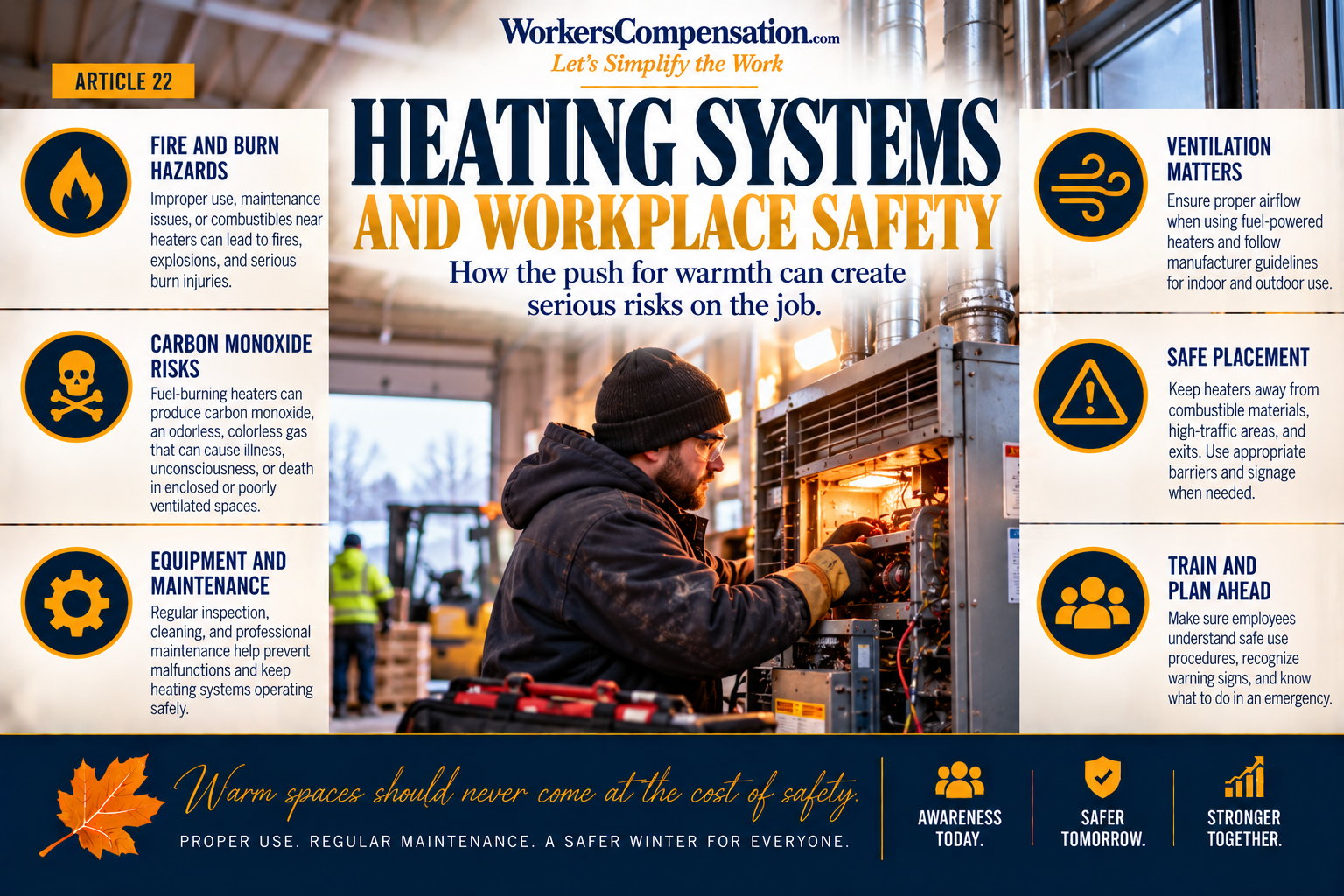
Welcome to The Science Behind Workplace Injuries: Fall Safety Series, where we explore how seasonal conditions interact with human physiology, behavior, and workplace systems. Yesterday, we examined the predictable risk created when seasonal employees enter unfamiliar jobs during accelerating holiday production. Today, another transition begins inside workplaces as furnaces and boilers restart, temporary heaters appear, and doors and windows close against colder air. Autumn is not the peak season for heating fires or occupational carbon monoxide fatalities; winter holds that distinction. Autumn matters because many of the conditions that determine winter outcomes are created now. Heating safety begins before the coldest weather arrives.
The Larger Worker Hazard May Be Invisible
Fire is the obvious concern when combustion equipment returns to service, but occupational research points toward another serious heating-season hazard: carbon monoxide. Scott Henn and colleagues examined national occupational fatality data from 1992 through 2008 and identified 374 unintentional, non-fire carbon monoxide deaths, averaging approximately 22 each year. The winter fatality rate was 2.3 times the summer rate. Furnaces, heaters, and boilers accounted for 14% of the deaths, while vehicles and generators contributed substantially as well. Cold weather changes more than heating use. Buildings close, work areas become enclosed, and combustion equipment that operated safely with greater ventilation may suddenly share air with workers.
Washington workers' compensation data demonstrate why the hazard should not be limited conceptually to furnaces. Carolyn Reeb-Whitaker and colleagues identified 345 occupational carbon monoxide claims arising from 221 incidents between 2000 and 2005. Fuel-powered forklifts were the leading source of incidents, followed closely by motor vehicles. Heating season can therefore amplify exposure from equipment that has operated all year because the surrounding environment has changed. Closing dock doors, enclosing work areas, hanging temporary barriers, or reducing outside-air exchange can transform the same combustion source into a different exposure. The equipment may be familiar while the conditions around it are no longer the same.
Carbon Monoxide Defeats Human Perception
Carbon monoxide is particularly dangerous because the human body provides no reliable environmental warning before exposure. The gas has no color, smell, or taste, and early symptoms such as headache, nausea, dizziness, weakness, and fatigue resemble ordinary illness. Paul Heckerling studied patients arriving at an emergency department with headaches during winter heating season and found 18.9% had carboxyhemoglobin levels above 10%. Neither the patients nor their physicians had suspected carbon monoxide poisoning before testing identified it. In a workplace, the same misattribution can become “the flu is going around” or “everyone is tired,” allowing exposure to continue while workers search for the wrong explanation.
The shared nature of symptoms can become important information. When several people working in the same space develop headaches, dizziness, or nausea around the same time, the pattern deserves environmental consideration. Solo workers lose that social cue entirely, which makes objective detection even more important in enclosed or mobile environments where combustion sources operate. As exposure increases, carbon monoxide can also produce confusion and weakness, impairing the very abilities a worker needs to recognize danger and leave. A safety system built around someone noticing that something feels wrong is poorly matched to a hazard that interferes with perception and judgment. Invisible hazards require engineered ways to see them.
Autumn Is the Time to Manage the Change
Seasonal heating startup is best understood as a management-of-change event. Equipment that has been dormant returns to service. Burners may have been repaired or replaced. Rental heaters arrive at temporary worksites. Ventilation patterns change as buildings are sealed, and portable heating equipment may be placed near materials that were never stored around a heat source during summer. A Wisconsin investigation illustrates how quickly those variables can combine: workers were exposed to carbon monoxide in an industrial food facility only days after burners had been replaced on gas-fired equipment, with inadequate ventilation contributing to the event. The lesson extends beyond one facility because equipment changes and environmental changes deserve verification before normal operations resume.
Fire prevention belongs in the same seasonal review. U.S. Fire Administration data show heating accounts for a modest share of nonresidential building fires overall, although its contribution is greater in settings such as manufacturing. Keeping heat sources separated from combustible materials, inspecting heating equipment and venting, controlling temporary heaters, and verifying smoke detection and suppression systems remain important controls. Carbon monoxide prevention adds another layer: inspect combustion equipment, verify ventilation after buildings are closed for cold weather, control indoor use of fuel-powered equipment, and use appropriate monitoring where exposure can occur. The objective is to identify what changed before workers become the indicator that something went wrong.
Heating-related injuries are relatively uncommon, which makes preparation easy to postpone. Their rarity also makes seasonal planning valuable because organizations can address predictable conditions without waiting for frequent events to justify action. Autumn provides time to inspect, test, repair, ventilate, detect, and communicate before winter increases exposure. The most important safety decision may happen weeks before anyone turns a thermostat higher or brings a temporary heater onto a jobsite. Risk can be built in one season and realized in another, which means prevention should follow the conditions creating the hazard rather than the calendar recording the injury.
Tomorrow in The Science Behind Workplace Injuries: Fall Safety Series — Roof Maintenance Before Snow. We will examine why the safest time to address winter roof hazards is before snow and ice conceal conditions, increase loads, and make access more difficult.
Research Referenced
Heckerling, P. S. (1987). Occult carbon monoxide poisoning: A cause of winter headache. The American Journal of Emergency Medicine, 5(3), 201–204. doi:10.1016/0735-6757(87)90320-2
Henn, S. A., Bell, J. L., Sussell, A. L., & Konda, S. (2013). Occupational carbon monoxide fatalities in the US from unintentional non-fire related exposures, 1992–2008. American Journal of Industrial Medicine, 56(11), 1280–1289. doi:10.1002/ajim.22226
Reeb-Whitaker, C. K., Bonauto, D. K., Whittaker, S. G., & Adams, D. (2010). Occupational carbon monoxide poisoning in Washington State, 2000–2005. Journal of Occupational and Environmental Hygiene, 7(10), 547–556. doi:10.1080/15459624.2010.488210
Wilson, E., Tomasallo, C., & Meiman, J. (2018). Notes from the Field: Occupational carbon monoxide exposure in an industrial kitchen facility—Wisconsin, 2017. Morbidity and Mortality Weekly Report, 67(28), 786. doi:10.15585/mmwr.mm6728a5


AI best practices california case file caselaw case management case management focus claims compensability compliance compliance corner courts do you know the rule employers exclusive remedy florida fraud glossary check Healthcare hr homeroom insurance insurers iowa kentucky leadership NCCI new jersey new york ohio pennsylvania Safety safety at work state info tech technology the case manager violence WDYT what do you think women's history women's history month workers' comp 101 workers' recovery Workplace Safety Workplace Violence
Read Also
About The Author
About The Author
-
Claire Muselman
Meet Dr. Claire C. Muselman, the Chief Operating Officer at WorkersCompensation.com, where she blends her vast academic insight and professional innovation with a uniquely positive energy. As the President of DCM, Dr. Muselman is renowned for her dynamic approach that reshapes and energizes the workers' compensation industry. Dr. Muselman's academic credentials are as remarkable as her professional achievements. Holding a Doctor of Education in Organizational Leadership from Grand Canyon University, she specializes in employee engagement, human behavior, and the science of leadership. Her diverse background in educational leadership, public policy, political science, and dance epitomizes a multifaceted approach to leadership and learning. At Drake University, Dr. Muselman excels as an Assistant Professor of Practice and Co-Director of the Master of Science in Leadership Program. Her passion for teaching and commitment to innovative pedagogy demonstrate her dedication to cultivating future leaders in management, leadership, and business strategy. In the industry, Dr. Muselman actively contributes as an Ambassador for the Alliance of Women in Workers’ Compensation and plays key roles in organizations such as Kids Chance of Iowa, WorkCompBlitz, and the Claims and Litigation Management Alliance, underscoring her leadership and advocacy in workers’ compensation. A highly sought-after speaker, Dr. Muselman inspires professionals with her engaging talks on leadership, self-development, and risk management. Her philosophy of empathetic and emotionally intelligent leadership is at the heart of her message, encouraging innovation and progressive change in the industry. "Empowerment is key to progress. By nurturing today's professionals with empathy and intelligence, we're crafting tomorrow's leaders." - Dr. Claire C. Muselman
More by This Author
Read More
- Oct 12, 2026
- Anne Llewellyn
- Oct 12, 2026
- Claire Muselman
- Oct 11, 2026
- Frank Ferreri
- Oct 11, 2026
- Anne Llewellyn
- Oct 10, 2026
- Claire Muselman
- Oct 10, 2026
- Frank Ferreri