


Share This Article:
Fall Into Safety
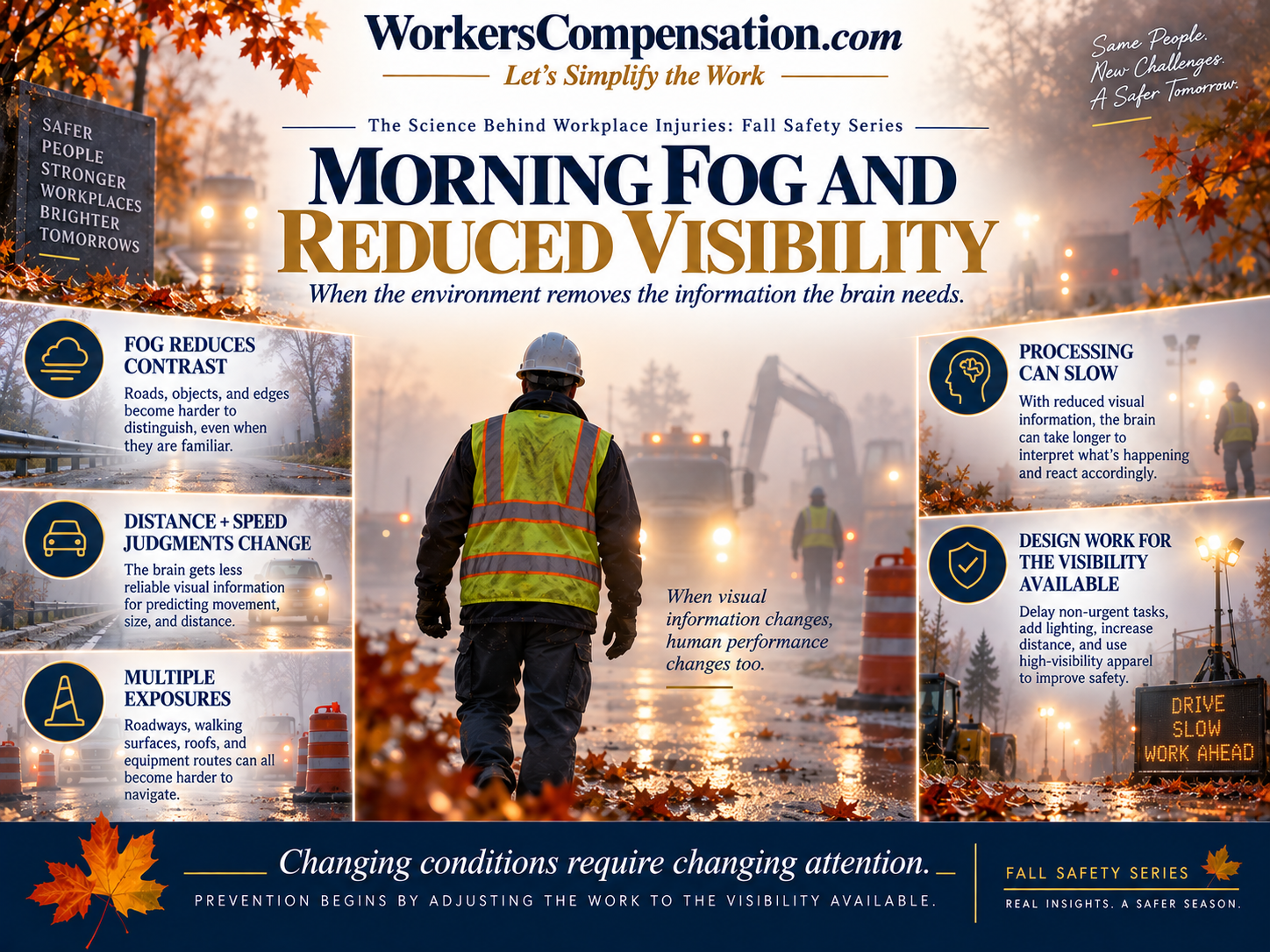
Welcome to The Science Behind Workplace Injuries: Fall Safety Series, where we explore how seasonal conditions interact with human physiology, behavior, and workplace systems. Today, we examine morning fog and what happens to human performance when the visual information we normally use to navigate the world becomes harder to interpret.
Morning fog changes a familiar workplace quickly. Roads disappear into haze, equipment becomes harder to distinguish, roof edges lose definition, and approaching vehicles emerge with less warning. Autumn creates favorable conditions for radiation fog because longer nights allow more time for the ground to cool while moisture remains available near the surface. Steam fog can also develop when colder air moves over lakes, rivers, or moist ground that still retains summer warmth. The result can place workers inside a visually altered environment at the beginning of the workday, when construction, transportation, agriculture, utilities, delivery operations, and other outdoor work may already be underway.
Fog Changes the Information Reaching the Brain
Vision depends on more than the ability to identify an object. The brain uses contrast, depth, movement, edges, relative size, and changes across the visual field to estimate where objects are and how quickly they are moving. Fog scatters light and reduces contrast, with distant objects losing more contrast than nearby objects. That distance-dependent degradation changes the visual information the brain uses to calculate movement through space.
Alberto Pretto, Jean-Pierre Bresciani, Gerta Rainer, and Heinrich Bülthoff demonstrated how this affects speed perception in their research on movement through fog. Earlier work by Robert Snowden, N. Stimpson, and R. A. Ruddle also established that reductions in contrast influence perceived speed. The science becomes more nuanced because atmospheric fog and uniform contrast loss do not necessarily produce the same perceptual error. Atmospheric fog contains a depth-dependent pattern of contrast degradation, while a dirty windshield, fogged safety glasses, or uniformly hazy visual field can reduce contrast differently. The brain responds to the visual information it receives, which means two environments that both seem “hard to see through” can affect speed perception differently.
Distance and speed judgments become especially relevant when objects are moving. Research by Alex Bosco, Roberta Actis-Grosso, and others examined time-to-contact estimation under impaired visual conditions and found contrast degradation interfered with people's ability to determine when an approaching object would reach them. In a workplace, that calculation may involve an approaching vehicle, mobile equipment, a forklift, or another moving hazard. A worker does not need to consciously calculate distance divided by speed. The visual system continuously performs versions of that task in the background. Reduced contrast gives the brain less reliable information from which to make the prediction.
Reduced Visibility Can Slow Processing
Fog can also affect performance through the cognitive demands created by degraded visual information. Joanne Wood, Alex Chaparro, Kaarin Anstey, and other researchers used simulated visual degradation to examine performance on standard cognitive tasks. Young adults with no underlying visual impairment became slower on measures involving processing speed and executive function when visual contrast was reduced. Accuracy was often preserved because participants compensated by taking more time. Similar research involving older adults found cognitive slowing under simulated visual impairment as well.
That distinction between speed and accuracy matters in occupational settings. An employee completing a task at a desk may have time to slow down and preserve accuracy. A worker interacting with moving equipment, crossing a roadway, navigating an elevated surface, or responding to an unexpected event may have a narrower window for action. The brain may still reach the correct interpretation, yet the additional processing time can matter when the environment continues moving while that interpretation occurs. Visual degradation therefore has implications for both seeing the hazard and processing what the available visual information means.
Walking and balance also depend on vision. The nervous system combines visual information with vestibular and proprioceptive input to maintain posture and guide movement. Research examining degraded lighting and visual conditions has found changes in gait velocity, stride, and postural control as people compensate for reduced visual information. Those adaptations become more consequential on stairs, slopes, uneven terrain, roofs, and surfaces where morning dew has already reduced traction. Fog can therefore coincide with another autumn condition that changes the physical environment beneath the worker's feet.
Outdoor Work Creates Multiple Exposures
Construction illustrates how these conditions can converge. Bureau of Labor Statistics and OSHA data show 389 of 1,034 construction fatalities in 2024 resulted from falls to a lower level. Roofers face substantial fall exposure, and research examining cross-slope roof walking has documented changes in gait, ankle position, and postural control simply from moving across an inclined surface. Add reduced contrast, morning dew, and limited visibility of roof edges or surrounding conditions, and several independent demands on human performance can occur during the same task. Current occupational databases do not identify fog as the cause of those falls, so attributing construction fall statistics directly to fog would exceed the evidence. The data instead establish the severity of the underlying occupational exposure to which poor visibility can add another demand.
Transportation research provides more direct evidence about fog. Walker Ashley, Stephen Strader, Douglas Dziubla, and Alex Haberlie examined weather-related vision hazards and fatal motor vehicle crashes and found fatalities associated with vision-obscuring weather such as fog, smoke, and dust represented an underrecognized transportation hazard. Earlier U.S. data attributed nearly 39,000 crashes, 16,000 injuries, and 630 deaths to fog or fog combined with precipitation between 1995 and 2005. Naturalistic driving research by Md Nasim Khan, Ali Ghasemzadeh, and Mohamed Ahmed found drivers reduced speed by approximately 10 percent in near fog and only 3 percent in distant fog. Those behavioral adjustments may not fully compensate for the reduction in stopping sight distance created by poor visibility.
Agriculture presents another autumn-specific example. Harvest increases the movement of tractors, combines, trucks, and other equipment on rural roads while daylight decreases and morning fog can reduce visibility. Transportation incidents remain a major source of fatal injury for farmers and farmworkers. Drivers approaching slow-moving agricultural equipment may have less visual information available to recognize the vehicle, estimate its speed, and determine closing distance. The worker operating that equipment faces the same degraded environment from the opposite perspective. Visibility becomes a shared safety condition across people performing different tasks within the same roadway system.
Design Work for the Visibility Available
Morning fog is temporary, which gives organizations options beyond asking employees to compensate individually. High-risk elevated, roadway, or mobile-equipment tasks can sometimes be delayed or resequenced until visibility improves. Supplemental lighting can improve contrast in work areas. High-visibility apparel meeting ANSI/ISEA 107 standards can increase worker conspicuity around traffic and equipment. Dew-prone surfaces can be assessed alongside visibility because seeing less while walking on a surface with reduced friction compounds the demands placed on balance. Pre-task planning can also account for actual conditions at the beginning of the shift rather than assuming yesterday's work environment still exists.
Supervisors have a role in determining whether the conditions support the work being assigned. Visibility can be assessed before crews move onto roofs, roadways, elevated surfaces, or equipment routes. Workers can be given additional distance and time around moving vehicles and machinery when contrast is reduced. Safety systems can also account for fogged eyewear and windshields because uniform contrast loss may alter perception differently from atmospheric fog. These actions recognize that human beings can compensate for degraded visual information, although compensation has limits when multiple hazards demand attention at the same time.
Morning fog demonstrates how much workplace safety depends on information. The brain uses visual input to predict movement, judge distance, maintain balance, navigate terrain, and decide when to act. When fog removes or distorts part of that information, people continue making those decisions with a less complete picture of the environment. Human performance depends on the quality of the information available to the person performing the work. Prevention begins by recognizing when the environment has reduced that information and adjusting the work accordingly.
Tomorrow in The Science Behind Workplace Injuries: Fall Safety Series - Wind Hazards for Outdoor Workers. Wind can change the forces acting on people, equipment, materials, vehicles, and elevated work within seconds. We examine how gusts affect balance, lifting, falling objects, equipment stability, and the decisions workers make when conditions refuse to stay constant.
Research Referenced
Ashley, W. S., Strader, S., Dziubla, D. C., & Haberlie, A. (2015). Driving blind: Weather-related vision hazards and fatal motor vehicle crashes. Bulletin of the American Meteorological Society, 96(5), 755–778. https://doi.org/10.1175/BAMS-D-14-00026.1
Pretto, P., Bresciani, J.-P., Rainer, G., & Bülthoff, H. H. (2012). Foggy perception slows us down. eLife, 1, e00031. https://doi.org/10.7554/eLife.00031
Wood, J. M., Chaparro, A., Anstey, K. J., Hsing, Y. E., Johnsson, A. K., Morse, A. L., &
Wainwright, S. E. (2009). Impact of simulated visual impairment on the cognitive test performance of young adults. British Journal of Psychology, 100(3), 593–602. https://doi.org/10.1348/000712608X374723


AI best practices california case file caselaw case management case management focus claims compensability compliance compliance corner courts do you know the rule employers exclusive remedy florida fraud glossary check Healthcare hr homeroom insurance insurers iowa kentucky leadership NCCI new jersey new york ohio pennsylvania Safety safety at work state info tech technology the case manager violence WDYT what do you think women's history women's history month workers' comp 101 workers' recovery Workplace Safety Workplace Violence
Read Also
- Sep 22, 2026
- Frank Ferreri
- Sep 22, 2026
- Chris Parker
About The Author
About The Author
-
Claire Muselman
Meet Dr. Claire C. Muselman, the Chief Operating Officer at WorkersCompensation.com, where she blends her vast academic insight and professional innovation with a uniquely positive energy. As the President of DCM, Dr. Muselman is renowned for her dynamic approach that reshapes and energizes the workers' compensation industry. Dr. Muselman's academic credentials are as remarkable as her professional achievements. Holding a Doctor of Education in Organizational Leadership from Grand Canyon University, she specializes in employee engagement, human behavior, and the science of leadership. Her diverse background in educational leadership, public policy, political science, and dance epitomizes a multifaceted approach to leadership and learning. At Drake University, Dr. Muselman excels as an Assistant Professor of Practice and Co-Director of the Master of Science in Leadership Program. Her passion for teaching and commitment to innovative pedagogy demonstrate her dedication to cultivating future leaders in management, leadership, and business strategy. In the industry, Dr. Muselman actively contributes as an Ambassador for the Alliance of Women in Workers’ Compensation and plays key roles in organizations such as Kids Chance of Iowa, WorkCompBlitz, and the Claims and Litigation Management Alliance, underscoring her leadership and advocacy in workers’ compensation. A highly sought-after speaker, Dr. Muselman inspires professionals with her engaging talks on leadership, self-development, and risk management. Her philosophy of empathetic and emotionally intelligent leadership is at the heart of her message, encouraging innovation and progressive change in the industry. "Empowerment is key to progress. By nurturing today's professionals with empathy and intelligence, we're crafting tomorrow's leaders." - Dr. Claire C. Muselman
More by This Author
Read More
- Sep 22, 2026
- Frank Ferreri
- Sep 22, 2026
- Chris Parker
- Sep 22, 2026
- Claire Muselman
- Sep 22, 2026
- Frank Ferreri
- Sep 21, 2026
- Claire Muselman
- Sep 21, 2026
- Frank Ferreri