


Share This Article:
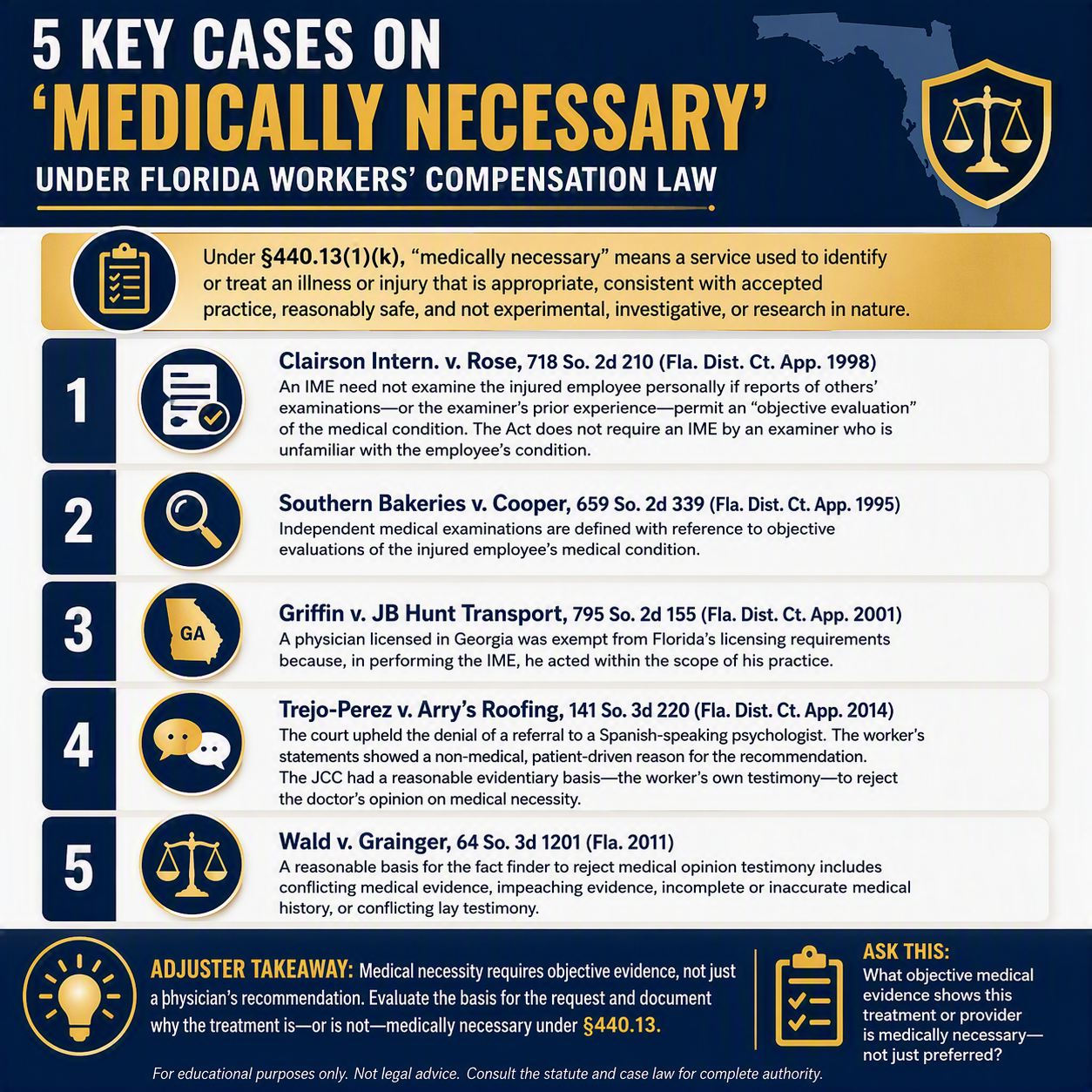
5 Key Cases on ‘Medically Necessary’ Under Fla. Workers’ Compensation Law
22 Sep, 2026 Frank Ferreri
Key Cases
Under Florida Statutes Sec. 440.13(1)(k), "medically necessary" or "medical necessity" is defined as any medical service or medical supply which is used to identify or treat an illness or injury, is appropriate to the patient’s diagnosis and status of recovery, and is consistent with the location of service, the level of care provided, and applicable practice parameters. The service should be widely accepted among practicing health care providers, based on scientific criteria, and determined to be reasonably safe. The service must not be of an experimental, investigative, or research nature.
Here's snapshot at how Florida courts have understood that definition.
Clairson Intern. v. Rose, 718 So. 2d 210 (Fla. Dist. Ct. App. 1998). An independent medical examiner need not examine the injured employee personally if reports of others' examinations—or the examiner's own prior experience with the injured employee—permit "objective evaluation" of the medical condition. The Workers' Compensation Law defines an independent medical examination as "an objective evaluation of the injured employee's medical condition." § 440.13(1)(k), Fla. Stat. (Supp.1994). Nothing in the Act requires that an independent medical examination be performed by an examiner who is not already familiar with the injured employee's medical condition. § 440.13(5)(a), Fla. Stat. (Supp.1994).
Southern Bakeries v. Cooper, 659 So. 2d 339 (Fla. Dist. Ct. App. 1995). Independent medical examinations are defined with reference to objective evaluations of the injured employee's medical condition.
Griffin v. JB Hunt Transport, 795 So. 2d 155 (Fla. Dist. Ct. App. 2001). A physician exempt from the licensing provisions in chapter 458 because he was licensed in Georgia and, in performing the IME, he acted within the scope of his practice.
Trejo-Perez v. Arry's Roofing, 141 So. 3d 220 (Fla. Dist. Ct. App. 2014). The worker challenged the denial of his request for referral to a Spanish-speaking psychologist as recommended by his authorized treating physician. He argued the Judge of Compensation Claims erred by denying the request despite unrebutted medical testimony that a Spanish-speaking psychologist was medically necessary. The court found that the worker's statements revealed a non-medical, patient-driven reason for the doctor's recommendation. The JCC found and articulated a reasonable evidentiary basis — the worker's own testimony — on which to reject the doctor's testimony as to the need for a Spanish-speaking psychologist.
Wald v. Grainger, 64 So.3d 1201 (Fla. 2011). A reasonable basis for the fact finder to reject medical opinion testimony can include conflicting medical evidence, evidence that impeaches the expert's testimony or calls it into question, such as the failure of the plaintiff to give the medical expert an accurate or complete medical history, or conflicting lay testimony or evidence that disputes the claim.
Practice Point
When reviewing requests for treatment, referrals, accommodations, or specialized providers, ask: Is the request medically necessary under §440.13, or is it primarily driven by the claimant's preference? Document objective evidence supporting or undermining the request, because medical opinions may be successfully challenged when the underlying rationale is not truly medical in nature.


AI best practices california case file caselaw case management case management focus claims compensability compliance compliance corner courts do you know the rule employers exclusive remedy florida fraud glossary check Healthcare hr homeroom insurance insurers iowa kentucky leadership NCCI new jersey new york ohio pennsylvania Safety safety at work state info tech technology the case manager violence WDYT what do you think women's history women's history month workers' comp 101 workers' recovery Workplace Safety Workplace Violence
Read Also
- Sep 22, 2026
- Claire Muselman
- Sep 22, 2026
- Chris Parker
About The Author
About The Author
-
Frank Ferreri
Frank Ferreri, M.A., J.D. covers workers' compensation legal issues. He has published books, articles, and other material on multiple areas of employment, insurance, and disability law. Frank received his master's degree from the University of South Florida and juris doctor from the University of Florida Levin College of Law. Frank encourages everyone to consider helping out the Kind Souls Foundation and Kids' Chance of America.
More by This Author
- Sep 22, 2026
- Frank Ferreri
- Sep 21, 2026
- Frank Ferreri
Read More
- Sep 22, 2026
- Claire Muselman
- Sep 22, 2026
- Chris Parker
- Sep 22, 2026
- Claire Muselman
- Sep 22, 2026
- Frank Ferreri
- Sep 21, 2026
- Claire Muselman
- Sep 21, 2026
- Frank Ferreri