


Share This Article:
Fall Into Safety
Welcome to The Science Behind Workplace Injuries: Fall Safety Series, where we explore how seasonal conditions interact with human physiology, behavior, and workplace systems. Today, we examine a hazard that can appear before winter coats, snowplows, and cold-weather routines return: the first frost.
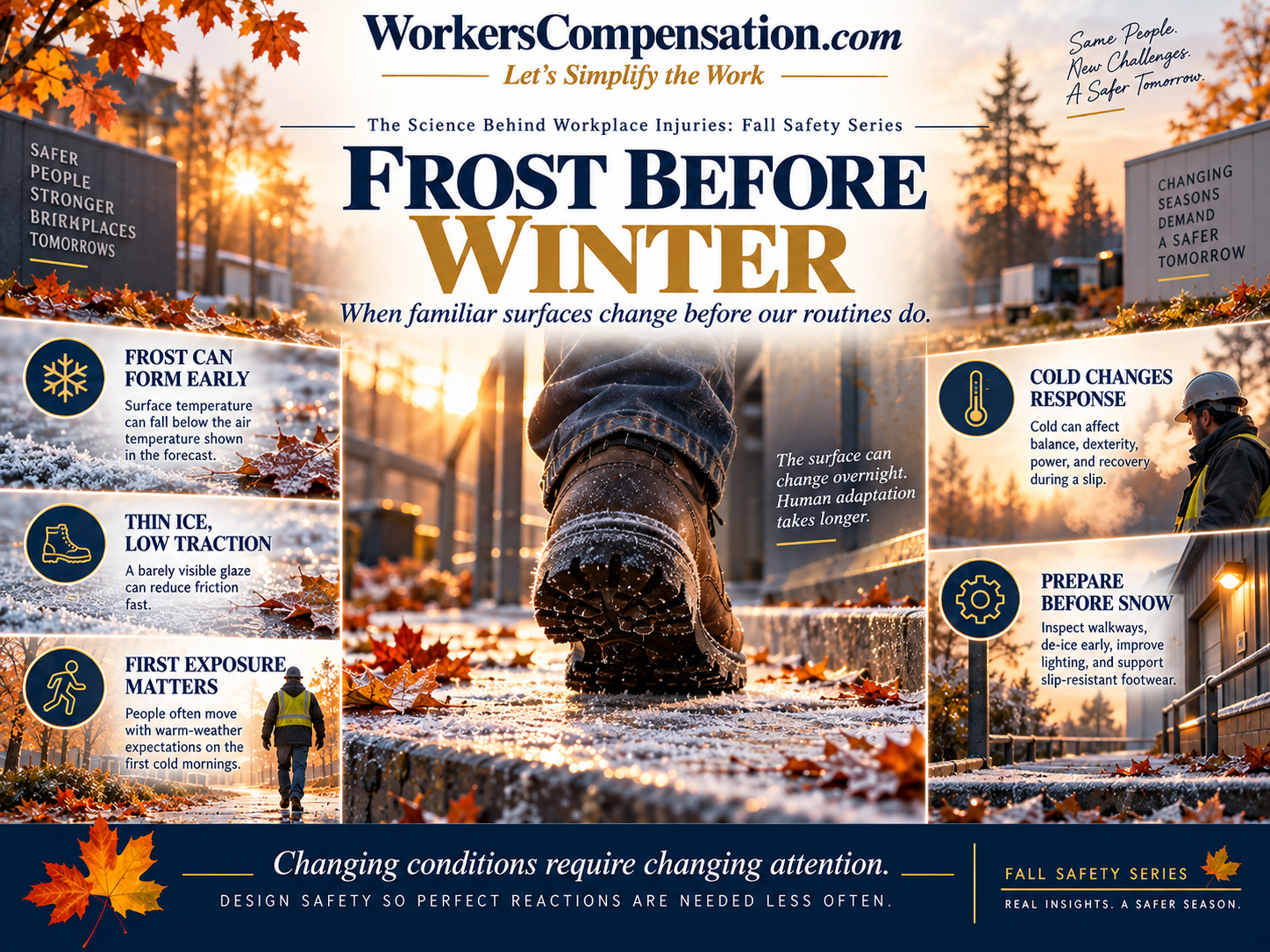
The first frost of autumn can be easy to underestimate. There may be no snow on the ground, no winter weather advisory, and no dramatic change in the landscape. Employees arrive at the same parking lot, use the same entrance, climb the same steps, and begin the same outdoor tasks they performed the day before. Yet the physical properties of those familiar surfaces may have changed overnight. At the same time, workers may have had little recent exposure to cold-weather conditions, creating a transition in which the environment has changed before behavior and physiology have fully adjusted.
Frost Can Arrive Before We Expect It
Frost formation begins with surface temperature rather than the air temperature displayed on a weather app. On clear and calm nights, the ground and other exposed surfaces lose heat through radiation. Those surfaces can cool enough for frost to form even when the measured air temperature several feet above the ground remains warmer. The National Weather Service recognizes this distinction in frost forecasting because surface conditions can differ from standard air-temperature measurements. A forecast that appears comfortably above freezing may therefore coexist with frost on pavement, vehicles, roofs, equipment, bridges, or other exposed surfaces.
The friction science makes early-season frost more interesting. Research on winter footwear and icy surfaces shows ice near its melting point can be especially slippery because a thin layer of liquid water can form at the interface between footwear and ice. Autumn freeze-thaw conditions frequently hover near this temperature range. A barely visible glaze on a walkway can therefore produce poor traction without the visual cues associated with deep snow or prolonged winter weather. Workers may be navigating a surface with substantially reduced available friction while the surrounding environment still looks like fall.
Slip mechanics depend on the relationship between the friction required by a person's gait and the friction available between footwear and the walking surface. James Hanson, Mark Redfern, and Malay Mazumdar demonstrated that slip probability rises as available friction falls below the amount required for the movement being performed. Chuansi Gao and Jack Abeysekera later examined icy and snowy surfaces from a systems perspective and showed how footwear, gait, age, surface conditions, and human responses interact. Frost can change one part of that system almost overnight while the worker approaches the surface using a movement pattern developed under different conditions.
First Exposure Matters
The first cold-weather event of the season deserves attention because people adapt through experience. Evidence from several areas of research suggests initial exposure to a seasonal hazard can produce different outcomes from later exposure to similar conditions. Daniel Eisenberg and Kenneth Warner examined U.S. motor vehicle data and found the first snowy day of the season had a 14 percent higher fatal-crash rate than an average snowy day. Among drivers age 65 and older, the difference reached 34 percent. Other transportation research has found substantial crash concentrations during the first day of snow accumulation.
Laboratory research on slips reveals a similar adaptation process. When people experience an unexpected slip, the nervous system learns from the perturbation and modifies subsequent movement. Research on reactive balance has found the first exposure can produce greater difficulty than repeated exposures because later attempts benefit from adaptation. Gao and Abeysekera also reported that experience living in cold climates or participating in winter activities was associated with fewer falls on icy surfaces. These findings come from different research settings and should not be treated as proof of a universal “first frost effect,” yet together they demonstrate how prior exposure can shape human response to changing conditions.
This has practical implications for workplace safety. A worker crossing an icy loading dock in February may have spent months adjusting stride length, speed, footwear, visual scanning, and expectations to winter conditions. That same worker encountering frost for the first time in October may still be moving according to a warm-weather mental model. The surface looks familiar, the route feels familiar, and the body's movement pattern reflects previous experience. Early-season risk therefore involves more than the presence of frost. It includes the transition between what the worker expects and what the environment now requires.
Cold Changes the Body's Ability to Respond
Surface friction determines whether a slip begins, while the body's response influences whether balance can be recovered. Cold exposure can affect that response before a worker experiences severe cold stress. Research by Ulf Bergh and Björn Ekblom found muscle temperature was related to strength and power, with cooling reducing physical performance. Other research has found local cooling can increase tendon stiffness and slow muscle-fiber conduction. These changes matter during a slip because recovery requires the body to detect instability and generate rapid corrective movement.
Brian Maki and William McIlroy's research on reactive balance describes the rapid change-in-support responses people use after losing stability. A corrective step, arm movement, or grasp may occur within fractions of a second as the nervous system attempts to regain control. Aging can reduce the speed and effectiveness of these responses, making recovery more difficult for some workers. Occupational research also shows older workers can experience more severe consequences and longer recovery following injuries even when their overall injury frequency is lower. Frost therefore presents a useful example of how the same environmental exposure can produce different outcomes depending on the person's physical capacity to respond.
Cold can influence cognition and dexterity as well. Controlled climate-chamber studies have documented declines in manual dexterity, selective attention, visual perception, and short-term memory during cold exposure. One study found manual dexterity decreased 13.6 percent at −10°C compared with 24°C. Work intensity can modify some of these effects because physical activity generates heat, demonstrating that exposure, workload, clothing, task demands, and physiology interact. The occupational evidence remains limited by relatively small laboratory samples, yet the findings reinforce an important point: cold exposure can alter human performance across several systems at once.
Prepare for the Transition
National injury surveillance does not isolate first-frost incidents as a separate category. U.S. occupational injury research instead shows falls, slips, and trips peak during winter, with January producing the highest rates in one analysis of emergency-department-treated occupational injuries from 2012 through 2019. Autumn marks the beginning of the transition toward those conditions. For employers, waiting for snow before activating cold-weather prevention can miss the period when frost, thin ice, unfamiliarity, and changing physiology begin affecting work.
Prevention can begin with the environment. Walkways and parking areas can be inspected when overnight conditions favor frost rather than relying only on daytime forecasts. De-icing protocols, drainage, lighting, slip-resistant footwear, and scheduling can reduce exposure before employees have to compensate through balance and reaction speed. A 2022 systematic review led by Johnny Dyreborg found workplace safety interventions operating at organizational and engineering levels generally produced more consistent injury reductions than approaches focused only on changing individual behavior. Timely warnings can still help workers recalibrate their expectations, especially during the first cold mornings, but communication works best when the workplace has already addressed the condition employees are being warned about.
Frost before winter illustrates why seasonal transitions matter. The surface can cool before the forecast looks alarming, traction can deteriorate before ice becomes obvious, and human movement can continue reflecting conditions that existed yesterday. Cold may simultaneously narrow the body's ability to recover when a slip occurs. Prevention begins before a seasonal hazard feels familiar enough to demand our attention. Preparing for the first frost recognizes that adaptation takes time while the environment can change overnight.
Tomorrow in The Science Behind Workplace Injuries: Fall Safety Series - Morning Fog and Reduced Visibility. Fog changes how far ahead we can see while the brain continues making decisions about speed, distance, movement, and approaching hazards. We examine the science of visibility and what happens to human perception when the environment removes information the brain normally uses to predict what comes next.
Research Referenced
Eisenberg, D., & Warner, K. E. (2005). Effects of snowfalls on motor vehicle collisions, injuries, and fatalities. American Journal of Public Health, 95(1), 120–124. https://doi.org/10.2105/AJPH.2004.048926
Gao, C., & Abeysekera, J. (2004). A systems perspective of slip and fall accidents on icy and snowy surfaces. Ergonomics, 47(5), 573- 598. https://doi.org/10.1080/00140130410081658718
Lundstrom, E. W., Hendricks, S. A., Marsh, S. M., Groth, C. P., Smith, G. S., & Bhandari, R. (2023). Temporal trends in occupational injuries treated in US emergency departments, 2012–2019. Injury Epidemiology, 10, 13. https://doi.org/10.1186/s40621-023-00423-y


AI california case file caselaw case management case management focus claims compensability compliance compliance corner courts covid do you know the rule employers exclusive remedy florida fraud glossary check Healthcare hr homeroom insurance insurers iowa kentucky leadership NCCI new jersey new york ohio pennsylvania Safety safety at work state info tech technology the case manager violence WDYT what do you think women's history women's history month workers' comp 101 workers' recovery Workplace Safety Workplace Violence
Read Also
About The Author
About The Author
-
Claire Muselman
Meet Dr. Claire C. Muselman, the Chief Operating Officer at WorkersCompensation.com, where she blends her vast academic insight and professional innovation with a uniquely positive energy. As the President of DCM, Dr. Muselman is renowned for her dynamic approach that reshapes and energizes the workers' compensation industry. Dr. Muselman's academic credentials are as remarkable as her professional achievements. Holding a Doctor of Education in Organizational Leadership from Grand Canyon University, she specializes in employee engagement, human behavior, and the science of leadership. Her diverse background in educational leadership, public policy, political science, and dance epitomizes a multifaceted approach to leadership and learning. At Drake University, Dr. Muselman excels as an Assistant Professor of Practice and Co-Director of the Master of Science in Leadership Program. Her passion for teaching and commitment to innovative pedagogy demonstrate her dedication to cultivating future leaders in management, leadership, and business strategy. In the industry, Dr. Muselman actively contributes as an Ambassador for the Alliance of Women in Workers’ Compensation and plays key roles in organizations such as Kids Chance of Iowa, WorkCompBlitz, and the Claims and Litigation Management Alliance, underscoring her leadership and advocacy in workers’ compensation. A highly sought-after speaker, Dr. Muselman inspires professionals with her engaging talks on leadership, self-development, and risk management. Her philosophy of empathetic and emotionally intelligent leadership is at the heart of her message, encouraging innovation and progressive change in the industry. "Empowerment is key to progress. By nurturing today's professionals with empathy and intelligence, we're crafting tomorrow's leaders." - Dr. Claire C. Muselman
More by This Author
Read More
- Sep 22, 2026
- Frank Ferreri
- Sep 21, 2026
- Claire Muselman
- Sep 21, 2026
- Frank Ferreri
- Sep 19, 2026
- Claire Muselman
- Sep 19, 2026
- Chris Parker