


Share This Article:
Summer Safety Series
Welcome to The Science Behind Workplace Injuries: 30 Days of Summer Safety, where we explore the environmental hazards, human physiology, behavioral science, and organizational decisions shaping workplace safety. This article is part of our July series examining the science behind workplace injuries and the factors influencing workplace safety during the summer months.
Every experienced employee was once new. The first day carries far more than a new job title. It brings unfamiliar equipment, new coworkers, different expectations, safety procedures, work routines, and the natural desire to make a good impression. The brain works hard to organize new information while simultaneously performing productive work. Human performance during those first weeks looks very different from human performance after months or years of experience.
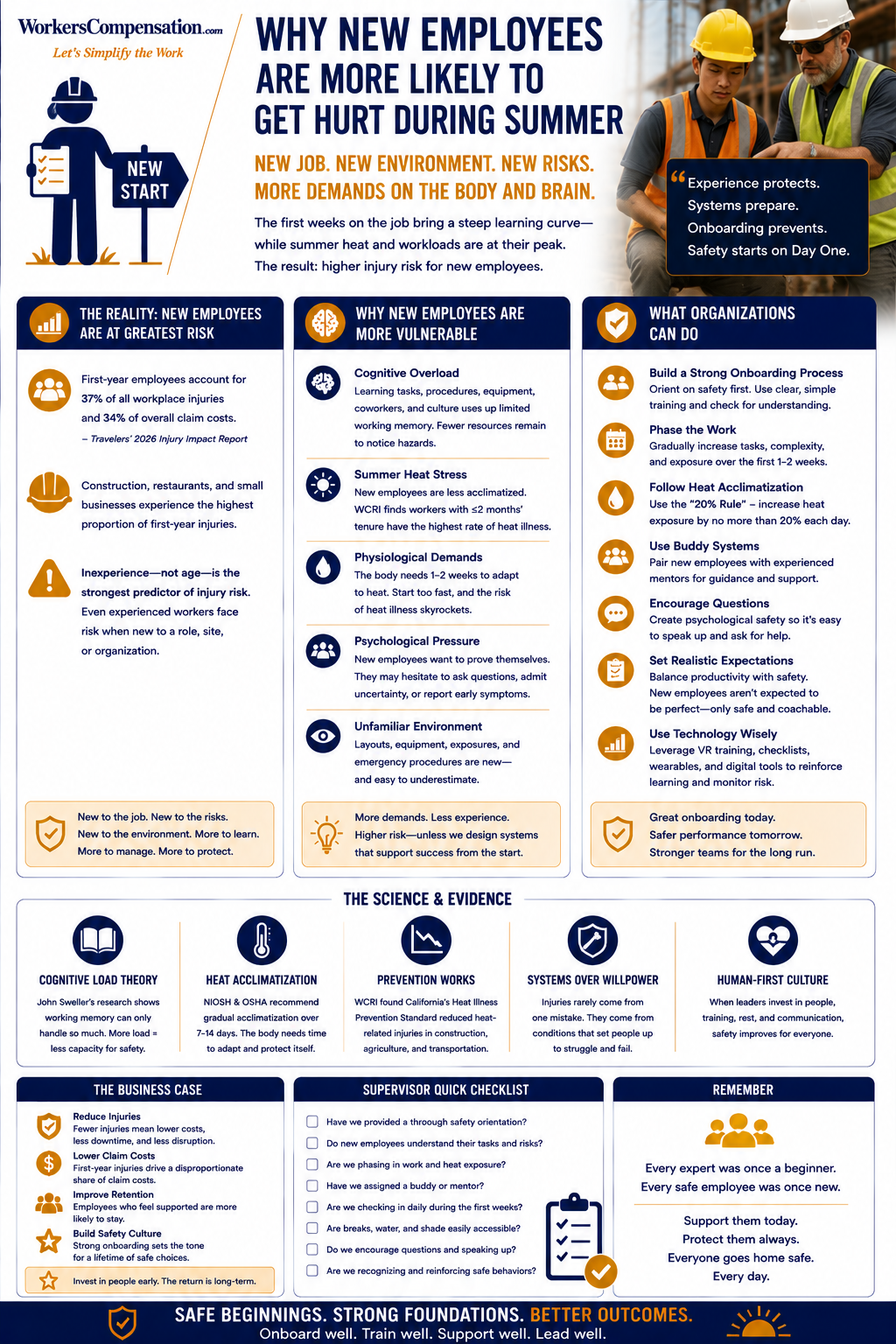
Workers' compensation data consistently reflect that reality. Travelers' 2026 Injury Impact Report, analyzing more than 1.2 million claims received between 2021 and 2025, found first-year employees accounted for approximately 37% of all workplace injuries and 34% of overall claim costs. Construction, restaurants, and small businesses experienced some of the highest proportions of first-year injuries. The common factor is newness, not age.
Researchers increasingly distinguish between youth and inexperience. Studies examining occupational injury risk conclude that being new to a specific job, organization, or work environment explains more injury risk than age alone. An experienced employee transferring into a new role often faces many of the same cognitive demands as someone entering the workforce for the first time. Newness changes how the brain processes information regardless of how many years someone has worked elsewhere.
Cognitive science helps explain why. John Sweller's Cognitive Load Theory proposes that working memory can process only a limited amount of new information at one time. New employees must simultaneously learn job tasks, safety procedures, equipment operation, workplace culture, communication patterns, and physical layouts. Each demand consumes part of the brain's available working memory. As cognitive load increases, fewer resources remain available for recognizing hazards, adapting to changing conditions, or anticipating risk. The challenge is not motivation. It is capacity.
Summer introduces another layer of complexity. Seasonal hiring increases across construction, landscaping, agriculture, hospitality, warehousing, and recreation precisely when environmental temperatures place greater physiological demands on the body. The Workers’ Compensation Research Institute (WCRI) found workers with two months or less of tenure experienced the highest rate of occupational heat illness, accounting for a disproportionate share of heat-related claims. New employees often begin physically demanding work before they have fully acclimatized to heat, developed efficient work routines, or gained confidence asking questions. Several independent risk factors begin interacting at the same time.
Heat acclimatization becomes one of the most important examples of that principle. Physiological adaptation does not happen automatically on the first day of work. NIOSH and OSHA recommend a gradual acclimatization process that progressively increases heat exposure over one to two weeks, often referred to as the "20% rule." During this period, the body expands plasma volume, improves sweating efficiency, reduces electrolyte loss, and becomes better equipped to regulate temperature. Those adaptations require time. Expecting a new employee to perform a full workload immediately asks the body to do work it has not yet been prepared to accomplish.
Psychology also influences new employee safety. Many people arrive eager to prove themselves, making them less likely to ask questions, request clarification, admit uncertainty, or report early signs of heat illness and fatigue. Optimism bias encourages people to believe serious injuries happen to someone else. At the same time, limited psychological safety can make new employees hesitate before speaking up because they want to be viewed as capable and dependable. The result is a worker managing physical strain, cognitive overload, and social pressure all at once.
Organizations can interrupt that cycle through thoughtful onboarding. Buddy systems, phased task assignments, shorter periods of heat exposure during the first weeks, realistic productivity expectations, and frequent supervisor check-ins all reduce unnecessary cognitive load while building confidence. Some employers are also incorporating virtual reality training, wearable heat-monitoring technology, and interactive simulations that allow employees to practice recognizing hazards before entering high-risk environments. Effective onboarding develops competence one step at a time rather than expecting mastery from the beginning.
Evidence demonstrates these efforts make a measurable difference. WCRI's evaluation of California's Heat Illness Prevention Standard found meaningful reductions in heat-related injuries across construction, agriculture, and transportation after requirements for water, shade, rest breaks, acclimatization, and emergency planning were implemented. Prevention succeeds when organizations recognize predictable human physiology and build systems that support it rather than expecting people to overcome it through determination alone.
Workers' compensation professionals benefit from viewing first-year injuries through this broader lens. A new employee's injury rarely reflects one poor decision. More often, it represents the interaction of unfamiliar work, environmental demands, cognitive overload, heat, incomplete acclimatization, and organizational systems. Understanding those contributing factors creates opportunities to improve onboarding, strengthen return-to-work planning, and prevent similar injuries for future employees. Better investigations lead to better prevention.
Every experienced employee began as a beginner. Organizations create safer workplaces when they recognize learning itself carries risk and design onboarding to match the way people acquire knowledge, adapt physiologically, and build confidence over time. The strongest organizations do not rush employees toward expertise. They create the conditions that allow expertise to develop safely.
Tomorrow in The Science Behind Workplace Injuries - Near Misses: The Warning Signs We Too Often Ignore. Every serious workplace injury is preceded by countless moments where something almost happened. Tomorrow, we explore why near misses are among the most valuable sources of safety information and how organizations can transform close calls into opportunities for learning rather than missed opportunities for prevention.


AI best practices california case file caselaw case management case management focus claims compensability compliance compliance corner courts do you know the rule employers exclusive remedy florida fraud glossary check Healthcare hr homeroom insurance insurers iowa kentucky leadership NCCI new jersey new york ohio pennsylvania Safety safety at work state info tech technology the case manager violence WDYT what do you think women's history women's history month workers' comp 101 workers' recovery Workplace Safety Workplace Violence
Read Also
About The Author
About The Author
-
Claire Muselman
Meet Dr. Claire C. Muselman, the Chief Operating Officer at WorkersCompensation.com, where she blends her vast academic insight and professional innovation with a uniquely positive energy. As the President of DCM, Dr. Muselman is renowned for her dynamic approach that reshapes and energizes the workers' compensation industry. Dr. Muselman's academic credentials are as remarkable as her professional achievements. Holding a Doctor of Education in Organizational Leadership from Grand Canyon University, she specializes in employee engagement, human behavior, and the science of leadership. Her diverse background in educational leadership, public policy, political science, and dance epitomizes a multifaceted approach to leadership and learning. At Drake University, Dr. Muselman excels as an Assistant Professor of Practice and Co-Director of the Master of Science in Leadership Program. Her passion for teaching and commitment to innovative pedagogy demonstrate her dedication to cultivating future leaders in management, leadership, and business strategy. In the industry, Dr. Muselman actively contributes as an Ambassador for the Alliance of Women in Workers’ Compensation and plays key roles in organizations such as Kids Chance of Iowa, WorkCompBlitz, and the Claims and Litigation Management Alliance, underscoring her leadership and advocacy in workers’ compensation. A highly sought-after speaker, Dr. Muselman inspires professionals with her engaging talks on leadership, self-development, and risk management. Her philosophy of empathetic and emotionally intelligent leadership is at the heart of her message, encouraging innovation and progressive change in the industry. "Empowerment is key to progress. By nurturing today's professionals with empathy and intelligence, we're crafting tomorrow's leaders." - Dr. Claire C. Muselman
More by This Author
Read More
- Sep 26, 2026
- Chris Parker
- Sep 26, 2026
- Frank Ferreri
- Sep 24, 2026
- Claire Muselman
- Sep 24, 2026
- Frank Ferreri
- Sep 24, 2026
- Claire Muselman
- Sep 24, 2026
- Anne Llewellyn