


Share This Article:
Fall Into Safety
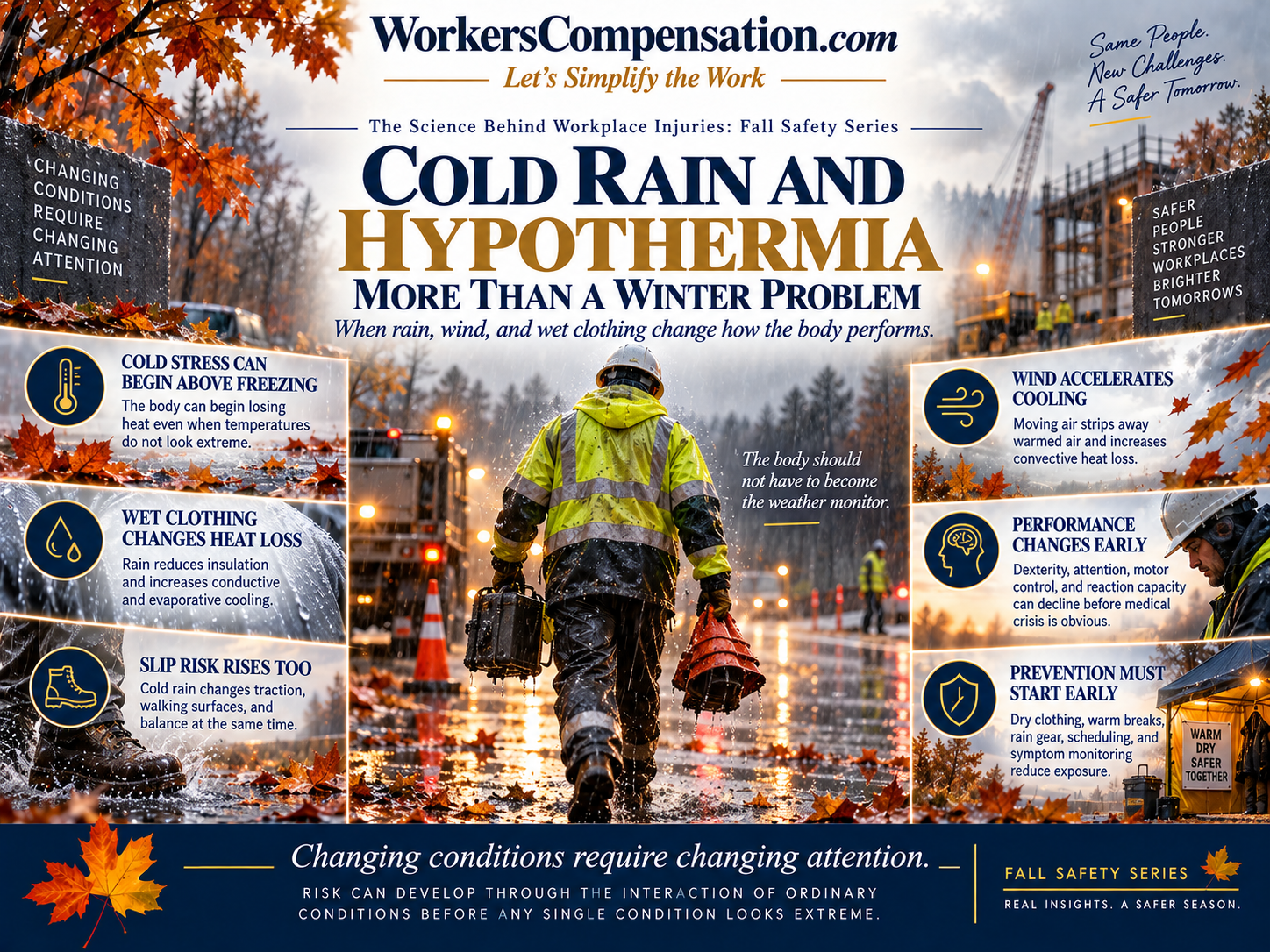
Welcome to The Science Behind Workplace Injuries: Fall Safety Series, where we explore how seasonal conditions interact with human physiology, behavior, and workplace systems. Today, we examine cold rain and a risk that often enters workplace conversations much later in the year: cold stress. Autumn can produce temperatures that feel uncomfortable without appearing extreme, especially when there is no snow or ice to signal the arrival of winter. Add rain, wind, wet clothing, prolonged exposure, and physical work, and the body's ability to maintain heat begins changing. The danger of cold exposure depends on the conditions surrounding the worker as much as the number displayed on the thermometer.
Cold Stress Can Begin Above Freezing
Hypothermia occurs when the body loses heat faster than it can produce it and core temperature falls below 95°F. The body initially responds by conserving heat through peripheral vasoconstriction, reducing blood flow to the skin and extremities while protecting the core. Shivering generates additional heat through muscular activity, but both responses come with physiological consequences. Hands and feet receive less warm blood, fine motor control can deteriorate, and the body begins using energy to defend core temperature while the worker is still expected to perform the job. These changes can begin before a person reaches clinical hypothermia.
Rain changes that equation because wetness increases heat loss. Clothing that normally traps insulating air can lose part of that protective function when saturated, while water against the skin increases conductive heat transfer. Evaporation adds another pathway for heat loss as moisture leaves the skin and clothing. Wind can accelerate the process by removing the thin layer of warmed air surrounding the body and increasing convective cooling. A cool, wet, windy autumn day can therefore place substantially different thermal demands on the body than the same air temperature under dry and calm conditions.
This is why cold stress cannot be managed by temperature alone. NIOSH notes that what constitutes cold stress varies by climate and that near-freezing temperatures can create cold-stress concerns in regions unaccustomed to winter weather. Cold-related injuries also include trench foot, which develops from prolonged exposure to wet and cold conditions and does not require freezing temperatures. The worker standing in wet boots, handling soaked materials, directing traffic in the rain, repairing a utility line, or completing deliveries may accumulate exposure over hours while the weather still looks relatively ordinary. The absence of snow does not tell us whether the body is losing heat.
Human Performance Changes Before Medical Crisis
Cold exposure becomes a workplace safety issue before someone reaches the point of a medical emergency. Peripheral vasoconstriction protects core temperature by reducing blood flow to the hands and feet, which can affect sensation and dexterity. Cooling also influences nerve and muscle function, making precise movements and rapid force production more difficult as tissue temperature falls. Tasks involving fasteners, tools, controls, ladders, steering, material handling, or emergency responses can become harder as the worker's physical capacity changes. The body may still be functioning while the margin available for accurate and efficient performance begins narrowing.
June Pilcher, Eric Nadler, and Caroline Busch examined temperature and human performance in a meta-analysis covering 22 studies and 515 effect sizes. They found both hot and cold exposure negatively affected performance across a range of cognitive tasks, with the effects varying according to exposure duration, task type, and other conditions. Cold exposures at 50°F or below produced the largest cold-related performance decrement in their analysis compared with neutral conditions. The research does not mean every worker exposed to 50°F weather will experience the same impairment because clothing, activity, acclimatization, wetness, wind, and exposure duration all matter. It does establish that temperature can become a human-performance variable well before we reach the dramatic cold associated with severe hypothermia.
Balance adds another consideration because preventing a fall requires sensory information and rapid muscular response. The nervous system integrates visual, vestibular, and proprioceptive input while the muscles continuously adjust posture and movement. Experimental cold research has documented changes in neuromuscular efficiency and postural control under colder exposures, although much of this literature uses temperatures below those experienced during a typical autumn rain. We should be careful about assuming the magnitude of those findings transfers directly to mild fall weather. The larger principle remains relevant: as the body cools, the same physiological systems needed to manipulate tools, respond to instability, and maintain balance can become less efficient.
The Claims Data Show the Interaction
Workers' compensation data give us a different way to examine the relationship because they capture injuries occurring during actual work rather than performance inside a laboratory. Patrick Coate, Casan Scott, and David Colón analyzed more than 2.3 million daily observations across 412 U.S. cities and 35 states for NCCI. Their analysis found both hot and cold temperatures were associated with increased workers' compensation claim frequency compared with mild conditions. The cold effect was particularly pronounced around freezing when precipitation was also present. The researchers controlled for several factors including location, month, year, and employment exposure, although the analysis remains observational and cannot prove weather caused each individual injury.
The slip-and-fall findings are particularly relevant to autumn. NCCI found wet days with daily highs between approximately 25°F and 40°F were associated with slip-and-fall claim frequencies 36 to 75 percent higher than the mild-weather baseline. Comparable dry days produced much smaller increases, demonstrating how dramatically precipitation changed the relationship. Motor vehicle claim frequency also increased during cold and wet conditions. The data reinforce something the physiology already suggests: risk often develops through interacting conditions rather than a single variable becoming extreme.
Industry differences make the findings even more useful. Transportation and warehousing showed substantial cold-related claim effects while construction, natural resources, and manufacturing sometimes experienced lower claim frequency during the coldest conditions. One plausible explanation identified by the researchers is exposure reduction because some outdoor work is curtailed when conditions become severe. That creates an important safety lesson for autumn because the highest practical exposure may occur during marginal conditions when the weather is unpleasant but work continues normally. Extreme weather often changes operations while ordinary-looking weather can leave the schedule untouched.
The Body Should Not Be the Weather Monitor
Cold-wet prevention works better when organizations decide how they will respond before workers begin showing symptoms. OSHA and NIOSH recommend scheduling cold work during warmer parts of the day when feasible, providing warm and dry areas for breaks, using appropriate protective clothing, monitoring workers for symptoms, and allowing employees to replace wet clothing. Employers can also evaluate temperature, precipitation, wind, task duration, workload, and access to shelter together rather than waiting for one predetermined temperature to trigger action. Footwear, drainage, mats, and walking-surface maintenance address the separate slip exposure created by rain. These controls recognize that the worker is navigating both a thermal environment and a physical one.
Supervisors also need enough discretion and organizational support to change the work when conditions deteriorate. A worker who becomes soaked early in a shift may have a very different exposure profile several hours later even if the temperature remains unchanged. Production pressure can make continuing seem reasonable because the rain is temporary, the job is almost finished, or the temperature does not appear particularly low. Clear expectations about dry clothing, warming opportunities, task rotation, and when work should be modified remove some of that decision burden from the moment. Prevention becomes more reliable when workers do not have to become cold enough to prove that conditions deserve attention.
Cold rain teaches us something broader about workplace risk. Temperature, wind, moisture, exposure time, clothing, workload, surface conditions, and individual physiology interact while the body continuously attempts to maintain thermal balance. Performance can begin changing before clinical illness becomes obvious, and injury data show meaningful increases when cold and precipitation occur together. Waiting for snow or extreme temperatures can therefore delay prevention until the environment has already been affecting workers for hours. Risk can develop through the interaction of ordinary conditions before any single condition looks extreme.
Tomorrow in The Science Behind Workplace Injuries: Fall Safety Series - Earlier Darkness and Commuting Safety. Autumn changes the workday even when schedules remain the same. Employees begin commuting, driving, loading, delivering, and completing outdoor work with less available daylight while the visual system works harder to identify people, objects, movement, and distance. Tomorrow, we examine what earlier darkness changes about visibility, reaction time, fatigue, and transportation risk.
Research Referenced
Coate, P., Scott, C., & Colón, D. (2024). Adverse weather and workers compensation claims. National Council on Compensation Insurance.
National Institute for Occupational Safety and Health. (2026). Cold and work: Types, causes, preparation. Centers for Disease Control and Prevention.
Pilcher, J. J., Nadler, E., & Busch, C. (2002). Effects of hot and cold temperature exposure on performance: A meta-analytic review. Ergonomics, 45(10), 682–698. https://doi.org/10.1080/00140130210158419


AI best practices california case file caselaw case management case management focus claims compensability compliance compliance corner courts do you know the rule employers exclusive remedy florida fraud glossary check Healthcare hr homeroom insurance insurers iowa kentucky leadership NCCI new jersey new york ohio pennsylvania Safety safety at work state info tech technology the case manager violence WDYT what do you think women's history women's history month workers' comp 101 workers' recovery Workplace Safety Workplace Violence
Read Also
About The Author
About The Author
-
Claire Muselman
Meet Dr. Claire C. Muselman, the Chief Operating Officer at WorkersCompensation.com, where she blends her vast academic insight and professional innovation with a uniquely positive energy. As the President of DCM, Dr. Muselman is renowned for her dynamic approach that reshapes and energizes the workers' compensation industry. Dr. Muselman's academic credentials are as remarkable as her professional achievements. Holding a Doctor of Education in Organizational Leadership from Grand Canyon University, she specializes in employee engagement, human behavior, and the science of leadership. Her diverse background in educational leadership, public policy, political science, and dance epitomizes a multifaceted approach to leadership and learning. At Drake University, Dr. Muselman excels as an Assistant Professor of Practice and Co-Director of the Master of Science in Leadership Program. Her passion for teaching and commitment to innovative pedagogy demonstrate her dedication to cultivating future leaders in management, leadership, and business strategy. In the industry, Dr. Muselman actively contributes as an Ambassador for the Alliance of Women in Workers’ Compensation and plays key roles in organizations such as Kids Chance of Iowa, WorkCompBlitz, and the Claims and Litigation Management Alliance, underscoring her leadership and advocacy in workers’ compensation. A highly sought-after speaker, Dr. Muselman inspires professionals with her engaging talks on leadership, self-development, and risk management. Her philosophy of empathetic and emotionally intelligent leadership is at the heart of her message, encouraging innovation and progressive change in the industry. "Empowerment is key to progress. By nurturing today's professionals with empathy and intelligence, we're crafting tomorrow's leaders." - Dr. Claire C. Muselman
More by This Author
Read More
- Oct 14, 2026
- Claire Muselman
- Oct 14, 2026
- Frank Ferreri
- Oct 13, 2026
- Claire Muselman
- Oct 13, 2026
- Frank Ferreri
- Oct 12, 2026
- Claire Muselman
- Oct 12, 2026
- Anne Llewellyn