


Share This Article:
Fall Into Safety
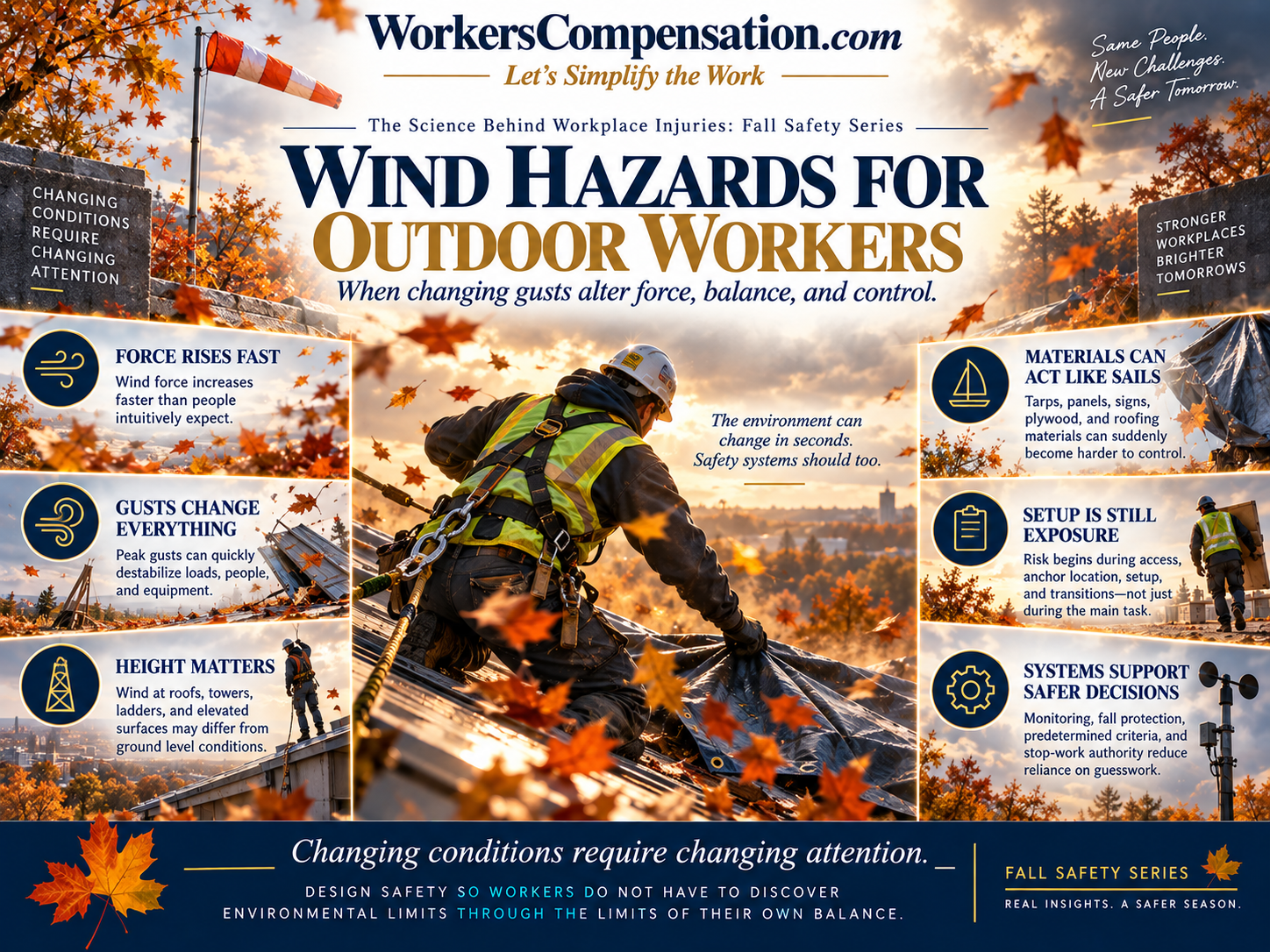
Welcome to The Science Behind Workplace Injuries: Fall Safety Series, where we explore how seasonal conditions interact with human physiology, behavior, and workplace systems. Today, we examine wind and why a condition that may feel manageable at ground level can become considerably more consequential when work moves upward, equipment begins moving, or a sudden gust changes the forces acting on a person. Wind changes speed, direction, and intensity while workers continue climbing ladders, carrying materials, operating equipment, trimming trees, repairing utilities, and working on roofs. Across much of the United States, wind patterns begin shifting during autumn toward the generally higher wind speeds associated with winter, although these patterns vary by region. Roofing, construction, harvest, utility work, tree care, and storm cleanup can place workers in environments where changing wind interacts with height, materials, equipment, and falling temperatures.
Wind Does Not Increase in a Straight Line
The physics of wind helps explain why conditions can change quickly. Aerodynamic drag is proportional to the square of wind velocity, which means the force created by moving air does not increase in a simple one-to-one relationship with wind speed. If wind speed doubles, aerodynamic force can increase approximately fourfold when the other variables remain constant. A change that sounds modest when described in miles per hour can produce a much larger change in the force acting on a worker, material, load, or piece of equipment. Human intuition tends to think about increasing conditions linearly, while the physical environment does not always behave that way.
Gusts add another dimension because average wind speed does not describe every moment a worker experiences. A piece of material may remain manageable during sustained wind and become difficult to control when a short gust rapidly increases the force acting across its surface. Plywood, roofing membrane, signs, tarps, panels, and other broad materials can effectively become sails as their surface area captures moving air. The worker may suddenly be responding to the movement of the material while simultaneously trying to stabilize their own body. The weight of an object therefore tells only part of the story when wind is acting on the load.
Wind engineering also distinguishes between mean wind speed and short-duration peak gusts because those peaks can create the forces most likely to destabilize people and objects. This matters for workplace decisions because a forecast describing average wind conditions can obscure the short periods when exposure becomes substantially greater. A crew can experience a relatively uneventful stretch of work followed by several seconds of force capable of shifting a load or disrupting balance. That variability makes wind different from hazards that remain relatively constant once identified. Conditions can move in and out of a worker's margin for control during the same task.
Height Changes What the Body Can Recover From
Wind exposure changes with elevation because surface friction slows moving air near the ground. As height increases, wind speeds generally increase through the atmospheric boundary layer, which means conditions experienced on a roof, tower, crane, or turbine can differ from what workers feel at ground level. Lejiang Yu and colleagues examined U.S. wind resources at 80 meters above ground and documented substantial seasonal and geographic variability, with winter generally producing higher wind speeds than summer across much of the country. Their findings also reinforce why regional differences matter when discussing autumn wind rather than assuming every part of the country experiences the same seasonal pattern. A ground-level observation can provide useful information while still failing to represent the worker's actual exposure at height.
The human body responds to wind as an external force that must be countered to maintain balance. Postural control depends on keeping the body's center of mass within a recoverable relationship to its base of support while the nervous system integrates visual, vestibular, and proprioceptive information. On level ground, a person can widen their stance, shift their weight, or take a corrective step when a gust disrupts stability. A ladder rung, scaffold, roof edge, utility pole, or structural beam provides considerably fewer options for that recovery. The same gust can therefore have a very different consequence depending on the worker's base of support and the environment surrounding them.
A Kentucky Fatality Assessment and Control Evaluation investigation demonstrates how quickly those conditions can converge. On a windy fall day, a 73-year-old roofer and his coworker climbed onto a commercial roof to determine where they would place their anchors before tying off. Investigators reported that an approximately 33-mph gust caused both workers to lose their balance and fall 15 feet 6 inches from the roof. One worker died from his injuries. The incident occurred during setup before the fall-protection system had been engaged, which makes the timing of the event particularly important for prevention.
That case raises a larger question about how organizations define the hazardous portion of a task. Exposure begins before the worker reaches the moment we traditionally label as “the work.” Employees position equipment, locate anchors, move materials, access elevated surfaces, set up tools, and transition into and out of protective systems. Those activities can involve the same environmental forces as the primary task while protections may still be incomplete. Safety planning has to account for the transitions surrounding the work because the environment does not wait for setup to be finished before creating exposure.
Experience Does Not Eliminate Risk Bias
Wind also creates decisions. Someone has to determine whether conditions remain acceptable, whether a gust was an isolated event, whether materials can still be controlled, and whether work should continue. Behavioral science gives us reason to examine those decisions carefully because people can recognize a hazard while still underestimating their own vulnerability to it. Optimism bias describes the tendency to believe negative outcomes are less likely to happen to us than to other people facing similar circumstances.
Siu Shing Man, Ruifeng Yu, Tingru Zhang, and Alan Hoi Shou Chan examined optimism bias, safety climate, and risk-taking among 183 construction workers. They found optimism bias related to personal work risks was associated with greater risk-taking behavior while safety climate was associated with reduced risk-taking. Their study examined construction risk generally rather than wind-specific decisions, so the findings should remain within that boundary. The research still offers a useful explanation for why knowledge of a hazard does not automatically produce conservative decisions when workers assess their own exposure. Experience, previous successful outcomes, production expectations, crew norms, and perceptions of personal skill can all become part of the decision about whether conditions remain manageable.
Past success can make these decisions even more complicated. A worker may have completed the same task in windy conditions dozens of times without an incident and may have developed legitimate skill in managing those conditions. Repeated success can also influence what begins to feel normal or acceptable. When a gust increases suddenly, the decision to stop may compete with a history suggesting the worker has handled similar conditions before. This is one reason safety systems benefit from objective information and predetermined decision structures rather than placing the entire burden on an individual standing in the hazard.
Move Wind Decisions into the System
There is no universal OSHA wind-speed limit covering every type of outdoor or elevated work. Specific OSHA standards establish numeric wind-related requirements for certain operations and equipment while other situations rely on competent-person assessments, manufacturer specifications, and site conditions. Treating one wind speed as a universal stop-work threshold can create false confidence because exposure changes with gusts, elevation, equipment, material surface area, and the work being performed. A number only becomes useful when it reflects the conditions and task to which it actually applies. Organizations need decision processes capable of accounting for those differences.
Real-time monitoring can improve those decisions by providing information closer to where the work occurs. Gusts can be considered alongside average speeds, manufacturer limitations can be incorporated into planning, and large-surface-area materials can be secured or moved before conditions deteriorate. Tree-care operations can evaluate wind as a force acting on limbs and trees as well as workers, while late-autumn planning can address wind chill as a separate physiological exposure created by accelerated heat loss. These controls reduce the number of decisions that have to be made through observation and intuition alone. Better information gives workers and supervisors a more accurate picture of the environment they are being asked to navigate.
Stop-work authority matters within that system because information has limited value when employees do not feel able to act on it. A policy may technically allow workers to stop a task while production pressure, crew expectations, or fear of being perceived as overly cautious sends a different message. Supervisors shape whether employees raise concerns when gusts increase or conditions at height differ from what everyone experienced during the morning briefing. Leadership becomes visible in the response to the person who says conditions have changed. When stopping work is treated as responsible decision-making rather than disruption, the organization creates room for environmental information to influence behavior before an injury occurs.
Wind offers a powerful example of why workplace risk cannot always be evaluated by how conditions feel in a single moment. Force can increase disproportionately as wind speed rises, gusts can create exposures hidden by averages, and elevation can reduce the body's available margin for recovery. Human judgment remains valuable while measurements, predetermined criteria, fall protection, competent-person oversight, and meaningful stop-work authority give that judgment better information and support. The worker should not have to discover the limits of a changing environment through the limits of their own balance. When environmental conditions can change within seconds, prevention has to be capable of changing with them.
Tomorrow in The Science Behind Workplace Injuries: Fall Safety Series - Cold Rain and Hypothermia Isn't Just a Winter Problem. Cold stress can begin without snow, ice, or subzero temperatures. Rain, wind, wet clothing, and falling temperatures change the body's ability to retain heat while work continues to demand movement, dexterity, attention, and judgment. Tomorrow, we examine what happens as the body works harder to maintain its core temperature and why a wet autumn day can become a physiological workplace hazard long before winter arrives.
Research Referenced
Kentucky Fatality Assessment and Control Evaluation Program. (2014). Roofer dies after gust of wind knocks him and a co-worker off roof. NIOSH FACE Report 13KY059. https://doi.org/10.26616/NIOSHSFACE13KY059
Man, S. S., Yu, R., Zhang, T., & Chan, A. H. S. (2022). How optimism bias and safety climate influence the risk-taking behavior of construction workers. International Journal of Environmental Research and Public Health, 19(3), 1243. https://doi.org/10.3390/ijerph19031243
Yu, L., Zhong, S., Bian, X., & Heilman, W. E. (2015). Temporal and spatial variability of wind resources in the United States as derived from the Climate Forecast System Reanalysis. Journal of Climate, 28(3), 1166–1183. https://doi.org/10.1175/JCLI-D-14-00322.1


AI best practices california case file caselaw case management case management focus claims compensability compliance compliance corner courts do you know the rule employers exclusive remedy florida fraud glossary check Healthcare hr homeroom insurance insurers iowa kentucky leadership NCCI new jersey new york ohio pennsylvania Safety safety at work state info tech technology the case manager violence WDYT what do you think women's history women's history month workers' comp 101 workers' recovery Workplace Safety Workplace Violence
Read Also
About The Author
About The Author
-
Claire Muselman
Meet Dr. Claire C. Muselman, the Chief Operating Officer at WorkersCompensation.com, where she blends her vast academic insight and professional innovation with a uniquely positive energy. As the President of DCM, Dr. Muselman is renowned for her dynamic approach that reshapes and energizes the workers' compensation industry. Dr. Muselman's academic credentials are as remarkable as her professional achievements. Holding a Doctor of Education in Organizational Leadership from Grand Canyon University, she specializes in employee engagement, human behavior, and the science of leadership. Her diverse background in educational leadership, public policy, political science, and dance epitomizes a multifaceted approach to leadership and learning. At Drake University, Dr. Muselman excels as an Assistant Professor of Practice and Co-Director of the Master of Science in Leadership Program. Her passion for teaching and commitment to innovative pedagogy demonstrate her dedication to cultivating future leaders in management, leadership, and business strategy. In the industry, Dr. Muselman actively contributes as an Ambassador for the Alliance of Women in Workers’ Compensation and plays key roles in organizations such as Kids Chance of Iowa, WorkCompBlitz, and the Claims and Litigation Management Alliance, underscoring her leadership and advocacy in workers’ compensation. A highly sought-after speaker, Dr. Muselman inspires professionals with her engaging talks on leadership, self-development, and risk management. Her philosophy of empathetic and emotionally intelligent leadership is at the heart of her message, encouraging innovation and progressive change in the industry. "Empowerment is key to progress. By nurturing today's professionals with empathy and intelligence, we're crafting tomorrow's leaders." - Dr. Claire C. Muselman
More by This Author
Read More
- Oct 13, 2026
- Claire Muselman
- Oct 13, 2026
- Frank Ferreri
- Oct 12, 2026
- Claire Muselman
- Oct 12, 2026
- Anne Llewellyn
- Oct 12, 2026
- Claire Muselman
- Oct 11, 2026
- Frank Ferreri