


Share This Article:
Summer Safety Series
Welcome to The Science Behind Workplace Injuries: 30 Days of Summer Safety, where we explore the environmental hazards, human physiology, behavioral science, and organizational decisions shaping workplace safety. This article is part of our July series examining the science behind workplace injuries and the factors influencing workplace safety during the summer months.
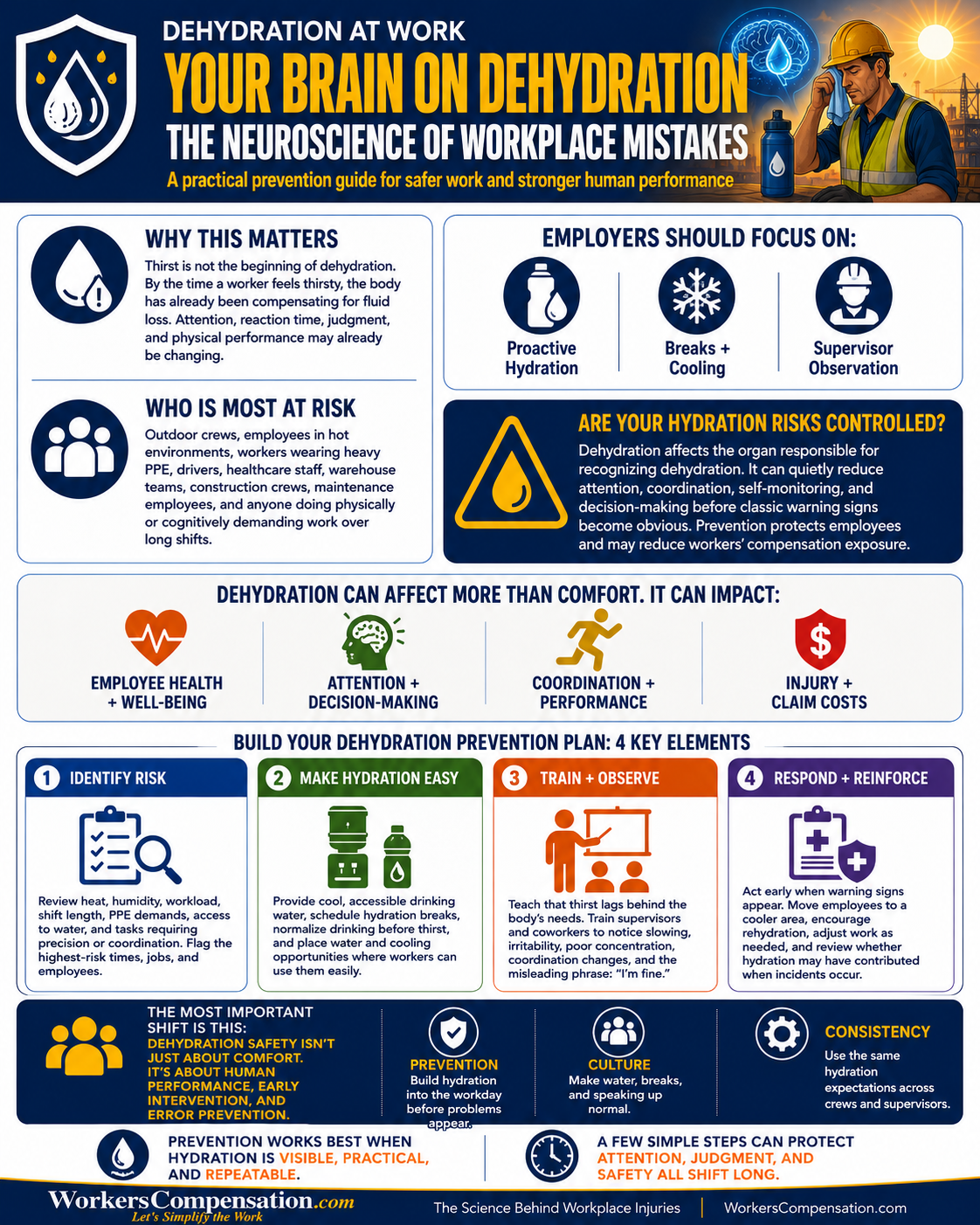
Your brain is remarkably good at recognizing danger. Dehydration presents an interesting exception because it begins changing the organ responsible for recognizing the danger in the first place. At first glance, the idea seems impossible. Most of us have trusted thirst since childhood. We become thirsty, drink water, and assume the body's warning system has done its job. Physiology follows a different timeline. Thirst is not the beginning of dehydration. Thirst is evidence the body has already been compensating for fluid loss. By the time thirst becomes noticeable, attention, reaction time, judgment, and physical performance may already be changing. The National Institute for Occupational Safety and Health recognizes the progression by recommending workers drink water before thirst develops because thirst lags behind the body's physiological need for fluids.
Viewing dehydration only as a comfort issue or a heat illness overlooks one of its most important consequences. The brain depends on adequate hydration to regulate attention, executive function, working memory, emotional regulation, and decision-making. Fluid loss reduces plasma volume, increases cardiovascular strain, and makes heat dissipation less efficient. Cerebral blood flow adjusts to compensate, increasing the effort required to maintain the same level of cognitive performance. Employees often continue working because the human body is remarkably adaptable. Adaptation, however, is not the same as optimal performance.
The irony is difficult to ignore. Dehydration affects the organ responsible for recognizing dehydration.
Scientists have pursued the same question for decades. How much dehydration does it take before cognitive performance begins changing? Wittbrodt and Millard helped answer the question in a 2018 meta-analysis synthesizing decades of dehydration research. Their work concluded attention, executive function, and motor coordination consistently declined once body water loss approached approximately two percent. A 2022 review reached a similar conclusion, reporting progressively greater effects on cognition and mood as dehydration advanced between three and five percent body mass loss. Neuroimaging studies have added another dimension by demonstrating measurable changes in brain activity and regional connectivity during dehydration with improvement following rehydration. Different research teams approached the question from different scientific disciplines. Every path arrived at the same conclusion. Cognitive performance begins changing before most people recognize hydration has become a concern.
Workplace safety is built on human performance. Once dehydration begins influencing human performance, workplace safety becomes part of the conversation. Most occupations require employees to think and move simultaneously. A construction worker evaluates footing while climbing a ladder. A nurse calculates medication dosages while monitoring subtle changes in a patient's condition. A forklift operator continuously scans the environment while making hundreds of steering corrections during a single shift. A maintenance technician diagnoses equipment while navigating confined mechanical spaces. Successful job performance depends on visual processing, motor coordination, judgment, communication, and decision-making occurring together.
Piil and colleagues explored the relationship between dehydration and occupational performance by simulating work in hot environments while measuring cognitive and physical function. Simple tasks showed relatively small changes. The greatest performance declines occurred during activities requiring participants to think and move simultaneously. Visuomotor tracking declined approximately sixteen percent, while combined cognitive-motor performance declined roughly nine percent under dehydrated conditions. Construction, manufacturing, transportation, healthcare, utilities, warehousing, and countless other industries require employees to integrate thinking with movement throughout every shift. Dehydration quietly influences both.
Behavioral science helps explain why dehydration remains an underestimated workplace hazard. Employees rarely postpone hydration because they are careless. Work naturally captures attention. Production schedules continue moving. Customers continue waiting. Equipment continues operating. Employees often convince themselves they will stop for water after finishing the next task. Unfortunately, dehydration gradually affects self-monitoring, judgment, and risk perception while the decision to delay hydration continues repeating itself. The employee saying, "I'm fine," may sincerely believe the statement because the physiological changes influencing cognitive performance are also influencing self-awareness.
Workers' compensation professionals recognize an important principle: Injuries rarely result from a single contributing factor. A fall from a ladder, a backing collision, an equipment incident, or a lifting injury often develops through a series of physiological, behavioral, and environmental influences. Dehydration deserves attention because it frequently functions as an error amplifier rather than the primary injury. The First Report of Injury may document a fall, motor vehicle crash, or machinery incident. The investigation may never identify declining hydration status, increasing cardiovascular strain, or reduced cognitive performance as contributors influencing the outcome. Looking beyond the immediate mechanism of injury creates opportunities to strengthen prevention before another employee experiences a similar event.
Leadership determines whether hydration becomes an individual responsibility or an organizational system. OSHA's proposed Heat Injury and Illness Prevention Rule, along with longstanding guidance from the National Institute for Occupational Safety and Health, emphasizes accessible drinking water, scheduled recovery breaks, acclimatization, supervisor observation, cooling opportunities, and emergency response planning. Every recommendation reflects the same philosophy. Build systems supporting human performance instead of expecting human performance to overcome weak systems.
Perhaps dehydration offers one of the clearest lessons in workplace safety because it illustrates the difference between leading and lagging indicators. Organizations often measure injury rates, workers' compensation claims, lost-time cases, and OSHA recordables. Every measure provides valuable information after harm has already occurred. Physiology encourages a different perspective. Declining hydration status, increasing heat strain, accumulating fatigue, and changing cognitive performance all represent opportunities to intervene before an injury develops. Prevention becomes more effective when organizations recognize early physiological signals instead of waiting for physiological consequences.
Tomorrow in The Science Behind Workplace Injuries - Air Quality: The Workplace Hazard You Cannot See. Smoke, ozone, fine particulate matter, and poor air quality rarely announce their presence with the urgency of a visible hazard. The lungs, cardiovascular system, and brain begin responding long before employees recognize the environment has changed. Tomorrow, we examine why one of the most significant workplace hazards is also one of the least visible and why clean air has become an increasingly important workplace safety issue.


AI best practices california case file caselaw case management case management focus claims compensability compliance compliance corner courts do you know the rule employers exclusive remedy florida fraud glossary check Healthcare hr homeroom insurance insurers iowa kentucky leadership NCCI new jersey new york ohio pennsylvania Safety safety at work state info tech technology the case manager violence WDYT what do you think women's history women's history month workers' comp 101 workers' recovery Workplace Safety Workplace Violence
Read Also
About The Author
About The Author
-
Claire Muselman
Meet Dr. Claire C. Muselman, the Chief Operating Officer at WorkersCompensation.com, where she blends her vast academic insight and professional innovation with a uniquely positive energy. As the President of DCM, Dr. Muselman is renowned for her dynamic approach that reshapes and energizes the workers' compensation industry. Dr. Muselman's academic credentials are as remarkable as her professional achievements. Holding a Doctor of Education in Organizational Leadership from Grand Canyon University, she specializes in employee engagement, human behavior, and the science of leadership. Her diverse background in educational leadership, public policy, political science, and dance epitomizes a multifaceted approach to leadership and learning. At Drake University, Dr. Muselman excels as an Assistant Professor of Practice and Co-Director of the Master of Science in Leadership Program. Her passion for teaching and commitment to innovative pedagogy demonstrate her dedication to cultivating future leaders in management, leadership, and business strategy. In the industry, Dr. Muselman actively contributes as an Ambassador for the Alliance of Women in Workers’ Compensation and plays key roles in organizations such as Kids Chance of Iowa, WorkCompBlitz, and the Claims and Litigation Management Alliance, underscoring her leadership and advocacy in workers’ compensation. A highly sought-after speaker, Dr. Muselman inspires professionals with her engaging talks on leadership, self-development, and risk management. Her philosophy of empathetic and emotionally intelligent leadership is at the heart of her message, encouraging innovation and progressive change in the industry. "Empowerment is key to progress. By nurturing today's professionals with empathy and intelligence, we're crafting tomorrow's leaders." - Dr. Claire C. Muselman
More by This Author
Read More
- Oct 14, 2026
- Claire Muselman
- Oct 14, 2026
- Frank Ferreri
- Oct 13, 2026
- Claire Muselman
- Oct 13, 2026
- Frank Ferreri
- Oct 12, 2026
- Claire Muselman
- Oct 12, 2026
- Anne Llewellyn