


Share This Article:
Fall Into Safety
Welcome to The Science Behind Workplace Injuries: Fall Safety Series, where we explore how seasonal conditions interact with human physiology, behavior, and workplace systems. Yesterday, we examined farm equipment on public roads and how differences in speed and capability create a shared roadway risk. Today, we turn to tree trimming and fall cleanup, where gravity, stored energy, electricity, cutting equipment, and uneven terrain converge.
Autumn does not appear to be a national peak for tree-care injuries. The seasonal connection comes primarily from exposure: storm damage, leaf and debris cleanup, end-of-season workloads, and early snow or ice can increase the amount and complexity of tree work being performed. Those conditions may also bring seasonal, temporary, or inexperienced workers into hazardous tasks. The physics of a falling limb do not change because the calendar says October. What changes is how often workers encounter these hazards and the conditions surrounding the work.
A Tree Can Hold Energy We Cannot See
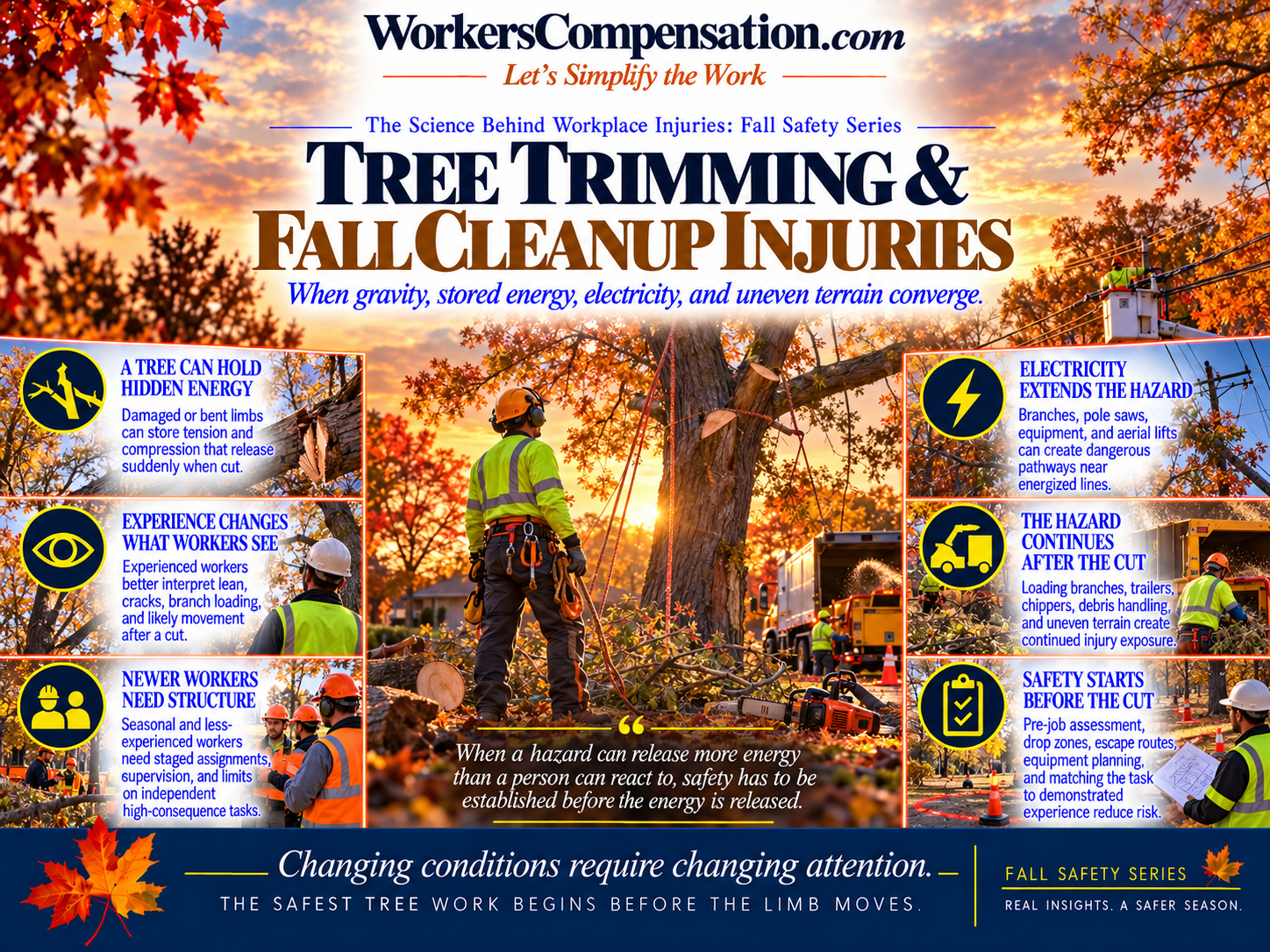
Tree work combines several forms of energy that can become dangerous within seconds. Gravity acts on limbs, trunk sections, workers, saws, and rigging systems, while damaged or partially fallen trees can store substantial energy as wood remains under tension or compression. Cutting changes how those forces are distributed, potentially causing a limb to rotate, a trunk to shift, or a bent section to spring toward the worker. National fatality data illustrate the consequences: among 1,285 tree-care deaths examined by the CDC from 1992 through 2007, 42% involved workers struck by trees or limbs, 34% involved falls, and 14% involved electrocution. The chainsaw is only one part of the hazard; the greater threat may be what the worker causes the tree or surrounding environment to do.
Storm damage makes those forces even more difficult to interpret. Elizabeth Marshall and colleagues examined emergency-department visits following Hurricane Sandy and found tree-related injuries increased during the recovery period, with struck-by injuries reaching 2.74 times the rate observed during the corresponding period the previous year. Damaged roots, partially fractured trunks, suspended branches, and bent sections can create hazards that are difficult to recognize before cutting begins. Once stored energy releases, human reaction time provides little protection against a falling branch, shifting trunk, or spring-loaded limb. Prevention therefore depends heavily on what happens before the cut: evaluating tension and compression, establishing drop zones and escape routes, determining cut sequence, and using rigging or mechanical assistance when the tree cannot be controlled safely by the worker alone.
Experience Changes What a Worker Can See
Tree work requires more than knowing how to operate equipment. Experienced workers develop mental models that help them interpret cracks, lean, decay, branch loading, tension, compression, and likely movement after a cut. A new worker may recognize that a tree is damaged without understanding how that damage changes its behavior. Gregory Kearney, Nancy Romano, and Anna Doub reviewed 95 landscaping and tree-care fatalities investigated through NIOSH and state FACE programs and found more than two-thirds of the tree-care fatalities involved workers who had been on the job for one year or less. Among employers represented in those investigations, 60% lacked a written safety plan and approximately one-third had provided no job training. Because FACE investigations are selected cases, the findings should not be interpreted as national rates, but the recurring combination of short tenure and limited safety infrastructure deserves attention.
Autumn can amplify that vulnerability when storm response, cleanup contracts, seasonal hiring, or end-of-season workloads add people to crews. A worker may know that a branch can fall without yet being able to predict its path or recognize the significance of a particular crack, lean, or loaded limb. Staged assignments, direct supervision, mentorship, and limits on independent climbing, felling, and chipper operation allow those mental models to develop before workers assume high-consequence tasks. Alex Julius and colleagues directly observed 63 tree-care companies and found better safety compliance among accredited companies and those employing certified arborists, although no group achieved complete compliance. Training establishes knowledge; the organization still determines whether workers have the supervision, equipment, time, and operating expectations necessary to apply it consistently.
The Hazard Continues Beyond the Cut
Electricity and powered equipment extend the danger beyond falling trees and branches. Workers do not have to touch an energized line directly to be injured; branches, pole saws, equipment, and aerial lifts can create conductive pathways. Storm cleanup can make those conditions particularly difficult to evaluate because damaged trees and damaged electrical infrastructure may occupy the same work area. Chippers introduce another form of rapidly moving energy because the machine actively pulls material toward its cutting system, leaving little time to recover from entanglement. These hazards reinforce the same principle as stored energy in the tree: once the physical process begins, the worker may have very little time available to correct an error.
Fall cleanup also includes less dramatic tasks that contribute meaningfully to injury exposure. Workers load branches, move debris, hitch trailers, operate tailgates, and repeatedly handle material across slopes and uneven terrain. Barbara Alexander and colleagues analyzed 18,037 accepted Ohio landscaping workers' compensation claims from 2001 through 2017 and found trucks, trailers, loading, unloading, and material handling throughout serious claim narratives, while tree work appeared frequently among expensive cases. Lost-time cases represented a minority of accepted claims but accounted for most of the workers' compensation costs in the study. The exposure therefore continues after the limb reaches the ground, and prevention must account for the entire cleanup operation rather than concentrating exclusively on saw use.
Organizations can influence these exposures before work begins. Pre-job assessments can identify tree condition, electrical hazards, stored energy, drop zones, equipment needs, and escape routes. Crew assignments can match tasks to demonstrated experience, while storm-response plans can establish supervision and contractor expectations before demand increases. Personal protective equipment remains essential, but PPE functions within a larger system that determines whether workers are placed in the path of uncontrolled energy in the first place. Autumn may change the volume of tree work, the condition of the trees, and the experience of the people performing the work, while the underlying physics remain constant. When a hazard can release more energy than a person can react to, safety has to be established before the energy is released.
Tomorrow in The Science Behind Workplace Injuries: Fall Safety Series — Deer Collisions and Fleet Safety. Autumn brings a predictable increase in deer movement as workers spend more driving hours in darkness. We will examine how animal behavior, sunset, speed, visibility, and human reaction time interact, and why the most serious injuries may occur after the driver first encounters the animal.
Research Referenced
Alexander, B. M., Wurzelbacher, S. J., Zeiler, R. J., & Naber, S. J. (2021). Lessons learned from Ohio workers' compensation claims to mitigate hazards in the landscaping services industry. American Journal of Industrial Medicine, 64(8), 699–713. doi:10.1002/ajim.23261
Julius, A. K., Kane, B., Bulzacchelli, M. T., & Ryan, H. D. P., III. (2014). Compliance with the ANSI Z133.1–2006 safety standard among arborists in New England. Journal of Safety Research, 51, 65–72. doi:10.1016/j.jsr.2014.09.010
Kearney, G. D., Romano, N., & Doub, A. (2024). Fatal injuries among landscaping and tree care workers: Insights from NIOSH and state-based FACE reports. Journal of Safety Research, 91, 393–400. doi:10.1016/j.jsr.2024.10.005
Marshall, E. G., Lu, S.-E., Williams, A. O., Lefkowitz, D., & Borjan, M. (2018). Tree-related injuries associated with response and recovery from Hurricane Sandy, New Jersey, 2011–2014. Public Health Reports, 133(3), 266–273. doi:10.1177/0033354918766871


AI best practices california case file caselaw case management case management focus claims compensability compliance compliance corner courts do you know the rule employers exclusive remedy florida fraud glossary check Healthcare hr homeroom insurance insurers iowa kentucky leadership NCCI new jersey new york ohio pennsylvania Safety safety at work state info tech technology the case manager violence WDYT what do you think women's history women's history month workers' comp 101 workers' recovery Workplace Safety Workplace Violence
Read Also
About The Author
About The Author
-
Claire Muselman
Meet Dr. Claire C. Muselman, the Chief Operating Officer at WorkersCompensation.com, where she blends her vast academic insight and professional innovation with a uniquely positive energy. As the President of DCM, Dr. Muselman is renowned for her dynamic approach that reshapes and energizes the workers' compensation industry. Dr. Muselman's academic credentials are as remarkable as her professional achievements. Holding a Doctor of Education in Organizational Leadership from Grand Canyon University, she specializes in employee engagement, human behavior, and the science of leadership. Her diverse background in educational leadership, public policy, political science, and dance epitomizes a multifaceted approach to leadership and learning. At Drake University, Dr. Muselman excels as an Assistant Professor of Practice and Co-Director of the Master of Science in Leadership Program. Her passion for teaching and commitment to innovative pedagogy demonstrate her dedication to cultivating future leaders in management, leadership, and business strategy. In the industry, Dr. Muselman actively contributes as an Ambassador for the Alliance of Women in Workers’ Compensation and plays key roles in organizations such as Kids Chance of Iowa, WorkCompBlitz, and the Claims and Litigation Management Alliance, underscoring her leadership and advocacy in workers’ compensation. A highly sought-after speaker, Dr. Muselman inspires professionals with her engaging talks on leadership, self-development, and risk management. Her philosophy of empathetic and emotionally intelligent leadership is at the heart of her message, encouraging innovation and progressive change in the industry. "Empowerment is key to progress. By nurturing today's professionals with empathy and intelligence, we're crafting tomorrow's leaders." - Dr. Claire C. Muselman
More by This Author
Read More
- Oct 07, 2026
- Frank Ferreri
- Oct 06, 2026
- Claire Muselman
- Oct 06, 2026
- Chriss Swaney
- Oct 05, 2026
- Claire Muselman
- Oct 05, 2026
- Frank Ferreri
- Oct 04, 2026
- Claire Muselman