


Share This Article:
Fall Into Safety
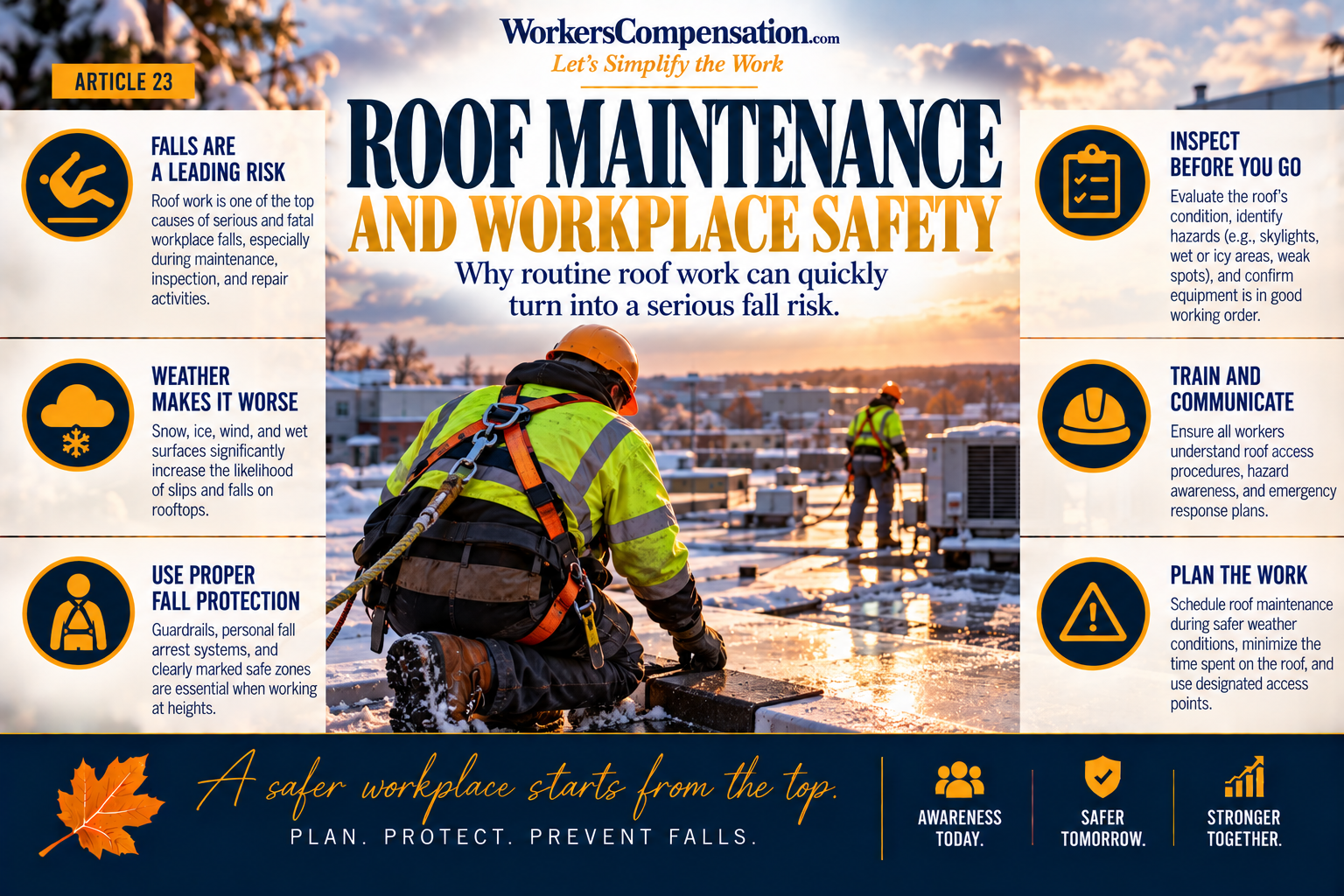
Welcome to The Science Behind Workplace Injuries: Fall Safety Series, where we explore how seasonal conditions interact with human physiology, behavior, and workplace systems. Yesterday, we examined heating systems and why autumn preparation can prevent hazards that emerge months later. Roof maintenance follows the same logic. Research does not show that autumn itself produces an unusual spike in occupational roof falls, nor has a study directly demonstrated that pre-winter roof maintenance reduces injuries. The opportunity is more practical: work completed while a roof is visible, dry, and accessible may eliminate work that would otherwise occur after snow and ice arrive. The safest winter roof task may be the one an organization completed in October.
Winter Changes More Than the Surface
Roof work already carries substantial consequences. Xiuwen Sue Dong and colleagues examined U.S. construction fatalities from 1992 through 2009 and found roof falls accounted for approximately one-third of fatal construction falls. The burden was particularly concentrated among smaller employers, with 67% of roof-fall deaths occurring in establishments with 10 or fewer employees. Winter adds conditions that can make an already unforgiving environment harder to manage. Snow and ice reduce traction, obscure roof edges and openings, and can conceal skylights that workers may incorrectly assume will support their weight. Blocked drains can contribute to ponding, ice dams, and concentrated loads, creating the very conditions that later prompt someone to access the roof urgently.
Snow removal deserves particular attention because the people sent onto a roof after a storm may not normally work there. OSHA has documented serious injuries and fatalities during rooftop snow removal involving maintenance workers and others with limited experience performing roof work. International evidence illustrates the severity of the task as well. Per-Olof Bylund and colleagues examined 95 people treated for injuries associated with roof snow removal in Sweden. Most incidents occurred during nonoccupational activity, limiting direct comparison with U.S. workplaces, but falls from roofs and ladders dominated the injury mechanisms and nearly 60% of patients sustained moderate or serious injuries. Snow depth was strongly associated with injury incidence. The conditions most likely to trigger roof access were also the conditions making that access more difficult.
Human Balance Does Not Always Feel as Unstable as It Is
Roof risk also provides an excellent example of the difference between actual human performance and perceived human performance. Peter Simeonov and NIOSH colleagues studied construction workers standing on surfaces that varied by slope and elevation. Both height and slope increased postural instability, and their combination produced greater instability than either condition alone. Workers recognized the effects of height and slope individually but did not accurately perceive the additional instability created when the two occurred together. The body was responding to a condition the worker did not fully experience as more dangerous.
That matters because winter adds variables that further narrow the margin for recovery. A worker may be balancing on a pitched surface while carrying tools, clearing snow, locating a hidden drain, or moving around an obstruction. Cold can reduce hand dexterity, while snow and ice alter the sensory information coming through the feet. Attention devoted to the task is attention unavailable for balance and hazard detection. None of those changes requires a dramatic mistake to produce a fall. At height, a small loss of traction or balance can have consequences far beyond the size of the initial movement. Feeling stable is therefore a poor substitute for controlling the conditions that determine stability.
Fall Protection Has to Exist Before Someone Needs It
The national fatality data show why telling workers to use fall protection is incomplete. Dong and colleagues later analyzed 325 construction fall deaths investigated through the NIOSH FACE program. Personal fall arrest systems were unavailable to 54% of those who died. Another 23% had access to a system but were not using it. The cases are not a random sample of every construction fall, but the pattern demonstrates two different organizational problems: protection has to be provided, and the work has to be designed so employees can realistically use it.
Autumn creates an opportunity to solve both problems before weather adds urgency. Roof edges, skylights, drains, vents, and access points are visible. Permanent anchors, guardrails, skylight screens, and rated covers can be inspected or installed before snow conceals the hazards they protect. Drains, gutters, and scuppers can be cleared to reduce the conditions that contribute to ponding and ice buildup. Organizations can also decide who is authorized to access a roof during winter, identify qualified contractors in advance, establish when snow removal is actually necessary, and select ground-based methods where possible. Those decisions are easier to make before a storm, leak, or structural concern creates pressure to act immediately.
Federal snow-load guidance adds an important challenge to the instinct to send someone up with a shovel whenever snow accumulates. Most buildings are not automatically at risk of structural failure simply because snow is present, and roof snow removal can introduce greater danger than leaving the snow in place. The appropriate response depends on the building, snow load, drainage, structural conditions, and professional assessment. Preparation allows those decisions to be made with information instead of urgency.
Roof maintenance before snow is ultimately about controlling when exposure occurs. Organizations cannot control winter weather, but they can decide whether routine inspection, repair, drainage work, and fall-protection preparation happen before winter changes the roof. They can also determine whether a January storm triggers a planned response or improvisation. The same roof can present a very different risk depending on when the work occurs. When timing changes the conditions of a task, timing becomes part of the safety system.
Tomorrow in The Science Behind Workplace Injuries: Fall Safety Series — Ladder Safety During Autumn Maintenance. We will examine why familiar equipment can produce serious injuries and how height, task demands, setup, and human perception interact before a fall occurs.
Research Referenced
Bylund, P.-O., Johansson, J., & Albertsson, P. (2016). Injuries sustained during snow removal from roofs resulting in hospital care. International Journal of Injury Control and Safety Promotion, 23(1), 105–109. doi:10.1080/17457300.2014.992349
Dong, X. S., Choi, S. D., Borchardt, J. G., Wang, X., & Largay, J. A. (2013). Fatal falls from roofs among U.S. construction workers. Journal of Safety Research, 44, 17–24. doi:10.1016/j.jsr.2012.08.024
Dong, X. S., Largay, J. A., Choi, S. D., Wang, X., Cain, C. T., & Romano, N. (2017). Fatal falls and PFAS use in the construction industry: Findings from the NIOSH FACE reports. Accident Analysis & Prevention, 102, 136–143. doi:10.1016/j.aap.2017.02.028
Simeonov, P. I., Hsiao, H., Dotson, B. W., & Ammons, D. E. (2003). Control and perception of balance at elevated and sloped surfaces. Human Factors, 45(1), 136–147. doi:10.1518/hfes.45.1.136.27232


AI best practices california case file caselaw case management case management focus claims compensability compliance compliance corner courts do you know the rule employers exclusive remedy florida fraud glossary check Healthcare hr homeroom insurance insurers iowa kentucky leadership NCCI new jersey new york ohio pennsylvania Safety safety at work state info tech technology the case manager violence WDYT what do you think women's history women's history month workers' comp 101 workers' recovery Workplace Safety Workplace Violence
Read Also
About The Author
About The Author
-
Claire Muselman
Meet Dr. Claire C. Muselman, the Chief Operating Officer at WorkersCompensation.com, where she blends her vast academic insight and professional innovation with a uniquely positive energy. As the President of DCM, Dr. Muselman is renowned for her dynamic approach that reshapes and energizes the workers' compensation industry. Dr. Muselman's academic credentials are as remarkable as her professional achievements. Holding a Doctor of Education in Organizational Leadership from Grand Canyon University, she specializes in employee engagement, human behavior, and the science of leadership. Her diverse background in educational leadership, public policy, political science, and dance epitomizes a multifaceted approach to leadership and learning. At Drake University, Dr. Muselman excels as an Assistant Professor of Practice and Co-Director of the Master of Science in Leadership Program. Her passion for teaching and commitment to innovative pedagogy demonstrate her dedication to cultivating future leaders in management, leadership, and business strategy. In the industry, Dr. Muselman actively contributes as an Ambassador for the Alliance of Women in Workers’ Compensation and plays key roles in organizations such as Kids Chance of Iowa, WorkCompBlitz, and the Claims and Litigation Management Alliance, underscoring her leadership and advocacy in workers’ compensation. A highly sought-after speaker, Dr. Muselman inspires professionals with her engaging talks on leadership, self-development, and risk management. Her philosophy of empathetic and emotionally intelligent leadership is at the heart of her message, encouraging innovation and progressive change in the industry. "Empowerment is key to progress. By nurturing today's professionals with empathy and intelligence, we're crafting tomorrow's leaders." - Dr. Claire C. Muselman
More by This Author
Read More
- Oct 13, 2026
- Frank Ferreri
- Oct 12, 2026
- Claire Muselman
- Oct 12, 2026
- Anne Llewellyn
- Oct 12, 2026
- Claire Muselman
- Oct 11, 2026
- Frank Ferreri
- Oct 11, 2026
- Anne Llewellyn