


Share This Article:
Fireworks and the Workplace: Why Knowing Better Doesn’t Always Mean Doing Better
03 Jul, 2026 Claire Muselman
Summer Safety Series
Welcome to The Science Behind Workplace Injuries: 30 Days of Summer Safety, where we explore the environmental hazards, human physiology, behavioral science, and organizational decisions shaping workplace safety. This article is part of our July series examining the science behind workplace injuries and the factors influencing workplace safety during the summer months.
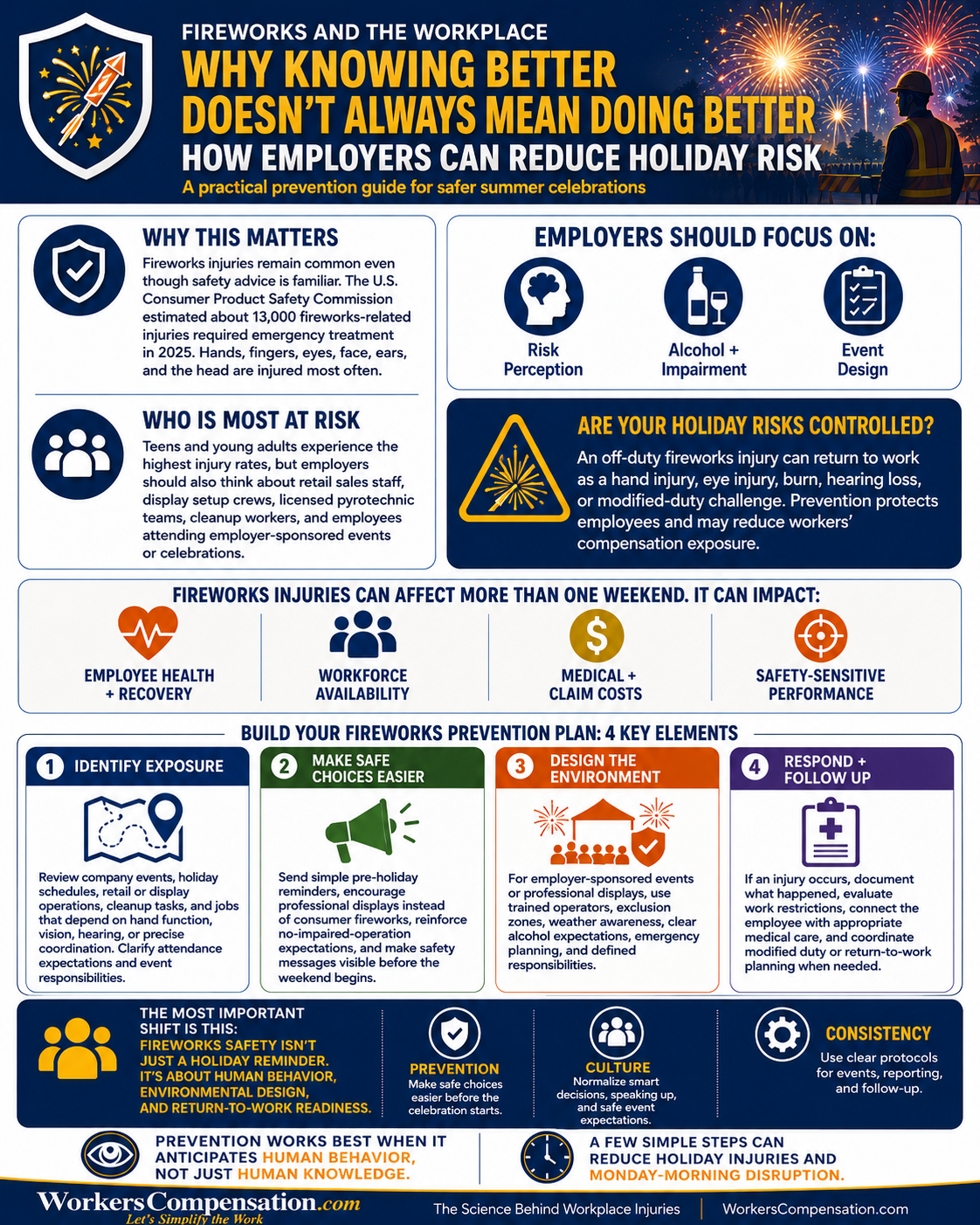
Every year, the same safety messages return. Leave fireworks to the professionals. Never relight a firework that fails to ignite. Keep water nearby. Wear eye protection. Never use fireworks while impaired by alcohol or drugs. None of these recommendations are new. The U.S. Consumer Product Safety Commission, OSHA, state fire marshals, and countless safety organizations have repeated them for years. Even so, emergency departments continue treating thousands of preventable fireworks injuries every summer. The Consumer Product Safety Commission estimated approximately 13,000 fireworks-related injuries required emergency treatment during 2025, with hands, fingers, the head, face, ears, and eyes representing the most frequently injured body regions.
Fireworks are dangerous. Everyone knows it. The more interesting question is why the injuries continue. If information alone changed behavior, fireworks injuries would have become increasingly rare decades ago. Instead, the same injury patterns continue appearing year after year despite widespread public education, annual media coverage, and highly visible safety campaigns. The persistence of those injuries reveals an important lesson extending beyond the Fourth of July. Knowledge alone rarely changes human behavior.
Workers' compensation professionals see this reality every day. Employees understand personal protective equipment reduces injuries. Drivers understand distracted driving increases crash risk. Supervisors understand fatigue influences decision-making. Organizations invest countless hours developing policies, conducting training, and reinforcing expectations. Even with those efforts, workplace injuries continue because information and behavior are not synonymous. Understanding the difference may be one of the most valuable opportunities available to safety professionals, organizational leaders, and claims professionals alike.
Behavioral science offers an explanation. Human beings rarely make decisions based exclusively on information. Decisions are shaped by previous experiences, emotional state, environmental cues, social expectations, perceived rewards, and personal risk perception. Fireworks create an environment where many of those influences converge at the same time. Family traditions, neighborhood celebrations, large crowds, excitement, alcohol, and peer encouragement all contribute to an atmosphere where caution quietly gives way to confidence. The hazard never changes. Human perception of the hazard does.
Alcohol further complicates risk perception because it alters judgment, coordination, self-control, and decision-making. The World Health Organization identifies alcohol as a psychoactive substance affecting both cognitive and physical performance, while OSHA specifically prohibits anyone under the influence from participating in professional fireworks display operations. Studies examining peer influence similarly demonstrate social environments increase reward sensitivity, particularly among adolescents and young adults. Those findings closely mirror national injury surveillance. According to the Consumer Product Safety Commission, individuals between 15 and 24 years of age consistently experience the highest rate of fireworks-related injuries in the United States.
The lesson for employers extends beyond holiday celebrations. Every organization depends on employees returning to work healthy enough to perform their jobs safely. A fireworks injury occurring over the holiday weekend may involve an off-duty event, yet the consequences arrive at work Monday morning. Hand injuries can limit grip strength and dexterity for months. Eye injuries may affect depth perception and precision work. Hearing loss and tinnitus interfere with communication, situational awareness, and safety-sensitive tasks. Burns frequently require extended rehabilitation, modified duty, and gradual return-to-work planning. Personal decisions made away from work often create organizational consequences once the workweek begins.
Fireworks also create important workers' compensation considerations. Manufacturing, retail sales, display setup, licensed pyrotechnic operations, cleanup activities, and employer-sponsored events each present unique occupational exposures. Compensability becomes considerably more complex when injuries occur during employer-sponsored celebrations, customer appreciation events, or company picnics. State law, attendance expectations, employer benefit, alcohol policies, and event design all influence how those claims may ultimately be evaluated. Fireworks deserve more attention than a seasonal safety reminder because they create medical, operational, legal, and organizational challenges simultaneously.
Perhaps the most valuable lesson fireworks teach has very little to do with fireworks themselves. Organizations frequently respond to injuries by increasing communication, sending another reminder, or requiring another training session. Education remains essential, yet awareness represents only one part of prevention. Lasting change occurs when leaders design environments where safe decisions become easier decisions. Professional fireworks displays rely on engineered controls, exclusion zones, trained operators, weather monitoring, emergency planning, and clearly defined responsibilities because professionals recognize human behavior alone cannot manage every hazard. Workplace safety deserves the same philosophy.
Fireworks illuminate more than the night sky. They illuminate the distance between knowing and doing. Closing that gap requires more than information. It requires understanding how people perceive risk, how environments influence behavior, and how leadership shapes everyday decisions long before an injury occurs. Those lessons extend well beyond a single holiday and offer organizations an opportunity to rethink prevention through the lens of human behavior rather than human compliance.
Tomorrow in The Science Behind Workplace Injuries - Your Brain on Dehydration: The Neuroscience of Workplace Mistakes. Most people recognize dehydration only after thirst appears. Physiology follows a different timeline. Tomorrow, we explore how dehydration begins altering cognitive performance, attention, reaction time, and decision-making before workers recognize anything has changed, creating conditions where small mistakes become significant workplace injuries.


AI best practices california case file caselaw case management case management focus claims compensability compliance compliance corner courts do you know the rule employers exclusive remedy florida fraud glossary check Healthcare hr homeroom insurance insurers iowa kentucky leadership NCCI new jersey new york ohio pennsylvania Safety safety at work state info tech technology the case manager violence WDYT what do you think women's history women's history month workers' comp 101 workers' recovery Workplace Safety Workplace Violence
Read Also
About The Author
About The Author
-
Claire Muselman
Meet Dr. Claire C. Muselman, the Chief Operating Officer at WorkersCompensation.com, where she blends her vast academic insight and professional innovation with a uniquely positive energy. As the President of DCM, Dr. Muselman is renowned for her dynamic approach that reshapes and energizes the workers' compensation industry. Dr. Muselman's academic credentials are as remarkable as her professional achievements. Holding a Doctor of Education in Organizational Leadership from Grand Canyon University, she specializes in employee engagement, human behavior, and the science of leadership. Her diverse background in educational leadership, public policy, political science, and dance epitomizes a multifaceted approach to leadership and learning. At Drake University, Dr. Muselman excels as an Assistant Professor of Practice and Co-Director of the Master of Science in Leadership Program. Her passion for teaching and commitment to innovative pedagogy demonstrate her dedication to cultivating future leaders in management, leadership, and business strategy. In the industry, Dr. Muselman actively contributes as an Ambassador for the Alliance of Women in Workers’ Compensation and plays key roles in organizations such as Kids Chance of Iowa, WorkCompBlitz, and the Claims and Litigation Management Alliance, underscoring her leadership and advocacy in workers’ compensation. A highly sought-after speaker, Dr. Muselman inspires professionals with her engaging talks on leadership, self-development, and risk management. Her philosophy of empathetic and emotionally intelligent leadership is at the heart of her message, encouraging innovation and progressive change in the industry. "Empowerment is key to progress. By nurturing today's professionals with empathy and intelligence, we're crafting tomorrow's leaders." - Dr. Claire C. Muselman
More by This Author
Read More
- Oct 14, 2026
- Claire Muselman
- Oct 14, 2026
- Frank Ferreri
- Oct 13, 2026
- Claire Muselman
- Oct 13, 2026
- Frank Ferreri
- Oct 12, 2026
- Claire Muselman
- Oct 12, 2026
- Anne Llewellyn