


Share This Article:
Fall Into Safety
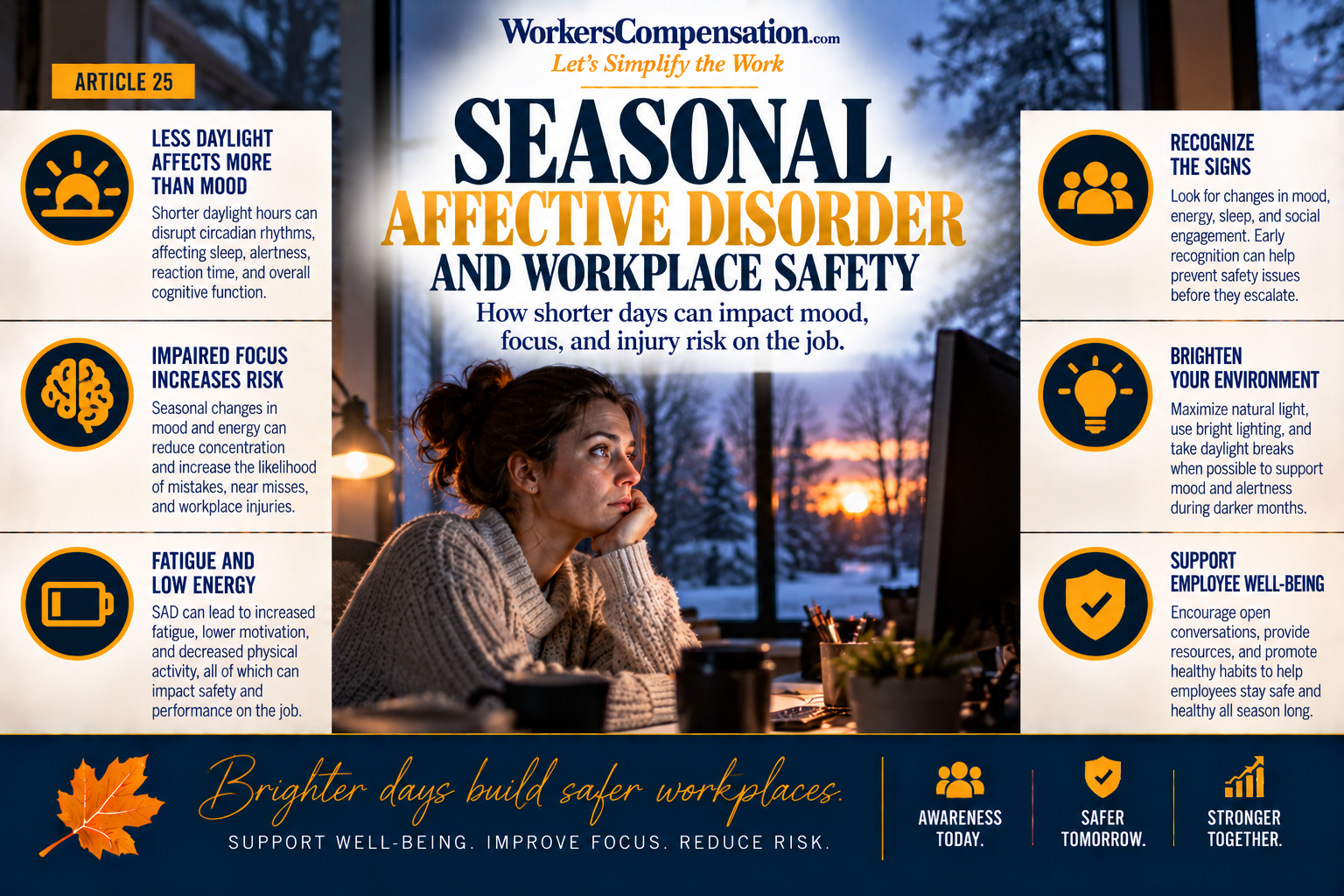
Welcome to The Science Behind Workplace Injuries: Fall Safety Series, where we explore how seasonal conditions interact with human physiology, behavior, and workplace systems. Yesterday, we examined ladder safety and the difference between feeling stable and actually having an adequate margin of safety. Seasonal affective disorder presents another perception challenge because the popular story is considerably broader than the science supports. Seasonal affective disorder, or SAD, is a real form of recurrent depression for some people, but evidence does not show that everyone experiences a meaningful neurological decline as daylight decreases. Research also has not established that SAD causes an autumn increase in workplace injuries. The more useful safety conversation begins by separating seasonal depression, depression-related injury risk, and the environmental effects of darkness.
Seasonal Light Affects People Differently
Light reaching the eye does more than support vision. Specialized retinal cells respond to light and provide information to the brain's circadian system, helping regulate biological timing across the day. For people vulnerable to SAD, shortening photoperiod appears capable of disrupting that system in meaningful ways. Brenda Mc Mahon and colleagues followed people with SAD and healthy controls across summer and winter using PET imaging. The groups showed similar serotonin-transporter binding during summer, but the SAD group showed a different seasonal response during winter, and the magnitude of that change was associated with depressive symptom severity. The biology supports genuine individual vulnerability without supporting the common assumption that everyone's serotonin simply drops when winter arrives.
In the workplace, broad seasonal stereotypes can obscure the people who are struggling. SAD can include depressed mood, low energy, concentration difficulty, changes in sleep, and withdrawal from normal activities. Those symptoms can affect the capacity someone brings to work, although researchers have not directly measured reaction time, balance, hazard perception, or occupational injury rates specifically among workers with SAD. Supervisors therefore should not attempt to diagnose seasonal depression from someone's performance or personality. A better organizational response creates access to support, appropriate accommodation pathways, and working conditions that recognize light as part of the human environment.
Depression and Injury Have a More Complicated Relationship
The broader depression literature provides stronger occupational evidence. Keith Palmer and colleagues studied 1,348 workers who sought medical care for occupational injuries and compared them with matched controls. A prior mental-health consultation was associated with approximately 44% higher odds of a subsequent work-injury consultation, while prior psychotropic medication use was associated with a similarly modest increase. The researchers could establish that the mental-health diagnosis or prescription preceded the injury consultation, strengthening the temporal relationship, although observational data cannot establish that depression or medication caused the injury.
Fatigue, concentration difficulty, sleep disruption, and medication effects are plausible pathways, but the relationship deserves careful interpretation. Health conditions, job demands, socioeconomic factors, pain, and other variables can influence both mental health and injury risk. Medication studies also face an additional problem because separating the effect of a medication from the condition being treated is difficult. The evidence supports awareness without supporting assumptions about an individual worker's safety based on a diagnosis or prescription. Mental health belongs in the safety conversation because human performance depends on available capacity, and capacity varies for many reasons.
Workplace Injury Can Also Change Mental Health
Workers' compensation adds an important reversal to the story. Research summarized in the brief shows that injury can precede depression as well as follow it. In longitudinal U.S. data, injured male workers had more than twice the odds of subsequently developing depression. Canadian research following workers with lost-time musculoskeletal injuries likewise found substantial depressive symptoms during the year after injury. Pain, disrupted routines, uncertainty about recovery, financial concerns, changes in identity, and separation from work can all become part of the post-injury experience.
That direction of the relationship has direct implications for how organizations care for injured workers. Mental health should not enter the conversation only when someone already carries a diagnosis. Communication, respectful claims handling, meaningful connection to the workplace, appropriate treatment, and thoughtful return-to-work planning can matter after an injury changes someone's daily life. Seasonal vulnerability may exist alongside those pressures for some people, but the larger lesson extends throughout the year: physical recovery and psychological experience do not occur in separate systems.
Light Is Also an Environmental Safety Condition
Autumn creates another light-related issue that requires no diagnosis at all. Earlier darkness changes visibility for workers driving, delivering, repairing utilities, working beside roads, crossing parking lots, or completing outdoor tasks late in the day. Research using daylight-saving transitions has helped isolate ambient light as a crash variable because the clock changes while many other behaviors remain relatively stable. Darkness alters the information available to both drivers and pedestrians, making lighting, high-visibility apparel, task scheduling, and work-zone design increasingly important as daylight contracts.
Employers can address both sides of the seasonal-light conversation without turning supervisors into clinicians. Outdoor and roadside work can be reviewed against available daylight. Parking lots, yards, entrances, and work zones can be evaluated for lighting. Indoor environments can provide access to daylight where practical, while employees experiencing seasonal depression can be directed toward established accommodation and treatment resources. Bright-light therapy and cognitive-behavioral therapy tailored specifically to SAD both have research support. In a randomized trial, Kelly Rohan and colleagues found similar acute outcomes between the two treatments, while CBT-SAD participants experienced fewer recurrences two winters later.
Seasonal affective disorder belongs in workplace safety with precision. Some people experience meaningful biological and psychological responses to seasonal light loss, while many do not. Depression has a modest relationship with occupational injury, and workplace injury can also become a pathway into depression. Darkness simultaneously changes the physical work environment for everyone. Good prevention respects those differences. Human capacity and environmental conditions both change with light, and effective safety systems pay attention to each without assuming one tells us everything about the other.
Tomorrow in The Science Behind Workplace Injuries: Fall Safety Series — Why Cooler Weather Changes Physical Performance. We will examine what happens to muscles, dexterity, reaction, and physical capacity as temperatures fall, including changes that can begin before conditions feel dangerously cold.
Research Referenced
Kim, J., & Choi, Y. (2016). Gender differences in the longitudinal association between work-related injury and depression. International Journal of Environmental Research and Public Health, 13(11), 1077. doi:10.3390/ijerph13111077
Mc Mahon, B., Andersen, S. B., Madsen, M. K., Hjordt, L. V., Hageman, I., Dam, H., Svarer, C., da Cunha-Bang, S., Baare, W., Madsen, J., Hasholt, L., Holst, K., & Knudsen, G. M. (2016). Seasonal difference in brain serotonin transporter binding predicts symptom severity in patients with seasonal affective disorder. Brain, 139(5), 1605–1614. doi:10.1093/brain/aww043
Palmer, K. T., D'Angelo, S., Harris, E. C., Linaker, C., & Coggon, D. (2014). The role of mental health problems and common psychotropic drug treatments in accidental injury at work: A case-control study. Occupational and Environmental Medicine, 71(5), 308–312. doi:10.1136/oemed-2013-101948
Rohan, K. J., Meyerhoff, J., Ho, S.-Y., Evans, M., Postolache, T. T., & Vacek, P. M. (2016). Outcomes one and two winters following cognitive-behavioral therapy or light therapy for seasonal affective disorder. American Journal of Psychiatry, 173(3), 244–251. doi:10.1176/appi.ajp.2015.15060773


AI best practices california case file caselaw case management case management focus claims compensability compliance compliance corner courts do you know the rule employers exclusive remedy florida fraud glossary check Healthcare hr homeroom insurance insurers iowa kentucky leadership NCCI new jersey new york ohio pennsylvania Safety safety at work state info tech technology the case manager violence WDYT what do you think women's history women's history month workers' comp 101 workers' recovery Workplace Safety Workplace Violence
Read Also
About The Author
About The Author
-
Claire Muselman
Meet Dr. Claire C. Muselman, the Chief Operating Officer at WorkersCompensation.com, where she blends her vast academic insight and professional innovation with a uniquely positive energy. As the President of DCM, Dr. Muselman is renowned for her dynamic approach that reshapes and energizes the workers' compensation industry. Dr. Muselman's academic credentials are as remarkable as her professional achievements. Holding a Doctor of Education in Organizational Leadership from Grand Canyon University, she specializes in employee engagement, human behavior, and the science of leadership. Her diverse background in educational leadership, public policy, political science, and dance epitomizes a multifaceted approach to leadership and learning. At Drake University, Dr. Muselman excels as an Assistant Professor of Practice and Co-Director of the Master of Science in Leadership Program. Her passion for teaching and commitment to innovative pedagogy demonstrate her dedication to cultivating future leaders in management, leadership, and business strategy. In the industry, Dr. Muselman actively contributes as an Ambassador for the Alliance of Women in Workers’ Compensation and plays key roles in organizations such as Kids Chance of Iowa, WorkCompBlitz, and the Claims and Litigation Management Alliance, underscoring her leadership and advocacy in workers’ compensation. A highly sought-after speaker, Dr. Muselman inspires professionals with her engaging talks on leadership, self-development, and risk management. Her philosophy of empathetic and emotionally intelligent leadership is at the heart of her message, encouraging innovation and progressive change in the industry. "Empowerment is key to progress. By nurturing today's professionals with empathy and intelligence, we're crafting tomorrow's leaders." - Dr. Claire C. Muselman
More by This Author
Read More
- Oct 14, 2026
- Claire Muselman
- Oct 14, 2026
- Frank Ferreri
- Oct 13, 2026
- Claire Muselman
- Oct 13, 2026
- Frank Ferreri
- Oct 12, 2026
- Claire Muselman
- Oct 12, 2026
- Anne Llewellyn