


Share This Article:
Fall Into Safety
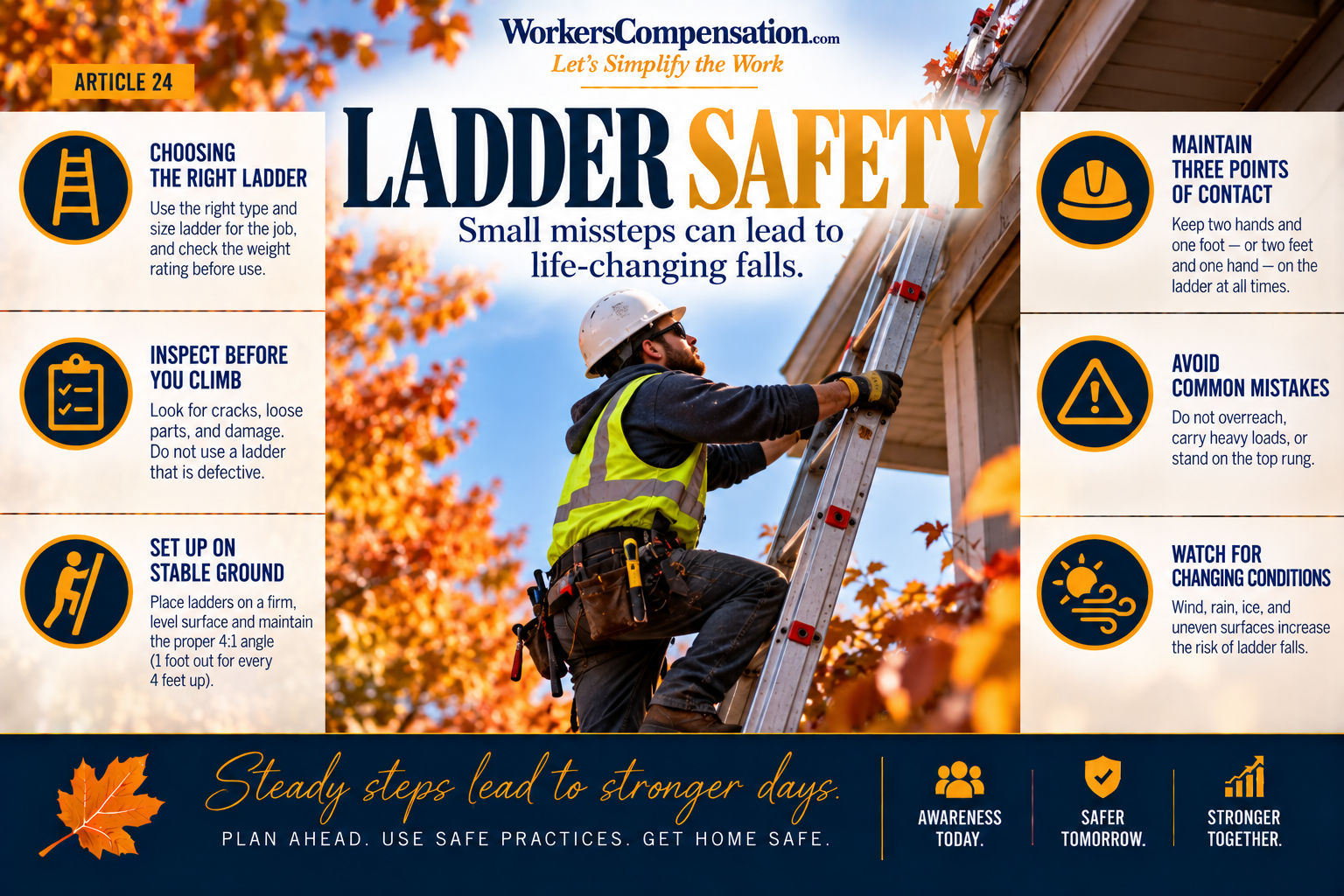
Welcome to The Science Behind Workplace Injuries: Fall Safety Series, where we explore how seasonal conditions interact with human physiology, behavior, and workplace systems. Yesterday, we examined why completing roof maintenance before snow can move hazardous work into better conditions. Many of those autumn tasks involve another familiar piece of equipment: the ladder. National injury data do not show a general autumn spike in ladder injuries. Autumn changes exposure by concentrating gutter cleaning, exterior repairs, harvest work, pre-winter maintenance, and holiday-light installation into a relatively short period. The ladder remains the same. More people simply spend more time climbing one.
Ladder Falls Often Begin with the Ladder
David Lombardi and colleagues interviewed 306 workers treated in emergency departments after work-related ladder falls. In 40% of the cases, the ladder itself moved before the worker fell. Environmental conditions contributed to fewer than 10% of the incidents. That distinction changes the prevention conversation because weather alone does not explain most ladder falls. The physical relationship among the ladder, its angle, the supporting surface, and the worker often matters more.
Extension-ladder angle provides a particularly useful example. A leaning ladder remains stable only while the friction available at its base exceeds the friction required to hold it in position. As the ladder becomes shallower, the amount of friction required at the feet increases substantially. Research comparing setup angles shows that moving from approximately 75 degrees to 65 degrees can increase the required base friction by roughly three-quarters. Autumn conditions such as wet leaves, mud, frost, or soft ground could further reduce stability, although researchers have not directly measured ladder-foot friction on those specific surfaces. The physics are established; the magnitude of the seasonal contribution is not.
What Feels Right Can Be Physically Wrong
Human perception makes ladder setup even more interesting. Wen-Ruey Chang and colleagues observed professional cable installers who had received both initial and refresher ladder training. Across 265 real-world setups, the average ladder angle was 67.3 degrees, substantially shallower than the recommended 75.5 degrees. Nearly all participants could identify a recommended setup method, but only three of the 67 workers actually used one during observed work. Even those three did not consistently achieve the target angle. Knowledge existed without reliably changing behavior.
A shallower ladder can feel more comfortable because a steeper position may create a sensation that the ladder could tip backward. Unfortunately, the position that feels more secure can require considerably more friction to prevent the base from sliding. Repeated successful climbs reinforce that perception because an improperly positioned ladder may work hundreds of times before conditions expose the weakness. Experience then provides misleading feedback: nothing happened yesterday, so the setup begins to feel proven. Angle indicators and other objective setup tools interrupt that cycle by replacing visual judgment with information. When perception and physics disagree, measurement provides the better control.
The Task Can Pull the Worker Beyond the Ladder
Setup is only one part of the problem. The work itself can encourage people to move outside the ladder's stable boundaries. David Williams and colleagues studied 104 older adults performing a simulated gutter-clearing task and found that situational factors—including the amount of debris remaining and the ladder's position—influenced reaching behavior. The finding matters because gutter cleaning creates a familiar decision: climb down, reposition the ladder, climb back up, and finish the remaining section, or stretch a little farther and complete it from the current position. The task creates its own incentive to overreach.
That same pressure appears across autumn maintenance. One more section of gutter, one more light, one more branch, or one final repair can make repositioning feel inefficient. Descending and moving a ladder costs time and physical effort, while the immediate reward for reaching is finishing the task. Prevention therefore has to address how the work is organized. Adequate time, correctly sized equipment, stabilizers, and access methods that reduce repeated repositioning can change the decision before someone is balancing at height. For longer or repeated work, a lift or scaffold may remove the ladder decision altogether.
Low Height Does Not Mean Low Consequence
Ladders can also distort risk perception because many common tasks occur relatively close to the ground. NIOSH's national analysis of occupational ladder injuries found that half of emergency-department-treated work ladder falls with known fall height occurred from six to ten feet. Fourteen percent of workers treated in emergency departments were admitted to the hospital, compared with approximately 5% of occupational injuries overall. Construction and extraction workers experiencing ladder falls had a median of 42 days away from work. A height that feels routine can still generate enough energy to produce fractures, head injuries, and prolonged disability.
Those consequences make ladder work a useful example of why training cannot carry an entire safety system. Workers need to understand ladder selection, inspection, setup, climbing, and positioning, but research shows knowledgeable workers can still make predictable setup errors. Organizations can eliminate some climbs, substitute safer access equipment, provide ladders appropriate to the task, use angle indicators and stabilizing equipment, establish acceptable surface conditions, and build repositioning time into the job. Autumn provides a reason to review those controls because the work calendar increases exposure. Familiar equipment deserves objective controls precisely because familiarity makes its risk easy to underestimate.
The larger lesson extends beyond ladders. People become comfortable with methods that have worked repeatedly, even when successful repetition provides poor information about the underlying margin of safety. A ladder does not have to fail every time it is set too shallow for the setup to be unstable. The absence of yesterday's injury cannot measure today's safety margin. When experience cannot reliably reveal the boundary between stable and unstable, the system should make that boundary easier to see.
Tomorrow in The Science Behind Workplace Injuries: Fall Safety Series — Seasonal Affective Disorder and Safety. We will examine what seasonal changes in light can do to sleep, mood, attention, and human performance—and where the evidence connecting those changes to workplace injuries remains incomplete.
Research Referenced
Chang, W.-R., Huang, Y.-H., Chang, C.-C., Brunette, C., & Fallentin, N. (2016). Straight ladder inclined angle in a field environment: The relationship among actual angle, method of set-up and knowledge. Ergonomics, 59(8), 1100–1108. doi:10.1080/00140139.2015.1115897
Lombardi, D. A., Smith, G. S., Courtney, T. K., Brennan, M. J., Kim, J. Y., & Perry, M. J. (2011). Work-related falls from ladders—A follow-back study of US emergency department cases. Scandinavian Journal of Work, Environment & Health, 37(6), 525–532.
doi:10.5271/sjweh.3174
Socias, C. M., Chaumont Menéndez, C. K., Collins, J. W., & Simeonov, P. (2014). Occupational ladder fall injuries—United States, 2011. Morbidity and Mortality Weekly Report, 63(16), 341–346.
Williams, D. D., Beschorner, K. E., Sturnieks, D. L., Lord, S. R., & Pliner, E. M. (2022). Situational factors that influence overreaching on a ladder during a gutter clearing task among older adults. Applied Ergonomics, 104, 103794. doi:10.1016/j.apergo.2022.103794


AI best practices california case file caselaw case management case management focus claims compensability compliance compliance corner courts do you know the rule employers exclusive remedy florida fraud glossary check Healthcare hr homeroom insurance insurers iowa kentucky leadership NCCI new jersey new york ohio pennsylvania Safety safety at work state info tech technology the case manager violence WDYT what do you think women's history women's history month workers' comp 101 workers' recovery Workplace Safety Workplace Violence
Read Also
About The Author
About The Author
-
Claire Muselman
Meet Dr. Claire C. Muselman, the Chief Operating Officer at WorkersCompensation.com, where she blends her vast academic insight and professional innovation with a uniquely positive energy. As the President of DCM, Dr. Muselman is renowned for her dynamic approach that reshapes and energizes the workers' compensation industry. Dr. Muselman's academic credentials are as remarkable as her professional achievements. Holding a Doctor of Education in Organizational Leadership from Grand Canyon University, she specializes in employee engagement, human behavior, and the science of leadership. Her diverse background in educational leadership, public policy, political science, and dance epitomizes a multifaceted approach to leadership and learning. At Drake University, Dr. Muselman excels as an Assistant Professor of Practice and Co-Director of the Master of Science in Leadership Program. Her passion for teaching and commitment to innovative pedagogy demonstrate her dedication to cultivating future leaders in management, leadership, and business strategy. In the industry, Dr. Muselman actively contributes as an Ambassador for the Alliance of Women in Workers’ Compensation and plays key roles in organizations such as Kids Chance of Iowa, WorkCompBlitz, and the Claims and Litigation Management Alliance, underscoring her leadership and advocacy in workers’ compensation. A highly sought-after speaker, Dr. Muselman inspires professionals with her engaging talks on leadership, self-development, and risk management. Her philosophy of empathetic and emotionally intelligent leadership is at the heart of her message, encouraging innovation and progressive change in the industry. "Empowerment is key to progress. By nurturing today's professionals with empathy and intelligence, we're crafting tomorrow's leaders." - Dr. Claire C. Muselman
More by This Author
Read More
- Oct 14, 2026
- Frank Ferreri
- Oct 13, 2026
- Claire Muselman
- Oct 13, 2026
- Frank Ferreri
- Oct 12, 2026
- Claire Muselman
- Oct 12, 2026
- Anne Llewellyn
- Oct 12, 2026
- Claire Muselman