


Share This Article:
Fall Into Safety
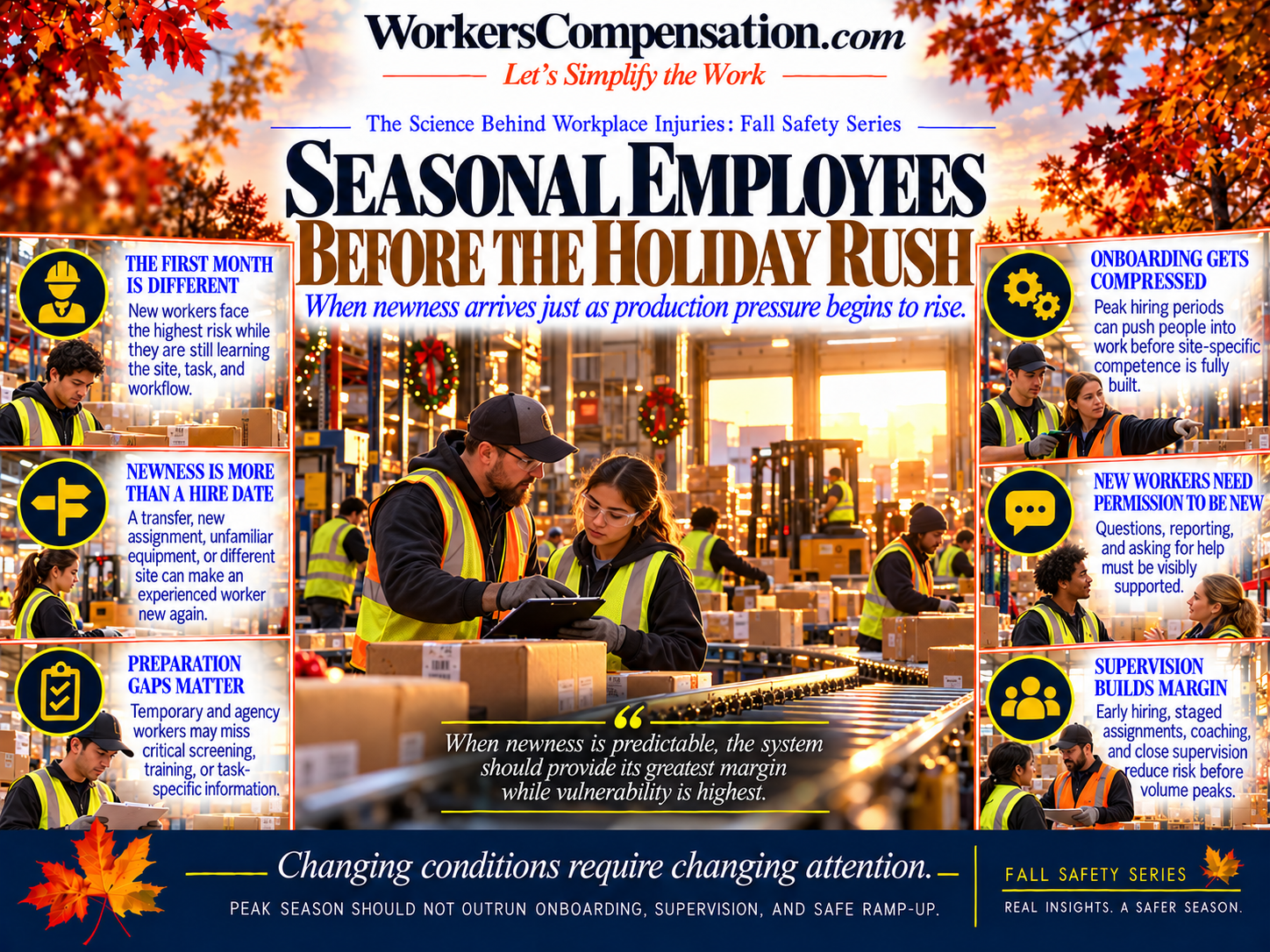
Welcome to The Science Behind Workplace Injuries: Fall Safety Series, where we explore how seasonal conditions interact with human physiology, behavior, and workplace systems. Yesterday, we examined what happens when holiday production stacks longer hours, faster pace, reduced recovery, and rising demand onto existing work. Today, we focus on another predictable part of that transition: thousands of employees entering unfamiliar jobs just as operations accelerate. Research does not suggest seasonal employees are inherently more likely to be injured because they are temporary, young, or less committed to the work. The more useful finding is that injury risk rises sharply when someone is new to a job, site, or task. Holiday hiring concentrates that newness into a narrow period when organizations have the least operational room for it.
The First Month Is a Different Risk Period
Curtis Breslin and Peter Smith examined workers' compensation data alongside labor-force information and found workers in their first month on a job were more than four times as likely to experience a lost-time claim as workers with more than one year of tenure. The relationship remained after accounting for age, sex, occupation, and industry, and appeared across every age group studied. A later systematic review led by Breslin examined 51 studies and found moderate evidence that new workers face greater risk of acute injuries such as cuts, burns, and falls. Evidence was considerably weaker for musculoskeletal injuries, an important distinction because it keeps us from turning “new worker risk” into a claim about every type of injury. The clearest signal involves acute events that occur while someone is learning how to function safely within an unfamiliar environment.
That makes newness more complex than a date on an employment record. An experienced employee can become new again when moving to another facility, changing assignments, learning unfamiliar equipment, or entering a different workflow. Prior work experience provides valuable knowledge, but it cannot provide complete familiarity with a specific site's traffic patterns, equipment, expectations, communication practices, or hazards. An established employee may recognize an unstable pallet, forklift route, awkward transition, or unusual equipment sound almost automatically because experience has taught the brain which information deserves attention. A new employee is still learning which information matters while simultaneously learning how to perform the job. The organization therefore has a predictable period in which the worker possesses less site-specific information while the environment continues demanding decisions.
Temporary Work Can Add a Preparation Gap
Temporary and agency workers introduce another layer because responsibility for preparation may be divided between organizations. Michael Foley compared injured temporary workers with permanent employees matched by industry, tenure, and demographic characteristics. Temporary workers actually reported less frequent exposure to hazards, but they were also less likely to receive experience screening, safety training, and control over their tasks. Their increased claim rates therefore cannot be explained simply by assuming they encountered more dangerous work. The difference appears to involve the countermeasures available when hazards occur.
During holiday hiring onboarding can become one of the first things compressed when organizations need people working quickly. A staffing agency may provide general preparation while the host employer understands the actual equipment, layout, production process, and site-specific hazards. When responsibility becomes ambiguous, important information can disappear between the two. Employers can reduce that gap by clearly defining who provides each component of training, screening workers for relevant task experience, using supervised practice, and confirming competence before assigning higher-hazard work. New employees can also begin with lower-hazard assignments and progress as familiarity develops. The first weeks should be intentionally designed because the elevated risk during those weeks is already known.
New Workers Need Permission to Be New
Preparation involves more than transferring information. New employees are also learning the unwritten rules of the organization: whether questions are welcomed, whether production targets can be interrupted for safety, whether reporting an injury creates consequences, and whether asking for help signals responsibility or weakness. Temporary workers may carry an additional concern that speaking up could affect whether they receive another assignment. A worker can complete orientation and still remain uncertain about whether using what they learned will be supported once production pressure arrives.
Leadership behavior becomes especially important in that environment. Dov Zohar demonstrated that changing supervisors' safety-oriented interactions with employees produced measurable improvements in safety climate, safety behavior, and minor-injury rates. The finding gives organizations something more useful than another reminder to “be careful.” Supervisors can routinely ask new employees what remains unclear, check understanding during actual work, reinforce that stopping for a hazard is expected, and visibly support reporting when something goes wrong. Those interactions communicate how safety functions under real production pressure. For someone still learning the culture, every supervisory response provides information about what the organization actually values.
Seasonal hiring is predictable, and so is the period of increased risk that accompanies new work. Organizations know when holiday employees will arrive, which departments will receive them, and approximately when production will accelerate. That creates an opportunity to hire earlier, protect the first weeks with greater supervision, match assignments to experience, and allow competence to develop before peak volume demands full performance. The employee may be seasonal, but the exposure comes from something every worker experiences repeatedly throughout a career: becoming new again. When newness creates a predictable period of vulnerability, the system should provide its greatest margin while that vulnerability is highest.
Tomorrow in The Science Behind Workplace Injuries: Fall Safety Series — Heating Systems and Fire Prevention. We will shift from human performance to the seasonal return of heating equipment and examine how dormant systems, combustible materials, and changing building conditions create preventable fire exposures.
Research Referenced
Breslin, F. C., Dollack, J., Mahood, Q., Maas, E. T., Laberge, M., & Smith, P. M. (2019). Are new workers at elevated risk for work injury? A systematic review. Occupational and Environmental Medicine, 76(9), 694–701. doi:10.1136/oemed-2018-105639
Breslin, F. C., & Smith, P. (2006). Trial by fire: A multivariate examination of the relation between job tenure and work injuries. Occupational and Environmental Medicine, 63(1), 27–32. doi:10.1136/oem.2005.021006
Foley, M. (2017). Factors underlying observed injury rate differences between temporary workers and permanent peers. American Journal of Industrial Medicine, 60(10), 841–851. doi:10.1002/ajim.22763
Zohar, D. (2002). Modifying supervisory practices to improve subunit safety: A leadership-based intervention model. Journal of Applied Psychology, 87(1), 156–163. doi:10.1037/0021-9010.87.1.156


AI best practices california case file caselaw case management case management focus claims compensability compliance compliance corner courts do you know the rule employers exclusive remedy florida fraud glossary check Healthcare hr homeroom insurance insurers iowa kentucky leadership NCCI new jersey new york ohio pennsylvania Safety safety at work state info tech technology the case manager violence WDYT what do you think women's history women's history month workers' comp 101 workers' recovery Workplace Safety Workplace Violence
Read Also
About The Author
About The Author
-
Claire Muselman
Meet Dr. Claire C. Muselman, the Chief Operating Officer at WorkersCompensation.com, where she blends her vast academic insight and professional innovation with a uniquely positive energy. As the President of DCM, Dr. Muselman is renowned for her dynamic approach that reshapes and energizes the workers' compensation industry. Dr. Muselman's academic credentials are as remarkable as her professional achievements. Holding a Doctor of Education in Organizational Leadership from Grand Canyon University, she specializes in employee engagement, human behavior, and the science of leadership. Her diverse background in educational leadership, public policy, political science, and dance epitomizes a multifaceted approach to leadership and learning. At Drake University, Dr. Muselman excels as an Assistant Professor of Practice and Co-Director of the Master of Science in Leadership Program. Her passion for teaching and commitment to innovative pedagogy demonstrate her dedication to cultivating future leaders in management, leadership, and business strategy. In the industry, Dr. Muselman actively contributes as an Ambassador for the Alliance of Women in Workers’ Compensation and plays key roles in organizations such as Kids Chance of Iowa, WorkCompBlitz, and the Claims and Litigation Management Alliance, underscoring her leadership and advocacy in workers’ compensation. A highly sought-after speaker, Dr. Muselman inspires professionals with her engaging talks on leadership, self-development, and risk management. Her philosophy of empathetic and emotionally intelligent leadership is at the heart of her message, encouraging innovation and progressive change in the industry. "Empowerment is key to progress. By nurturing today's professionals with empathy and intelligence, we're crafting tomorrow's leaders." - Dr. Claire C. Muselman
More by This Author
Read More
- Oct 11, 2026
- Frank Ferreri
- Oct 11, 2026
- Anne Llewellyn
- Oct 10, 2026
- Claire Muselman
- Oct 10, 2026
- Frank Ferreri
- Oct 10, 2026
- Claire Muselman
- Oct 10, 2026
- Chris Parker