


Share This Article:
Fall Into Safety
Welcome to The Science Behind Workplace Injuries: Fall Safety Series, where we explore how seasonal conditions interact with human physiology, behavior, and workplace systems. Yesterday, we examined grain bin entrapment and how storage decisions made during harvest can create an exposure months later. Today, we return to the active harvest season and follow agricultural equipment beyond the field, where tractors, combines, grain carts, wagons, and other slow-moving machinery share roads with vehicles traveling two or three times faster.
Farm-equipment crashes are relatively uncommon compared with ordinary motor-vehicle collisions, but their consequences can be severe. Across nine Midwestern states, researchers identified more than 7,000 farm-equipment crashes from 2005 through 2010; approximately 32% involved an injury and 2.2% included at least one fatality. The most important finding concerns who gets hurt. Agricultural operators are working inside large, heavy machines, while occupants of passenger vehicles have far less protection when the two collide. Research from Iowa found drivers of non-farm vehicles were more than five times as likely to be injured as farm-equipment operators in crashes involving both vehicle types. The occupational task therefore creates a roadway exposure extending well beyond the person performing the agricultural work.
The Speed Difference Creates a Perception Problem
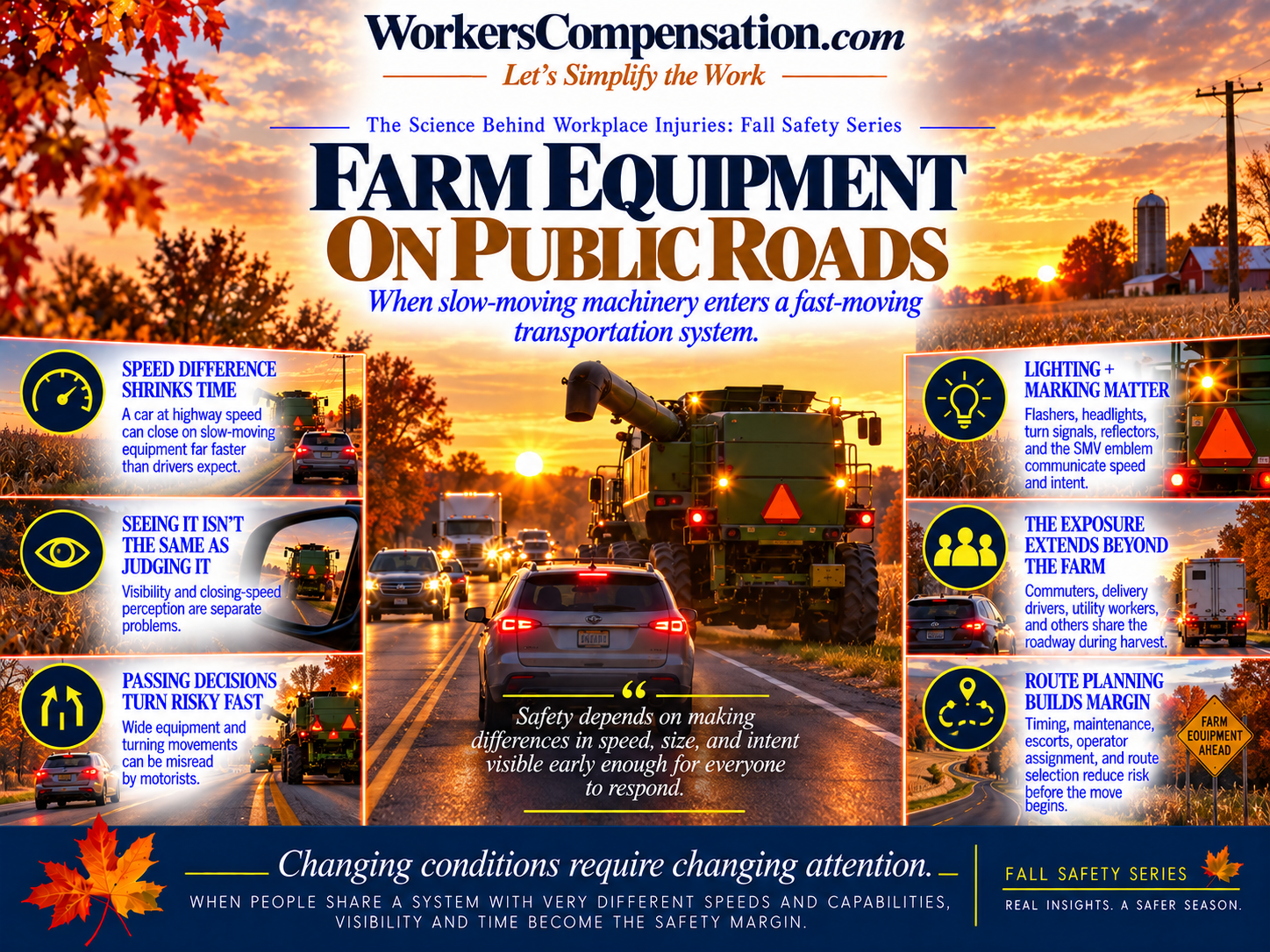
Consider a passenger vehicle traveling 55 miles per hour behind a tractor moving 20. The closing speed is 35 miles per hour, or approximately 51 feet every second. A 500-foot gap disappears in less than 10 seconds. During that interval, the approaching driver must notice the equipment, recognize that it is moving unusually slowly, estimate the closing rate, decide whether to brake or pass, and execute the decision safely. Each step consumes part of a rapidly shrinking time budget.
Human vision is imperfect at estimating that closing rate, particularly when an object is still relatively far away. Drivers use changes in an object's apparent size, sometimes called looming, to judge whether they are approaching it. A slow-moving piece of equipment may be clearly visible while the rate at which the distance is disappearing remains difficult to appreciate. Darkness, curves, hills, glare, and distraction can reduce the information available to the driver even further. Visibility and speed perception are therefore separate problems: seeing a tractor does not guarantee that the approaching motorist accurately understands how quickly they are reaching it.
The crash patterns are consistent with those perceptual demands. Corinne Peek-Asa and colleagues examined Iowa crashes involving farm equipment and another vehicle from 1995 through 2004 and found drivers of non-farm vehicles were 5.23 times more likely to be injured than farm-equipment drivers. Passing the farm equipment, speeding, frontal collisions, county roads, and darkness were among the characteristics associated with greater injury odds for the non-farm driver. Rear-end and passing collisions also appear repeatedly across the broader research literature. The pattern suggests that preventing these crashes requires giving approaching motorists enough information and enough time to understand what the equipment is doing.
Equipment geometry can make that interpretation harder. Agricultural machines may be significantly wider than a traffic lane, tow implements that extend the vehicle's length, and require operators to swing outward before completing a turn. A motorist may interpret that outward movement as the operator pulling aside and begin passing just as the equipment turns left. Turn signals can also be difficult to distinguish among other flashing lights on large equipment. Two drivers can therefore observe the same movement and form entirely different expectations about what happens next, making clear signaling and patient passing decisions especially important.
Visibility Has to Communicate More Than Presence
Conspicuity is the ability of equipment to be noticed and correctly interpreted, and both parts matter. An approaching driver needs to perceive the machine's width, direction, speed, and intended movement early enough to respond. Marizen Ramirez and colleagues examined 7,083 farm-equipment crashes across nine Midwestern states and compared state lighting and marking policies with standards developed by the American Society of Agricultural and Biological Engineers. Every five-point increase in the researchers' policy score was associated with a 17% lower crash rate, while lighting-specific policies showed an even larger association. Because the study compared state policies rather than experimentally assigning equipment controls, the results demonstrate association rather than proving that lighting requirements caused the reduction.
The findings still provide useful evidence for the value of communicating information clearly. Headlights, taillights, flashing amber lights, turn signals, reflectors, and slow-moving-vehicle emblems work together to help other drivers identify what they are approaching. Harvest conditions can degrade those signals as dust and debris accumulate on lights and reflective materials, while ordinary wear can leave lights inoperative precisely when they become most important. Pre-trip inspections should therefore include visibility equipment along with the mechanical systems required to operate the machine. A tractor that runs perfectly but cannot communicate its presence and movement to surrounding traffic is not fully prepared for road travel.
The familiar orange slow-moving-vehicle triangle illustrates why the quality of that communication matters. Philip Garvey studied motorists' comprehension of the slow-moving-vehicle emblem and found drivers did not consistently interpret it correctly. The symbol also changes in appearance between daytime and nighttime conditions as its fluorescent and reflective components interact differently with available light. A warning symbol can only influence behavior when the person seeing it understands the information it is intended to convey. Multiple complementary signals reduce dependence on a motorist recognizing one emblem correctly.
Autumn introduces shorter days and more equipment movement during harvest, but darkness should not become the entire explanation for these crashes. Farm-level research has found that many incidents occur during daylight, clear weather, and dry road conditions, while other studies have associated darkness with greater crash severity. The distinction is important because ordinary conditions can create a false sense that the roadway environment is uncomplicated. The fundamental speed, size, and maneuverability mismatch exists at noon on a clear day just as it does after sunset.
The Exposure Extends Beyond Rural Roads and Farm Workers
Agricultural-equipment crashes also occur closer to population centers than the stereotypical image of an isolated country road suggests. Karisa Harland, Mitchell Greenan, and Marizen Ramirez found approximately 30% of Midwestern agricultural-equipment crashes occurred in urban ZIP codes. Many rural crashes outside incorporated areas were also located only a few miles from town. Harvest equipment therefore interacts with commuters, school traffic, delivery drivers, service vehicles, and other road users who may have limited experience interpreting agricultural machinery.
That expands the occupational safety implications beyond agriculture. Utility crews, home-health employees, delivery drivers, sales professionals, service technicians, public employees, and other workers traveling through agricultural regions share the roadway exposure. A fleet driver may never operate a tractor and still encounter one repeatedly during harvest. Seasonal driver training can prepare employees for the speed differential, unusual turning movements, limited opportunities for safe passing, and the need for additional following distance without relying on the worker to learn those lessons during an unexpected encounter.
Agricultural employers also control several important conditions before equipment reaches the pavement. Route selection, timing, lighting and marking, equipment maintenance, operator assignment, and the use of escort vehicles are operational decisions. Nearly half of the farm-reported crashes in one multistate study involved an employee driving, reinforcing that movement between fields is part of the job rather than incidental travel. Harvest fatigue belongs in that planning as well, although current evidence does not establish sleep loss as a direct cause of farm-equipment roadway crashes. Relief drivers, reasonable work-hour expectations, and avoiding unnecessary road moves at the end of extended shifts create additional margin without overstating what the research can prove.
Workers' compensation data provide an incomplete picture of the resulting injuries. Iowa trauma-registry research found workers' compensation was the payer for only 18.5% of work-related agricultural injuries, reflecting self-employment, family operations, agricultural exemptions, and other differences in coverage. Farm-equipment road crashes complicate the picture further because non-farm vehicle occupants carry much of the injury burden. Depending on who was traveling and why, the resulting costs may appear in workers' compensation, commercial auto, personal auto, health insurance, liability, or several systems simultaneously. A small number of agricultural workers' compensation claims therefore cannot establish that the underlying roadway exposure is small.
Farm equipment on public roads illustrates how risk can emerge from the interaction between systems that function safely on their own. A tractor traveling 20 miles per hour may be operating exactly as designed. A motorist traveling 55 miles per hour may be driving legally. When those vehicles occupy the same road, the rapidly disappearing distance between them changes how much time both operators have to perceive, interpret, communicate, and respond. When people must share a system with very different speeds and capabilities, safety depends on making those differences visible early enough for everyone to respond.
Tomorrow in The Science Behind Workplace Injuries: Fall Safety Series — Tree Trimming and Fall Cleanup Injuries. Autumn cleanup brings workers into contact with damaged trees, falling limbs, chainsaws, chippers, electrical hazards, and uneven terrain. We will examine why the physics of tree work can overwhelm human reaction time and why experience, supervision, and work design become especially important when seasonal demand brings new workers into high-consequence tasks.
Research Referenced
Garvey, P. M. (2003). Motorist comprehension of the slow-moving vehicle (SMV) emblem. Journal of Agricultural Safety and Health, 9(2), 159–169.
Harland, K. K., Greenan, M., & Ramirez, M. (2014). Not just a rural occurrence: Differences in agricultural equipment crash characteristics by rural-urban crash site and proximity to town. Accident Analysis & Prevention, 70, 8–13. doi:10.1016/j.aap.2014.02.013
Peek-Asa, C., Sprince, N. L., Whitten, P. S., Falb, S. R., Madsen, M. D., & Zwerling, C. (2007). Characteristics of crashes with farm equipment that increase potential for injury. Journal of Rural Health, 23(4), 339–347. doi:10.1111/j.1748-0361.2007.00112.x
Ramirez, M., Bedford, R., Wu, H., Harland, K., Cavanaugh, J. E., & Peek-Asa, C. (2016). Lighting and marking policies are associated with reduced farm equipment-related crash rates: A policy analysis of nine Midwestern US states. Occupational and Environmental Medicine, 73(9), 621–626. doi:10.1136/oemed-2016-103672


AI best practices california case file caselaw case management case management focus claims compensability compliance compliance corner courts do you know the rule employers exclusive remedy florida fraud glossary check Healthcare hr homeroom insurance insurers iowa kentucky leadership NCCI new jersey new york ohio pennsylvania Safety safety at work state info tech technology the case manager violence WDYT what do you think women's history women's history month workers' comp 101 workers' recovery Workplace Safety Workplace Violence
Read Also
About The Author
About The Author
-
Claire Muselman
Meet Dr. Claire C. Muselman, the Chief Operating Officer at WorkersCompensation.com, where she blends her vast academic insight and professional innovation with a uniquely positive energy. As the President of DCM, Dr. Muselman is renowned for her dynamic approach that reshapes and energizes the workers' compensation industry. Dr. Muselman's academic credentials are as remarkable as her professional achievements. Holding a Doctor of Education in Organizational Leadership from Grand Canyon University, she specializes in employee engagement, human behavior, and the science of leadership. Her diverse background in educational leadership, public policy, political science, and dance epitomizes a multifaceted approach to leadership and learning. At Drake University, Dr. Muselman excels as an Assistant Professor of Practice and Co-Director of the Master of Science in Leadership Program. Her passion for teaching and commitment to innovative pedagogy demonstrate her dedication to cultivating future leaders in management, leadership, and business strategy. In the industry, Dr. Muselman actively contributes as an Ambassador for the Alliance of Women in Workers’ Compensation and plays key roles in organizations such as Kids Chance of Iowa, WorkCompBlitz, and the Claims and Litigation Management Alliance, underscoring her leadership and advocacy in workers’ compensation. A highly sought-after speaker, Dr. Muselman inspires professionals with her engaging talks on leadership, self-development, and risk management. Her philosophy of empathetic and emotionally intelligent leadership is at the heart of her message, encouraging innovation and progressive change in the industry. "Empowerment is key to progress. By nurturing today's professionals with empathy and intelligence, we're crafting tomorrow's leaders." - Dr. Claire C. Muselman
More by This Author
Read More
- Oct 06, 2026
- Chriss Swaney
- Oct 05, 2026
- Claire Muselman
- Oct 05, 2026
- Frank Ferreri
- Oct 04, 2026
- Claire Muselman
- Oct 04, 2026
- Chris Parker