


Share This Article:
3 Key Cases on Salary in Lieu of Compensation under Florida Workers’ Compensation Law
27 Sep, 2026 Frank Ferreri
Key Cases
In most states, when compensation for disability or remedial treatment is furnished by the employer and then is terminated, the limitation period on claims for additional compensation begins to run, the statute specifies, from "the last payment of compensation" or "the last remedial treatment furnished by the employer." Under Florida workers' compensation law, the two-year bar of the statute of limitations applies unless the employer intended, or the employee reasonably believed that the employer intended, to pay wages in lieu of Chapter 440 disability benefits — not as sick pay, not as a gratuity, not as the act of enlightened labor management, but specifically in lieu of Chapter 440 benefits considered to be due.
Here's a look at how some Florida courts have viewed look at "wages in lieu of compensation."
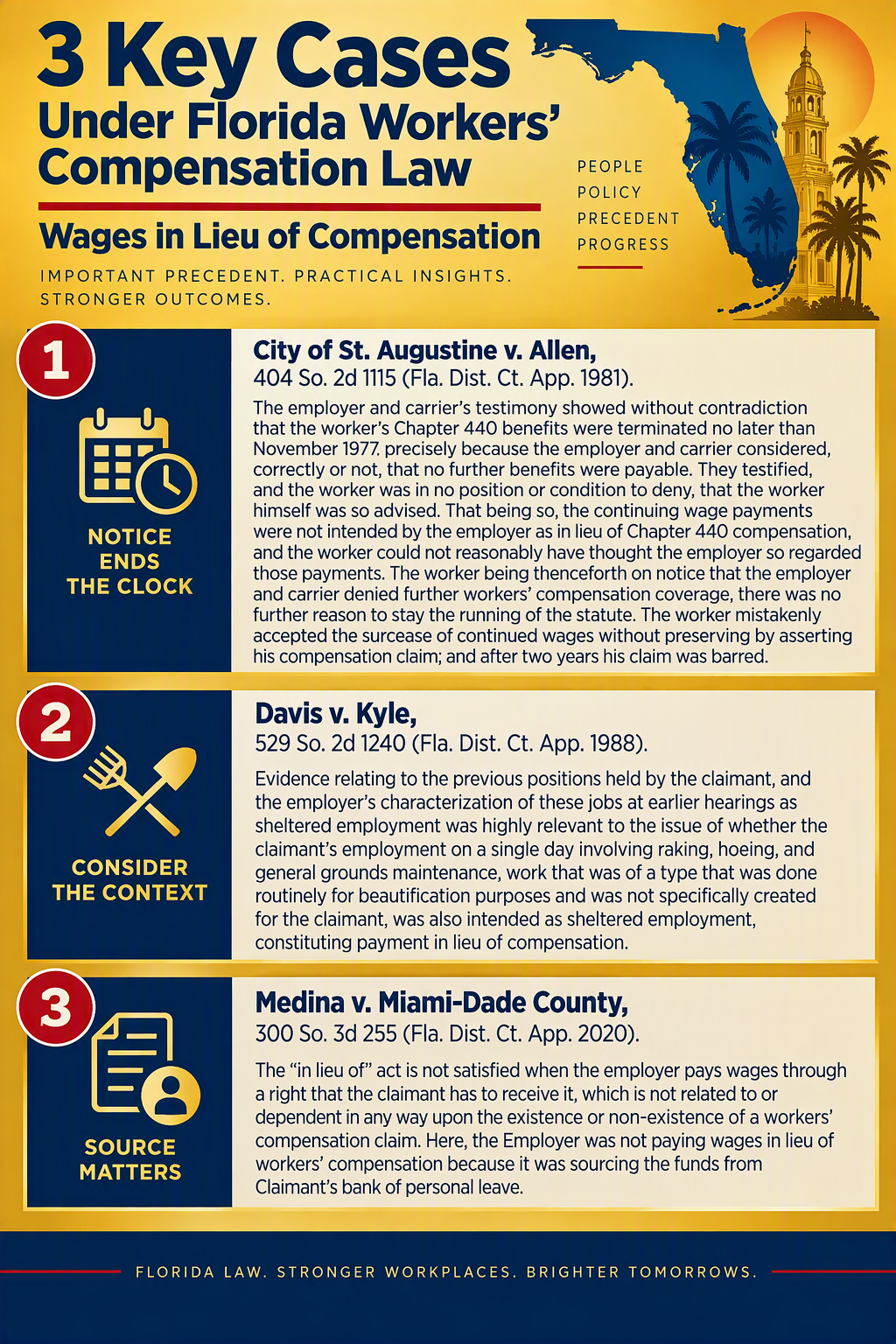
City of St. Augustine v. Allen, 404 So. 2d 1115 (Fla. Dist. Ct. App. 1981). The employer and carrier's testimony showed without contradiction that the worker's Chapter 440 benefits were terminated no later than November 1977 precisely because the employer and carrier considered, correctly or not, that no further benefits were payable. They testified, and the worker was in no position or condition to deny, that the worker himself was so advised. That being so, the continuing wage payments were not intended by the employer as in lieu of Chapter 440 compensation, and the worker could not reasonably have thought the employer so regarded those payments. The worker being thenceforth on notice that the employer and carrier denied further workers' compensation coverage, there was no further reason to stay the running of the statute. The worker mistakenly accepted the surcease of continued wages without preserving by asserting his compensation claim; and after two years his claim was barred.
Davis v. Kyle, 529 So. 2d 1240 (Fla. Dist. Ct. App. 1988). Evidence relating to the previous positions held by the claimant, and the employer's characterization of these jobs at earlier hearings as sheltered employment was highly relevant to the issue of whether the claimant's employment on a single day involving raking, hoeing, and general grounds maintenance, work that was of a type that was done routinely for beautification purposes and was not specifically created for the claimant, was also intended as sheltered employment, constituting payment in lieu of compensation.
Medina v. Miami-Dade County, 300 So. 3d 255 (Fla. Dist. Ct. App. 2020). The "in lieu of" act is not satisfied when the employer pays wages through a right that the claimant has to receive it, which is not related to or dependent in any way upon the existence or non-existence of a workers' compensation claim. Here, the Employer was not paying wages in lieu of workers' compensation because it was sourcing the funds from Claimant's bank of personal leave.
Practice Point
As the Allen case explained, when it can be shown that the employer and carrier didn't even know for a long time that the employee suffered an arguably compensable industrial accident, a decision to bar the stale claim, filed beyond the limitation period, is in good harmony with the conventional purposes of limitation statutes. Conversely, limitations concerns are less compelling where the carrier initially accepted the injury as compensable and provided benefits. In those circumstances, the employer and carrier already have notice of the accident and the claim, reducing the concerns that statutes of limitation are designed to address.
Additionally, it's important to note that in Florida:
(1) Continued wages are not automatically wages in lieu of compensation.
(2) Employer intent remains a critical factor.
(3) Clear notice that workers' compensation benefits are being denied generally prevents wage payments from tolling the statute.
(4) Sheltered employment may constitute wages in lieu of compensation depending on the circumstances.
(5) Payments derived from accrued leave, sick leave, or other independently earned benefits generally do not qualify as wages in lieu of compensation.


AI best practices california case file caselaw case management case management focus claims compensability compliance compliance corner courts do you know the rule employers exclusive remedy florida fraud glossary check Healthcare hr homeroom insurance insurers iowa kentucky leadership NCCI new jersey new york ohio pennsylvania Safety safety at work state info tech technology the case manager violence WDYT what do you think women's history women's history month workers' comp 101 workers' recovery Workplace Safety Workplace Violence
Read Also
About The Author
About The Author
-
Frank Ferreri
Frank Ferreri, M.A., J.D. covers workers' compensation legal issues. He has published books, articles, and other material on multiple areas of employment, insurance, and disability law. Frank received his master's degree from the University of South Florida and juris doctor from the University of Florida Levin College of Law. Frank encourages everyone to consider helping out the Kind Souls Foundation and Kids' Chance of America.
More by This Author
Read More
- Sep 27, 2026
- Claire Muselman
- Sep 26, 2026
- Chris Parker
- Sep 26, 2026
- Frank Ferreri
- Sep 24, 2026
- Claire Muselman
- Sep 24, 2026
- Frank Ferreri
- Sep 24, 2026
- Claire Muselman