


Share This Article:
Summer Safety Series
Welcome to The Science Behind Workplace Injuries: 30 Days of Summer Safety, where we explore the environmental hazards, human physiology, behavioral science, and organizational decisions shaping workplace safety. This article is part of our July series examining the science behind workplace injuries and the factors influencing workplace safety during the summer months.
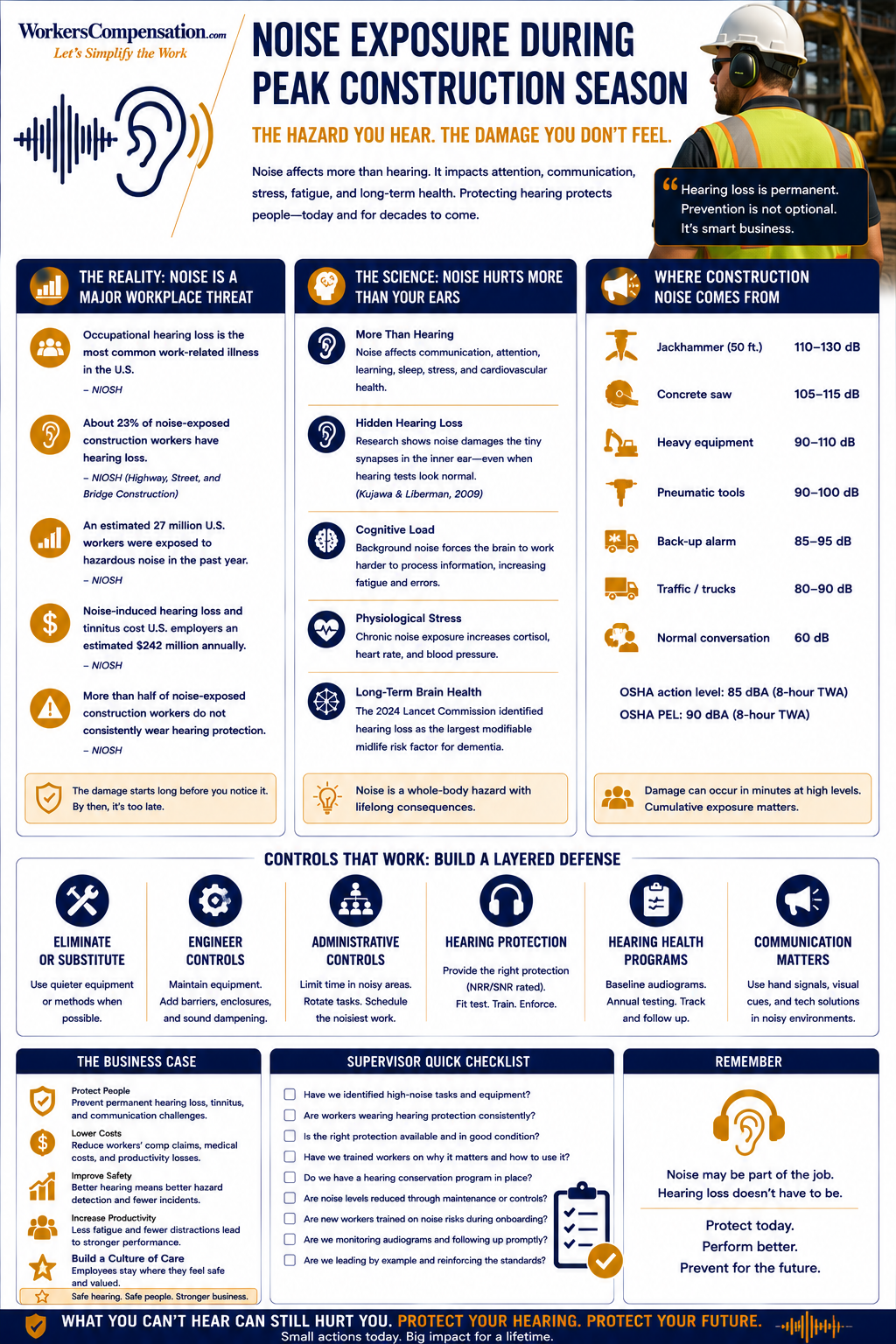
Most people think noise damages one part of the body, the ears. Science tells us that it damages more than just the ears. Excessive workplace noise influences hearing, communication, attention, stress, fatigue, cardiovascular health, and long-term cognitive function. Before permanent hearing loss develops, the brain is working harder to separate important information from background sound. Every warning signal, conversation, backing alarm, and equipment movement competes for the same limited attentional resources. Noise then becomes more than auditory hazard as it impacts human performance.
Construction provides a clear example. Peak construction season brings longer workdays, more simultaneous projects, additional heavy equipment, seasonal employees, and overlapping trades working within the same space. According to NIOSH, approximately twenty-three percent of noise-exposed construction workers experience occupational hearing loss, with highway, street, and bridge construction demonstrating some of the highest rates. More than half of noise-exposed construction workers report they do not consistently wear hearing protection, despite the well-established risks associated with prolonged exposure.
Occupational hearing loss remains the most common work-related illness in the United States. NIOSH estimates approximately twenty-seven million American workers were exposed to hazardous workplace noise during the previous year. Yet hearing loss often develops so gradually that many employees fail to recognize the damage until years after it has occurred. The absence of pain creates the illusion of safety while permanent biological changes continue accumulating inside the inner ear.
The science of hearing has also changed dramatically over the past two decades. For many years, researchers believed hearing damage occurred only after permanent changes appeared on a standard hearing test. That understanding shifted following the landmark work of Sharon Kujawa and M. Charles Liberman, who demonstrated noise exposure can permanently damage the synapses connecting inner hair cells to the auditory nerve even after hearing thresholds appear to recover. Researchers now refer to this as hidden hearing loss or cochlear synaptopathy. Damage may already be occurring while conventional hearing tests continue appearing normal.
The implications extend well beyond hearing. As auditory information becomes more difficult to process, the brain devotes additional cognitive resources to understanding speech, identifying warning signals, and filtering background noise. Mental effort increases. Fatigue develops more quickly. Communication becomes less efficient. Safety depends on more than whether people can hear. It depends on whether the brain can accurately interpret what it hears while continuing to monitor everything else happening in the environment.
Noise also acts as a physiological stressor. Continuous exposure activates the sympathetic nervous system and the hypothalamic-pituitary-adrenal axis, increasing cortisol, heart rate, and blood pressure. Researchers continue finding associations between long-term occupational noise exposure and hypertension, cardiovascular disease, and chronic stress. The body responds to excessive noise much like it responds to other workplace stressors. It prepares for action even when no immediate physical threat exists.
The long-term implications may extend even further. The 2024 Lancet Commission on Dementia Prevention, Intervention, and Care identified hearing loss as the largest modifiable midlife risk factor for dementia. Scientists believe hearing loss increases cognitive demand because the brain must devote greater effort to interpreting sounds that were once processed automatically. Fewer cognitive resources remain available for memory, executive function, and attention. Protecting hearing today may also help preserve cognitive health decades from now.
If the science is well established, why do many workers still remove hearing protection? Behavioral research offers several answers. Construction workers commonly report discomfort, heat, communication challenges, and concern about missing warning signals or conversations. Others gradually normalize noisy environments because hearing damage develops slowly and without pain. Studies by Neitzel and Seixas found construction workers wore hearing protection during fewer than one-quarter of the periods when measured noise exceeded recommended exposure limits. The challenge rarely reflects a lack of equipment. More often, it reflects how people perceive risk, comfort, and communication while performing demanding work.
Regulatory standards also highlight an important opportunity. OSHA's construction noise standard differs substantially from the more comprehensive hearing conservation requirements that apply to general industry. NIOSH recommends a more protective exposure limit, encourages comprehensive hearing conservation programs beginning at lower noise levels, and supports baseline audiograms, annual hearing evaluations, fit testing, and engineering controls whenever feasible. Many organizations already exceed the minimum requirements because protecting hearing protects far more than the ear itself.
Workers' compensation professionals understand occupational hearing loss claims can appear years or even decades after the exposure occurred. Unlike a fall or equipment injury, hearing loss develops gradually and is typically evaluated as an occupational disease rather than a single accident. Baseline audiograms, ongoing hearing evaluations, exposure monitoring, and detailed records become invaluable because they help establish the progression of hearing changes over time. Prevention and documentation frequently become inseparable.
Leadership has tremendous influence over hearing conservation because organizational culture shapes daily behavior. Supervisors who model hearing protection, provide comfortable and properly fitted devices, reduce unnecessary noise through engineering controls, schedule high-noise tasks thoughtfully, and explain the science behind hearing conservation create stronger compliance than organizations relying on rules alone. Protecting hearing should feel like an investment in every employee's long-term health, communication, and ability to perform safely.
The quality of information reaching the brain matters just as much as the information itself. Every warning alarm, conversation, equipment signal, and verbal instruction depends on the brain's ability to separate meaningful sounds from background noise. Organizations create safer workplaces when they recognize hearing conservation is not simply about preventing hearing loss. It is about preserving attention, communication, decision-making, and human performance throughout an employee's career.
Tomorrow in The Science Behind Workplace Injuries - The Human Cost of Rushing: Production Pressure and Injury Risk. Productivity and safety are often presented as competing priorities. Human performance science suggests a different perspective. Tomorrow, we examine how production pressure influences attention, decision-making, and workplace injuries, and why the fastest path is not always the safest or the most productive.


AI best practices california case file caselaw case management case management focus claims compensability compliance compliance corner courts do you know the rule employers exclusive remedy florida fraud glossary check Healthcare hr homeroom insurance insurers iowa kentucky leadership NCCI new jersey new york ohio pennsylvania Safety safety at work state info tech technology the case manager violence WDYT what do you think women's history women's history month workers' comp 101 workers' recovery Workplace Safety Workplace Violence
Read Also
About The Author
About The Author
-
Claire Muselman
Meet Dr. Claire C. Muselman, the Chief Operating Officer at WorkersCompensation.com, where she blends her vast academic insight and professional innovation with a uniquely positive energy. As the President of DCM, Dr. Muselman is renowned for her dynamic approach that reshapes and energizes the workers' compensation industry. Dr. Muselman's academic credentials are as remarkable as her professional achievements. Holding a Doctor of Education in Organizational Leadership from Grand Canyon University, she specializes in employee engagement, human behavior, and the science of leadership. Her diverse background in educational leadership, public policy, political science, and dance epitomizes a multifaceted approach to leadership and learning. At Drake University, Dr. Muselman excels as an Assistant Professor of Practice and Co-Director of the Master of Science in Leadership Program. Her passion for teaching and commitment to innovative pedagogy demonstrate her dedication to cultivating future leaders in management, leadership, and business strategy. In the industry, Dr. Muselman actively contributes as an Ambassador for the Alliance of Women in Workers’ Compensation and plays key roles in organizations such as Kids Chance of Iowa, WorkCompBlitz, and the Claims and Litigation Management Alliance, underscoring her leadership and advocacy in workers’ compensation. A highly sought-after speaker, Dr. Muselman inspires professionals with her engaging talks on leadership, self-development, and risk management. Her philosophy of empathetic and emotionally intelligent leadership is at the heart of her message, encouraging innovation and progressive change in the industry. "Empowerment is key to progress. By nurturing today's professionals with empathy and intelligence, we're crafting tomorrow's leaders." - Dr. Claire C. Muselman
More by This Author
Read More
- Sep 24, 2026
- Claire Muselman
- Sep 24, 2026
- Frank Ferreri
- Sep 24, 2026
- Claire Muselman
- Sep 24, 2026
- Anne Llewellyn
- Sep 22, 2026
- Claire Muselman
- Sep 22, 2026
- Frank Ferreri