


Share This Article:
Summer Safety Series
Welcome to The Science Behind Workplace Injuries: 30 Days of Summer Safety, where we explore the environmental hazards, human physiology, behavioral science, and organizational decisions shaping workplace safety. This article is part of our July series examining the science behind workplace injuries and the factors influencing workplace safety during the summer months.
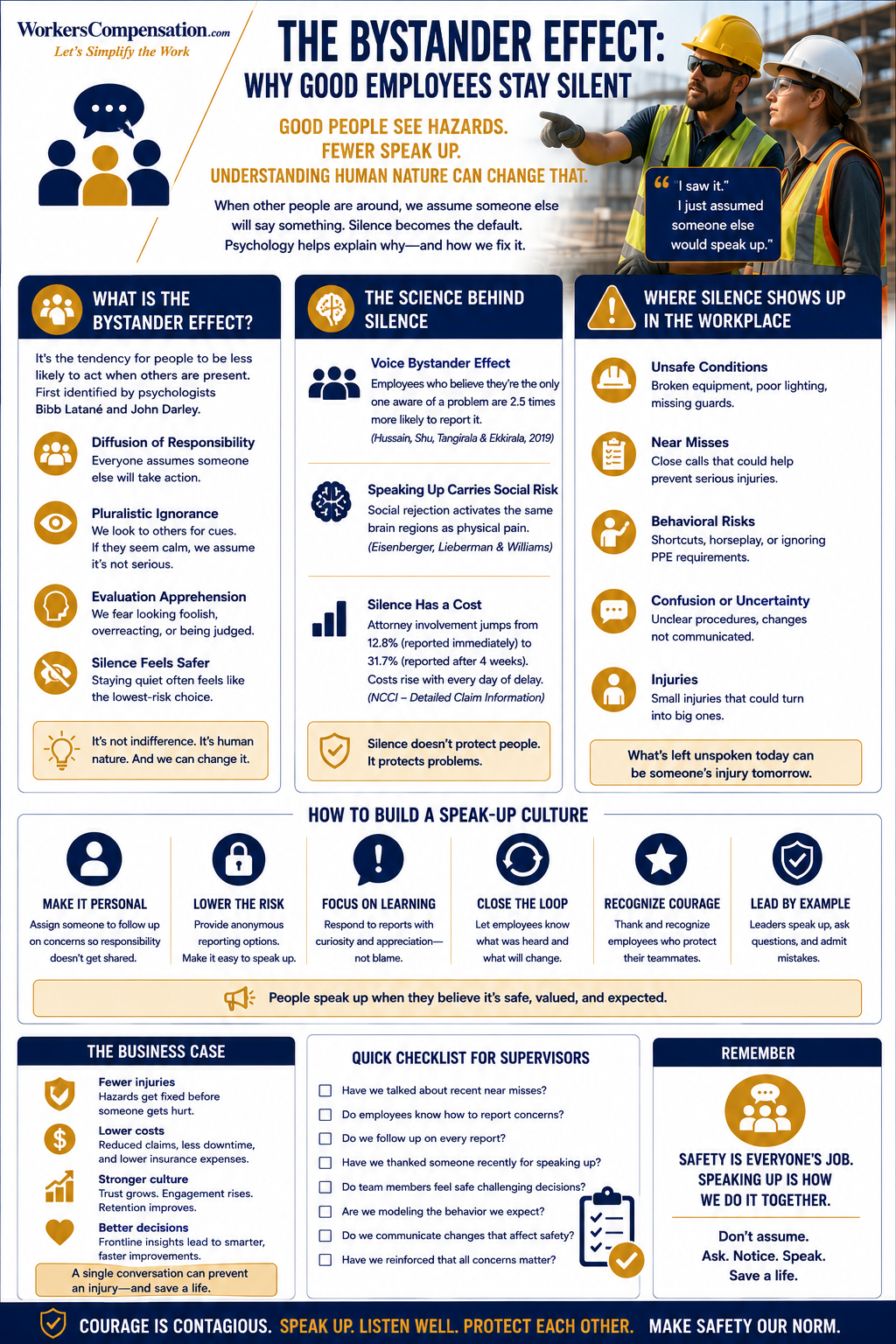
Most employees recognize a hazard when they see one. Far fewer say something. The difference has fascinated psychologists for decades. The bystander effect describes the tendency for people to become less likely to act when other people are present. At first glance, the behavior appears confusing. More people should create more opportunities for someone to speak up. Behavioral science consistently demonstrates the opposite can occur. Responsibility quietly becomes shared, assumptions replace action, and silence becomes surprisingly common.
The concept emerged from the work of social psychologists Bibb Latané and John Darley, who demonstrated people were less likely to intervene during an emergency when other bystanders were present. Their research identified several predictable psychological processes. Diffusion of responsibility occurs when everyone assumes someone else will take action. Pluralistic ignorance develops when people interpret everyone else's calm behavior as evidence the situation is not serious. Evaluation apprehension reflects the fear of looking foolish, overreacting, or being judged by others. None of those responses reflect indifference. They reflect predictable human psychology.
Modern organizational research shows the same pattern exists inside the workplace. Insiya Hussain, Rui Shu, Subra Tangirala, and Srinivas Ekkirala's 2019 study introduced the concept of the voice bystander effect, demonstrating employees who believed they were the only person aware of a problem were approximately two and a half times more likely to report it than employees who believed coworkers already knew. Ironically, widely recognized problems may be the least likely to reach leadership because everyone assumes someone else has already spoken up.
Neuroscience offers another fascinating explanation. Speaking up carries social risk. Research led by Naomi Eisenberger, Matthew Lieberman, and Kipling Williams demonstrated social rejection activates many of the same brain regions involved in processing physical pain, including the dorsal anterior cingulate cortex and anterior insula. Although physical pain and social pain are not neurologically identical, the overlap helps explain why remaining silent often feels emotionally safer than risking embarrassment, criticism, or exclusion. The decision is not simply rational. It is biological.
Silence carries consequences beyond communication. Delayed reporting allows hazards to remain uncorrected, near misses to disappear, and injuries to become more severe before intervention occurs. NCCI's Detailed Claim Information demonstrates attorney involvement increases from 12.8% for claims reported immediately to 31.7% for claims reported after four weeks. Median costs for sprain and strain claims also rise substantially as reporting delays increase. Every day of silence removes another opportunity to reduce harm.
Workers' compensation professionals understand silence influences claim severity, recovery, litigation, and organizational learning. A hazard that goes unreported today may become tomorrow's serious injury. A near miss that remains unspoken removes one of the most valuable opportunities to strengthen a safety program before someone gets hurt. Every conversation that never happens leaves valuable information unavailable to the people responsible for preventing the next injury.
Silence is also influenced by organizational culture. Amy Edmondson's work on psychological safety demonstrated employees speak up more readily when they believe they can ask questions, report concerns, admit mistakes, and offer ideas without fear of embarrassment or retaliation. Later research from James Detert and Amy Edmondson found 85% of employees reported withholding important information from a manager because they feared the consequences of speaking up. The challenge rarely reflects a lack of caring but rather reflects uncertainty about what will happen after someone raises a concern.
Employees watch how supervisors respond when concerns are raised. A leader who thanks someone for identifying a hazard reinforces future reporting. A leader who dismisses concerns, becomes defensive, or searches for someone to blame quietly teaches the opposite lesson. Every interaction shapes the psychological safety employees experience the next time they notice something that deserves attention. Trust grows one response at a time. Silence does the same.
OSHA recognizes the importance of this principle. Section 11(c) of the Occupational Safety and Health Act prohibits retaliation against employees who report workplace safety concerns, and OSHA's recordkeeping requirements emphasize that reporting procedures should encourage rather than discourage employees from reporting injuries and hazards. Regulations establish an important foundation. Organizational culture determines whether employees believe those protections truly exist in practice.
Organizations strengthen reporting by making responsibility personal rather than collective. Assigning a specific individual to follow up on a hazard reduces diffusion of responsibility. Anonymous reporting options lower the interpersonal cost of speaking up. Near-miss reporting systems shift attention toward learning instead of blame. Leaders who ask genuine questions, close the loop on reported concerns, and publicly recognize employees for protecting one another reinforce a culture where speaking up becomes an expected part of the job rather than an exceptional act of courage. The objective is not encouraging more reports. The objective is ensuring important information reaches the people who can act on it.
The bystander effect reminds us silence is rarely a sign that people do not care. More often, it reflects predictable human psychology operating within a particular environment. Organizations create safer workplaces by designing systems that make the right action easier to take. Every employee sees the workplace from a slightly different perspective. Safety improves when every one of those perspectives has a voice.
Tomorrow in The Science Behind Workplace Injuries - Stress, Heat, and Human Behavior. We talked about heat earlier in this series; however, heat influences more than body temperature. It changes mood, patience, decision-making, and human behavior in ways that often go unnoticed. Tomorrow, we explore how physiology, psychology, and environmental stress interact to shape workplace safety during the hottest months of the year.


AI california case file caselaw case management case management focus claims compensability compliance compliance corner courts covid do you know the rule employers exclusive remedy florida fraud glossary check Healthcare hr homeroom insurance insurers iowa kentucky leadership NCCI new jersey new york ohio pennsylvania Safety safety at work state info tech technology the case manager violence WDYT what do you think women's history women's history month workers' comp 101 workers' recovery Workplace Safety Workplace Violence
Read Also
About The Author
About The Author
-
Claire Muselman
Meet Dr. Claire C. Muselman, the Chief Operating Officer at WorkersCompensation.com, where she blends her vast academic insight and professional innovation with a uniquely positive energy. As the President of DCM, Dr. Muselman is renowned for her dynamic approach that reshapes and energizes the workers' compensation industry. Dr. Muselman's academic credentials are as remarkable as her professional achievements. Holding a Doctor of Education in Organizational Leadership from Grand Canyon University, she specializes in employee engagement, human behavior, and the science of leadership. Her diverse background in educational leadership, public policy, political science, and dance epitomizes a multifaceted approach to leadership and learning. At Drake University, Dr. Muselman excels as an Assistant Professor of Practice and Co-Director of the Master of Science in Leadership Program. Her passion for teaching and commitment to innovative pedagogy demonstrate her dedication to cultivating future leaders in management, leadership, and business strategy. In the industry, Dr. Muselman actively contributes as an Ambassador for the Alliance of Women in Workers’ Compensation and plays key roles in organizations such as Kids Chance of Iowa, WorkCompBlitz, and the Claims and Litigation Management Alliance, underscoring her leadership and advocacy in workers’ compensation. A highly sought-after speaker, Dr. Muselman inspires professionals with her engaging talks on leadership, self-development, and risk management. Her philosophy of empathetic and emotionally intelligent leadership is at the heart of her message, encouraging innovation and progressive change in the industry. "Empowerment is key to progress. By nurturing today's professionals with empathy and intelligence, we're crafting tomorrow's leaders." - Dr. Claire C. Muselman
More by This Author
Read More
- Sep 15, 2026
- Claire Muselman
- Sep 15, 2026
- Anne Llewellyn
- Sep 15, 2026
- Frank Ferreri
- Sep 14, 2026
- Claire Muselman
- Sep 14, 2026
- Frank Ferreri
- Sep 14, 2026
- Claire Muselman