


Share This Article:
Summer Safety Series
Welcome to The Science Behind Workplace Injuries: 30 Days of Summer Safety, where we explore the environmental hazards, human physiology, behavioral science, and organizational decisions shaping workplace safety. This article is part of our July series examining the science behind workplace injuries and the factors influencing workplace safety during the summer months.
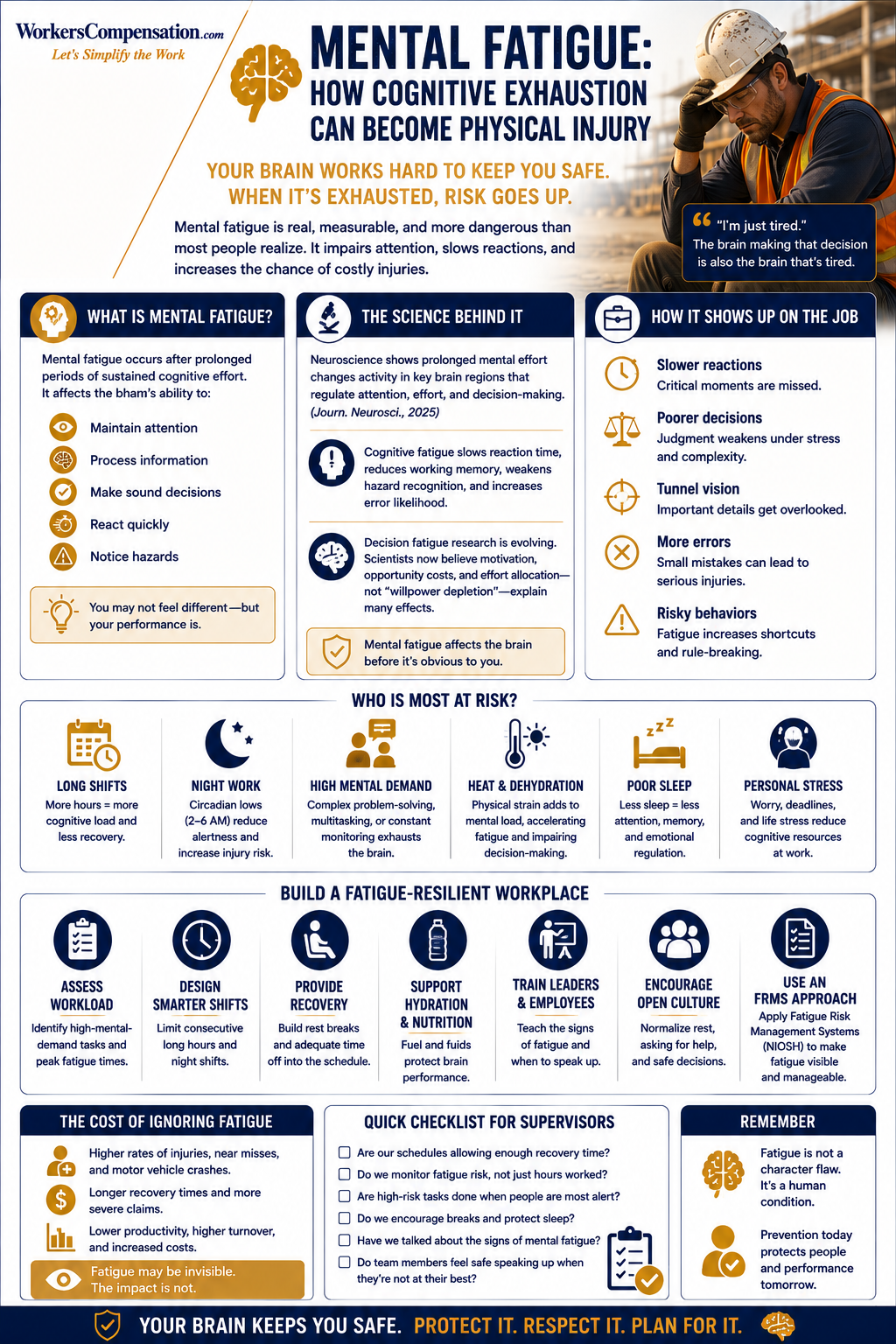
Most people recognize physical fatigue: heavy legs after climbing stairs, sore shoulders after lifting, tired muscles after a demanding day. Mental fatigue is more difficult to recognize because it leaves very few visible signs. The brain continues making decisions, solving problems, and responding to the world around it. The difference is not whether decisions are made. The difference is how much effort each decision requires.
Cognitive fatigue develops after prolonged periods of sustained mental effort. Attention gradually becomes more difficult to maintain. Reaction time slows. Working memory becomes less efficient. Hazard recognition declines. The changes often develop gradually enough that people rarely notice them while they are happening. The brain evaluating its own performance is experiencing the same fatigue influencing that performance. That biological reality helps explain why mentally exhausted employees often believe they are functioning normally.
Researchers have spent decades studying this phenomenon. Modern brain imaging consistently identifies a network involving the dorsolateral prefrontal cortex, dorsal anterior cingulate cortex, ventromedial prefrontal cortex, and insula that helps regulate executive function, effort, and decision-making. A 2025 study published in the Journal of Neuroscience found prolonged cognitive effort altered activity within this network, changing how the brain evaluates whether additional mental effort is worthwhile. Cognitive fatigue influences both performance and the willingness to continue investing effort.
One important distinction deserves attention. Cognitive fatigue is strongly supported across neuroscience, occupational medicine, and human factors research. Decision fatigue, a specific theory suggesting repeated decision-making gradually shifts people toward easier choices or decision avoidance, remains an active area of scientific discussion. Early theories proposed willpower functioned like a limited fuel source that became depleted throughout the day. Large replication studies have challenged that explanation, and the original glucose-depletion model has largely been abandoned. Scientists now believe motivation, opportunity costs, and effort allocation provide more accurate explanations for many observed effects. The science continues evolving, although the relationship between mental fatigue and workplace safety remains remarkably consistent.
The effects of cognitive fatigue are important because they extend well beyond thinking. Researchers consistently find mental fatigue slows reaction time, reduces response inhibition, weakens hazard recognition, and impairs fine motor control. A fatigued brain detects changes more slowly, processes information less efficiently, and requires greater effort to produce the same level of performance. Those changes create the conditions for slips, trips, falls, vehicle crashes, machinery incidents, and struck-by injuries. The injury may appear physical. The contributing factors often begin in the brain.
The relationship becomes even clearer when examining occupations requiring sustained concentration. Healthcare professionals make hundreds of clinical decisions during a single shift while managing interruptions, alarms, documentation, and patient care. Commercial drivers continuously monitor traffic, weather, road conditions, and vehicle performance for hours at a time. Manufacturing employees, construction workers, and equipment operators repeatedly scan their environments for subtle hazards while maintaining production. Different industries perform different work. The neurological demands remain remarkably similar. Attention, working memory, and executive function are continuously supporting safe performance.
Fatigue also follows predictable patterns throughout the day. Occupational medicine researchers have shown injury risk increases during evening and night shifts, with particularly high risk occurring during the body's circadian low between approximately 2:00 a.m. and 6:00 a.m. The National Safety Council estimates drowsy driving contributes to approximately twenty-one percent of fatal motor vehicle crashes. Those findings reinforce an important lesson. Human performance reflects biology as much as motivation. The brain cannot simply decide to ignore circadian rhythms.
Workers' compensation professionals rarely receive a claim labeled "cognitive fatigue." Instead, fatigue quietly appears beneath the surface of many investigations. A vehicle drifts across the centerline. A worker fails to recognize a developing hazard. A hand moves into the wrong location while operating equipment. An employee forgets a familiar step in a routine procedure. The diagnosis may be a fracture, laceration, or traumatic brain injury. Understanding the cognitive conditions preceding the event often provides a more complete explanation than focusing exclusively on the physical outcome.
Leadership creates one of the greatest opportunities for prevention because organizations can reduce unnecessary cognitive load before performance begins to decline. Fatigue Risk Management Systems, commonly known as FRMS, encourage employers to evaluate scheduling practices, workload, staffing levels, shift design, recovery opportunities, and high-risk tasks through the lens of human performance. NIOSH incorporates fatigue into its Total Worker Health framework, while OSHA recognizes long work hours, irregular schedules, and inadequate recovery as important occupational hazards. Effective fatigue management begins with thoughtful system design rather than expecting employees to simply push through exhaustion.
Simple organizational changes can produce meaningful improvements. Scheduling the most complex tasks earlier in a shift, minimizing unnecessary interruptions during safety-critical work, using checklists to reduce decision load, encouraging meaningful breaks, limiting excessive overtime, and creating psychologically safe environments where employees can report fatigue all help preserve cognitive capacity. The objective is not removing every demand from the workplace. The objective is ensuring mental energy is available when it matters most.
Mental fatigue reminds us the brain is every bit as important to workplace safety as the body. Employees do not leave their cognitive capacity at the door when they arrive at work. They rely on it with every decision, every observation, every movement, and every conversation throughout the day. Understanding how cognitive fatigue influences performance allows organizations to design work that respects both the remarkable strengths and the natural limits of the human brain. Protecting people begins by protecting the capacity they depend on to make safe decisions.
Tomorrow in The Science Behind Workplace Injuries - Vacation Brain: Why Injuries Spike Before and After Time Off. Vacations restore energy and improve well-being, yet the days immediately before and after time away often present unique safety challenges. Tomorrow, we explore how anticipation, routine disruption, prospective memory, and attention influence workplace decision-making as employees transition into and out of vacation mode.


AI best practices california case file caselaw case management case management focus claims compensability compliance compliance corner courts do you know the rule employers exclusive remedy florida fraud glossary check Healthcare hr homeroom insurance insurers iowa kentucky leadership NCCI new jersey new york ohio pennsylvania Safety safety at work state info tech technology the case manager violence WDYT what do you think women's history women's history month workers' comp 101 workers' recovery Workplace Safety Workplace Violence
Read Also
About The Author
About The Author
-
Claire Muselman
Meet Dr. Claire C. Muselman, the Chief Operating Officer at WorkersCompensation.com, where she blends her vast academic insight and professional innovation with a uniquely positive energy. As the President of DCM, Dr. Muselman is renowned for her dynamic approach that reshapes and energizes the workers' compensation industry. Dr. Muselman's academic credentials are as remarkable as her professional achievements. Holding a Doctor of Education in Organizational Leadership from Grand Canyon University, she specializes in employee engagement, human behavior, and the science of leadership. Her diverse background in educational leadership, public policy, political science, and dance epitomizes a multifaceted approach to leadership and learning. At Drake University, Dr. Muselman excels as an Assistant Professor of Practice and Co-Director of the Master of Science in Leadership Program. Her passion for teaching and commitment to innovative pedagogy demonstrate her dedication to cultivating future leaders in management, leadership, and business strategy. In the industry, Dr. Muselman actively contributes as an Ambassador for the Alliance of Women in Workers’ Compensation and plays key roles in organizations such as Kids Chance of Iowa, WorkCompBlitz, and the Claims and Litigation Management Alliance, underscoring her leadership and advocacy in workers’ compensation. A highly sought-after speaker, Dr. Muselman inspires professionals with her engaging talks on leadership, self-development, and risk management. Her philosophy of empathetic and emotionally intelligent leadership is at the heart of her message, encouraging innovation and progressive change in the industry. "Empowerment is key to progress. By nurturing today's professionals with empathy and intelligence, we're crafting tomorrow's leaders." - Dr. Claire C. Muselman
More by This Author
Read More
- Oct 25, 2026
- Claire Muselman
- Oct 25, 2026
- Chris Parker
- Oct 24, 2026
- Claire Muselman
- Oct 24, 2026
- Frank Ferreri
- Oct 24, 2026
- Claire Muselman
- Oct 23, 2026
- Claire Muselman