


Share This Article:
Summer Safety Series
Welcome to The Science Behind Workplace Injuries: 30 Days of Summer Safety, where we explore the environmental hazards, human physiology, behavioral science, and organizational decisions shaping workplace safety. This article is part of our July series examining the science behind workplace injuries and the factors influencing workplace safety during the summer months.
Have you ever caught yourself thinking about vacation while you were still sitting at your desk? Perhaps you were mentally packing a suitcase, thinking about an early morning flight, planning activities with family, or making a list of everything that still needed to be finished before leaving town. Your body remained at work. Part of your attention had already begun the trip.
The opposite often happens after returning home. Employees arrive back at work carrying jet lag, disrupted sleep, unfinished emails, changing priorities, and the mental effort required to reconnect with projects that suddenly feel less familiar. The transition lasts longer than unpacking a suitcase. The brain needs time to reestablish routines, rebuild context, and regain cognitive rhythm.
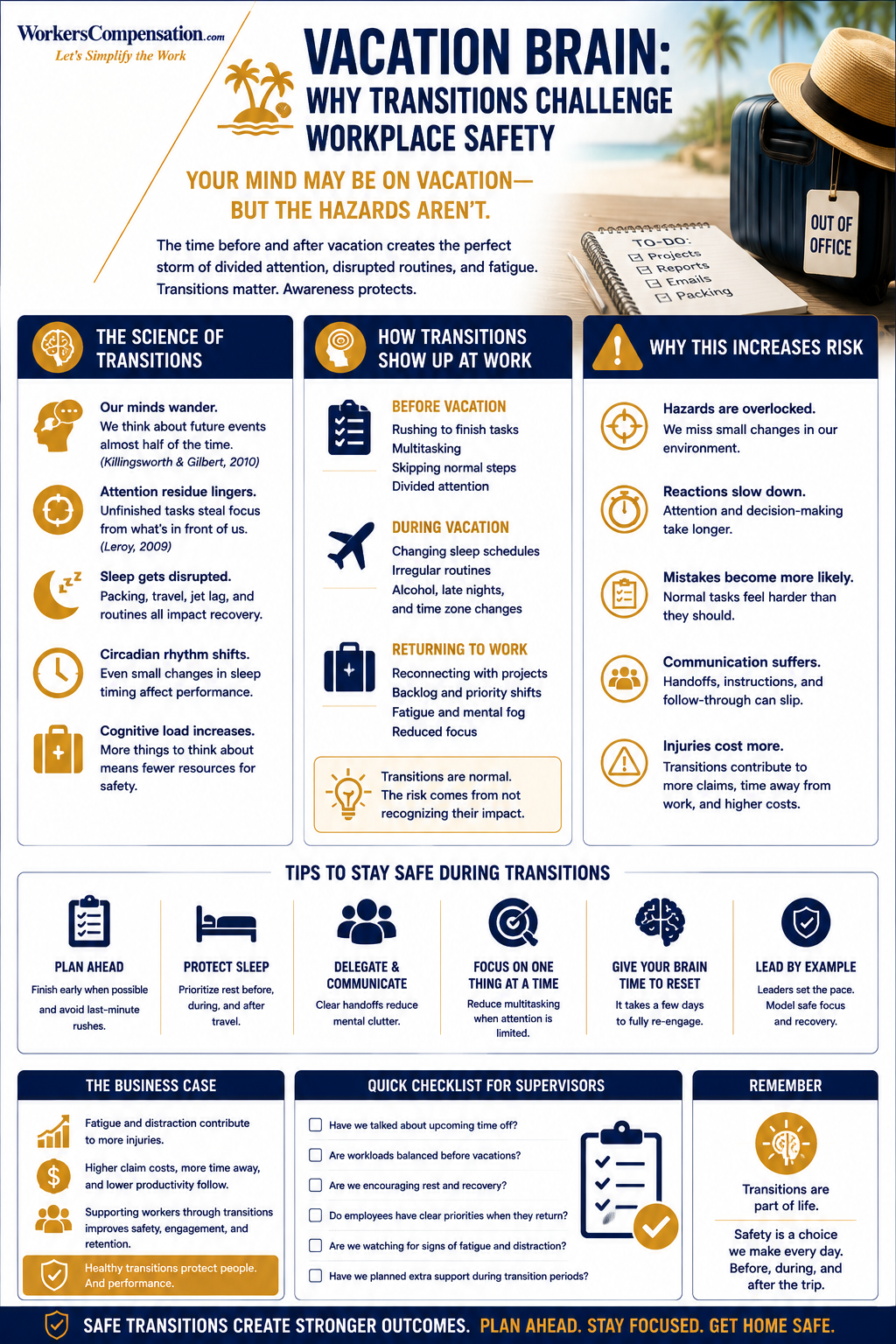
Researchers have not yet identified a definitive spike in workplace injuries immediately before or after vacations. The science tells a more interesting story. Sleep disruption, divided attention, routine interruption, fatigue, and cognitive switching each increase the likelihood of human error. Vacation periods bring many of those factors together at the same time. Understanding the physiology and psychology behind those transitions provides valuable insight into workplace safety.
One of the strongest explanations comes from attention itself. Matthew Killingsworth and Daniel Gilbert's research published in Science found people spend nearly half of their waking hours thinking about something other than what they are currently doing. Much of that mental activity focuses on future events. Before a vacation, the brain naturally rehearses upcoming plans, solves future problems, and imagines experiences that have not yet occurred. Attention becomes divided because the mind is simultaneously managing the present and preparing for the future.
Organizational psychologist Sophie Leroy described another important concept known as attention residue. When people leave one task before mentally finishing it, part of their attention remains attached to the previous activity. Beginning a new task becomes more difficult because cognitive resources remain invested elsewhere. The days leading up to vacation often involve dozens of unfinished conversations, incomplete projects, handoffs, and last-minute responsibilities. Attention becomes fragmented long before the employee walks out the door.
Sleep often changes during the same period. Packing, travel logistics, early departures, changing schedules, and excitement frequently reduce sleep immediately before leaving. Returning home introduces another transition through late flights, jet lag, social jet lag, or simply returning to an unfamiliar routine. Dawson and Reid's research demonstrated prolonged wakefulness impairs performance at levels comparable to alcohol intoxication, reinforcing that even modest sleep disruption influences reaction time, attention, and decision-making. Vacation itself is rarely the challenge. The transition surrounding it deserves greater attention.
The effects of disrupted routines become even more apparent when examining workplace injury patterns. Occupational researchers have long observed what is commonly called the Monday effect, where nonfatal workplace injuries occur more frequently on Mondays than other weekdays. Researchers continue exploring the reasons behind this pattern, although routine disruption, readjusting after time away, changes in sleep schedules, and diminished habituation all appear to contribute. Returning from vacation presents many of those same cognitive challenges on a larger scale. The body has settled into one routine while the workplace expects another.
Another fascinating example comes from daylight saving time. Christopher Barnes and David Wagner's 2009 study examined mining injuries following the spring time change, when most workers lose only one hour of sleep. The researchers found injuries increased and became more severe during the Monday following the transition. Although later studies have produced mixed findings, the broader lesson remains remarkably consistent. Small disruptions in sleep and circadian rhythm can produce meaningful changes in workplace performance, particularly when combined with demanding work and divided attention.
The days leading up to vacation create another predictable challenge. Behavioral economists describe present bias as the tendency to place greater value on immediate rewards than future consequences. As departure approaches, the immediate goal becomes finishing projects, responding to emails, completing reports, and leaving work in good order. The desire to accomplish one more task can quietly encourage rushing, multitasking, or skipping normal routines. Productivity feels urgent. Safety quietly competes for the same cognitive resources.
Workers' compensation professionals understand many workplace injuries result from several contributing factors rather than one isolated mistake. A returning employee may be managing disrupted sleep, a backlog of work, changing priorities, and the mental effort required to reconnect with ongoing projects. Another employee may be thinking about an afternoon flight while attempting to finish several remaining assignments before leaving town. Neither situation reflects poor work ethic. Both reflect normal human cognition operating during periods of transition. Understanding those transitions often provides greater insight into why an injury occurred than focusing exclusively on the final event itself.
Leadership plays an important role in reducing transition-related risk. Clear handoff procedures, realistic workload expectations before scheduled leave, structured re-entry conversations, buffer time for reconnecting with priorities, and thoughtful scheduling of high-risk tasks all reduce unnecessary cognitive demands. The objective is not slowing productivity. The objective is recognizing that transitions require mental resources and designing work in a way that protects those resources during periods of change.
Vacations remain one of the healthiest investments employees can make. Time away supports recovery, strengthens relationships, improves well-being, and helps restore cognitive capacity. The science reminds us to pay closer attention to the transitions surrounding vacations. Human performance rarely changes because of one dramatic event. More often, it changes through a series of small physiological and psychological adjustments that occur as people move from one routine to another. Recognizing those moments creates another opportunity to prevent injuries before they happen.
Tomorrow in The Science Behind Workplace Injuries - The Bystander Effect: Why Good Employees Stay Silent. Most employees recognize hazards when they see them. Far fewer speak up. Tomorrow, we explore the psychology of the bystander effect, social influence, and why silence can become one of the most overlooked contributors to workplace injuries.


AI california case file caselaw case management case management focus claims compensability compliance compliance corner courts covid do you know the rule employers exclusive remedy florida fraud glossary check Healthcare hr homeroom insurance insurers iowa kentucky leadership NCCI new jersey new york ohio pennsylvania Safety safety at work state info tech technology the case manager violence WDYT what do you think women's history women's history month workers' comp 101 workers' recovery Workplace Safety Workplace Violence
Read Also
About The Author
About The Author
-
Claire Muselman
Meet Dr. Claire C. Muselman, the Chief Operating Officer at WorkersCompensation.com, where she blends her vast academic insight and professional innovation with a uniquely positive energy. As the President of DCM, Dr. Muselman is renowned for her dynamic approach that reshapes and energizes the workers' compensation industry. Dr. Muselman's academic credentials are as remarkable as her professional achievements. Holding a Doctor of Education in Organizational Leadership from Grand Canyon University, she specializes in employee engagement, human behavior, and the science of leadership. Her diverse background in educational leadership, public policy, political science, and dance epitomizes a multifaceted approach to leadership and learning. At Drake University, Dr. Muselman excels as an Assistant Professor of Practice and Co-Director of the Master of Science in Leadership Program. Her passion for teaching and commitment to innovative pedagogy demonstrate her dedication to cultivating future leaders in management, leadership, and business strategy. In the industry, Dr. Muselman actively contributes as an Ambassador for the Alliance of Women in Workers’ Compensation and plays key roles in organizations such as Kids Chance of Iowa, WorkCompBlitz, and the Claims and Litigation Management Alliance, underscoring her leadership and advocacy in workers’ compensation. A highly sought-after speaker, Dr. Muselman inspires professionals with her engaging talks on leadership, self-development, and risk management. Her philosophy of empathetic and emotionally intelligent leadership is at the heart of her message, encouraging innovation and progressive change in the industry. "Empowerment is key to progress. By nurturing today's professionals with empathy and intelligence, we're crafting tomorrow's leaders." - Dr. Claire C. Muselman
More by This Author
Read More
- Sep 14, 2026
- Claire Muselman
- Sep 14, 2026
- Frank Ferreri
- Sep 14, 2026
- Claire Muselman
- Sep 14, 2026
- Frank Ferreri
- Sep 14, 2026
- Claire Muselman
- Sep 14, 2026
- Frank Ferreri