


Share This Article:
Summer Safety Series
Welcome to The Science Behind Workplace Injuries: 30 Days of Summer Safety, where we explore the environmental hazards, human physiology, behavioral science, and organizational decisions shaping workplace safety. This article is part of our July series examining the science behind workplace injuries and the factors influencing workplace safety during the summer months.
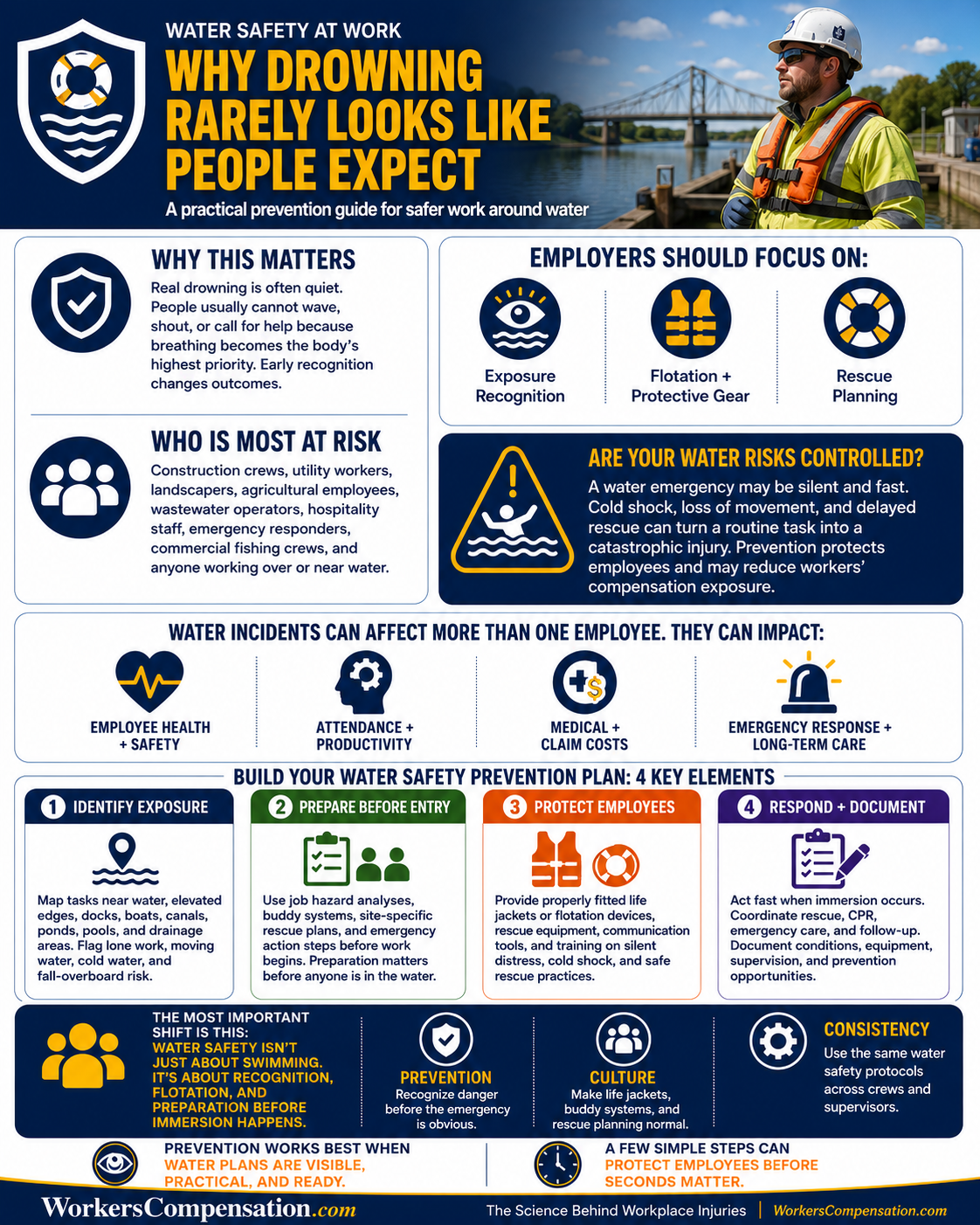
Most of us learned what drowning looks like from television and movies. Someone splashes wildly. They wave their arms and yell for help while struggling to stay above the surface. It is a dramatic scene that leaves little doubt an emergency is unfolding. Human physiology tells a different story as real drowning is often remarkably quiet. Understanding that difference changes how supervisors, coworkers, and organizations recognize risk around water.
One of the most influential researchers in water rescue, Dr. Francesco A. Pia, described what he called the Instinctive Drowning Response. As oxygen becomes the body's highest priority, breathing replaces speaking. People lose the ability to call for help because every effort is directed toward keeping the airway above the surface. Arms instinctively press downward instead of waving. The body remains upright with little or no effective kicking. Many victims disappear beneath the surface within twenty to sixty seconds. The absence of shouting does not signal safety and often reflects the physiology of drowning itself.
Water introduces another physiological challenge many people never consider. Entering cold water triggers an immediate cold-shock response characterized by an involuntary gasp, rapid breathing, and a dramatic increase in heart rate. Dr. Gordon Giesbrecht's widely recognized "1-10-1" principle explains how cold-water immersion rapidly changes the body's ability to function. Approximately one minute is spent managing the initial cold shock. Roughly ten minutes remain before cold incapacitation begins limiting meaningful movement. Survival beyond that point depends far more on flotation than swimming ability. The strongest swimmer cannot overcome physiology indefinitely.
The relationship between physiology and decision-making extends even further. Tipton, Montgomery, Bierens, and their coauthors have shown drowning progresses through predictable physiological stages beginning with breath-holding, followed by water aspiration, loss of consciousness, cardiorespiratory arrest, and death if rescue does not occur. Their work reminds us drowning is a process rather than a single event. Every stage creates another opportunity for prevention before the final outcome occurs.
Occupational exposure extends beyond commercial fishing. Construction workers building bridges, utility crews working near retention ponds, landscapers maintaining lakes, agricultural employees working around irrigation canals, wastewater operators, hospitality employees responsible for pools, and emergency responders all perform duties near water. The environment changes. Human physiology does not. Every worker entering or working near water remains subject to the same biological responses when an unexpected immersion occurs.
Research from NIOSH illustrates another important lesson. Between 2000 and 2019, the Commercial Fishing Incident Database documented 266 fatalities following falls overboard. None of those workers were wearing a functional personal flotation device at the time of the incident. NIOSH also reports workers who wear a properly fitted life jacket are approximately five times more likely to survive an overboard fall. The distinction matters. Life jackets save lives because they are worn before an emergency begins, not because they are available after one starts.
Behavioral science helps explain why personal flotation devices remain underused. Experienced employees often develop confidence through years of successful work around water. Familiarity creates a sense of control. Modern life jackets may also be viewed as uncomfortable, unnecessary, or restrictive. NIOSH interviews with commercial fishermen found cultural attitudes, comfort concerns, and perceived inconvenience frequently influenced whether flotation devices were worn. Human behavior consistently demonstrates a familiar pattern. When a hazard becomes routine, protective behaviors often become optional in people's minds. Biology never makes the same assumption.
Workers' compensation professionals recognize drowning claims represent some of the most catastrophic injuries in occupational medicine. Survivors frequently experience hypoxic or anoxic brain injuries requiring lifelong medical care, rehabilitation, and support. The financial impact can be extraordinary. The human impact extends even further. Prevention therefore begins well before anyone enters the water. Job hazard analyses, rescue planning, buddy systems, emergency action plans, properly fitted flotation devices, rescue equipment, and CPR training all become essential components of a comprehensive water safety program.
Leadership determines whether those protections become part of everyday work. OSHA already requires life jackets, rescue equipment, and additional safeguards for many employees working over or near water. Organizations strengthen those requirements by creating a culture where preparation receives the same attention as productivity. The strongest rescue plan is the one employees never need because thoughtful planning prevented the emergency from developing.
Water teaches an important lesson extending far beyond lakes, rivers, and pools. Human beings naturally respond to what they expect to see. Science reminds us many occupational hazards look very different from our expectations. Curiosity encourages people to look more closely. Understanding physiology allows them to recognize risk sooner. Prevention often begins the moment we replace assumption with understanding.
Tomorrow in The Science Behind Workplace Injuries - Road Construction: Why Familiar Work Zones Continue to Produce Serious Injuries. Road work surrounds us every summer, making it easy to overlook the complex interaction between speed, attention, fatigue, and human decision-making. Tomorrow, we explore why familiar environments can quietly become some of the most challenging places to work safely.


AI california case file caselaw case management case management focus claims compensability compliance compliance corner courts covid do you know the rule employers exclusive remedy florida fraud glossary check Healthcare hr homeroom insurance insurers iowa kentucky leadership NCCI new jersey new york ohio pennsylvania Safety safety at work state info tech technology the case manager violence WDYT what do you think women's history women's history month workers' comp 101 workers' recovery Workplace Safety Workplace Violence
Read Also
- Sep 09, 2026
- Chris Parker
- Sep 09, 2026
- Claire Muselman
About The Author
About The Author
-
Claire Muselman
Meet Dr. Claire C. Muselman, the Chief Operating Officer at WorkersCompensation.com, where she blends her vast academic insight and professional innovation with a uniquely positive energy. As the President of DCM, Dr. Muselman is renowned for her dynamic approach that reshapes and energizes the workers' compensation industry. Dr. Muselman's academic credentials are as remarkable as her professional achievements. Holding a Doctor of Education in Organizational Leadership from Grand Canyon University, she specializes in employee engagement, human behavior, and the science of leadership. Her diverse background in educational leadership, public policy, political science, and dance epitomizes a multifaceted approach to leadership and learning. At Drake University, Dr. Muselman excels as an Assistant Professor of Practice and Co-Director of the Master of Science in Leadership Program. Her passion for teaching and commitment to innovative pedagogy demonstrate her dedication to cultivating future leaders in management, leadership, and business strategy. In the industry, Dr. Muselman actively contributes as an Ambassador for the Alliance of Women in Workers’ Compensation and plays key roles in organizations such as Kids Chance of Iowa, WorkCompBlitz, and the Claims and Litigation Management Alliance, underscoring her leadership and advocacy in workers’ compensation. A highly sought-after speaker, Dr. Muselman inspires professionals with her engaging talks on leadership, self-development, and risk management. Her philosophy of empathetic and emotionally intelligent leadership is at the heart of her message, encouraging innovation and progressive change in the industry. "Empowerment is key to progress. By nurturing today's professionals with empathy and intelligence, we're crafting tomorrow's leaders." - Dr. Claire C. Muselman
More by This Author
Read More
- Sep 09, 2026
- Chris Parker
- Sep 09, 2026
- Claire Muselman
- Sep 09, 2026
- Frank Ferreri
- Sep 09, 2026
- Chris Parker
- Sep 09, 2026
- Anne Llewellyn
- Sep 09, 2026
- Claire Muselman