


Share This Article:
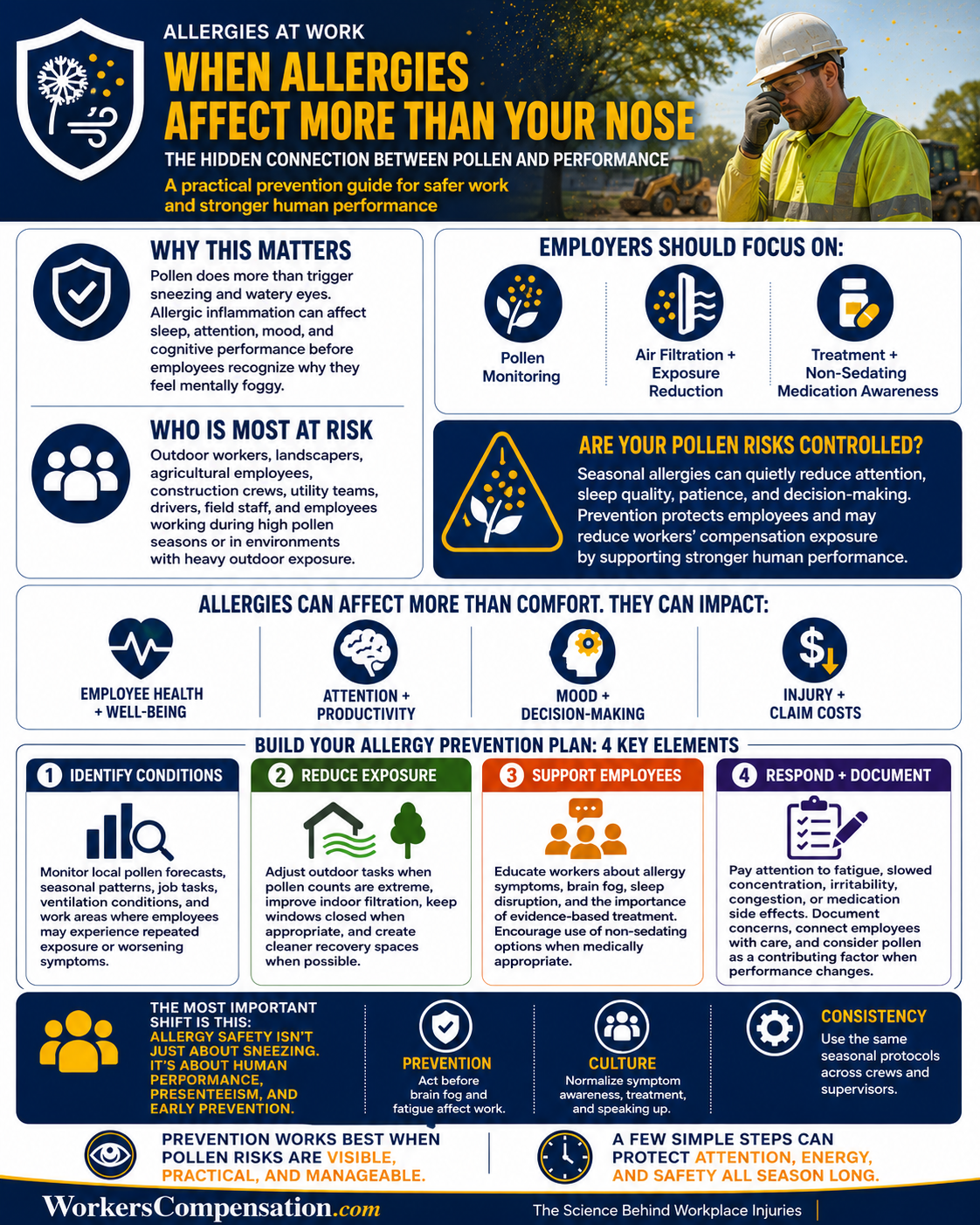
When Allergies Affect More Than Your Nose: The Hidden Connection Between Pollen and Performance
10 Jul, 2026 Claire Muselman
Summer Safety Series
Welcome to The Science Behind Workplace Injuries: 30 Days of Summer Safety, where we explore the environmental hazards, human physiology, behavioral science, and organizational decisions shaping workplace safety. This article is part of our July series examining the science behind workplace injuries and the factors influencing workplace safety during the summer months.
Have you ever walked into work feeling mentally foggy without quite knowing why? Perhaps you slept well. You ate breakfast. Nothing seems obviously different, yet concentrating feels more difficult than usual. You reread the same email twice. A routine task requires more effort than expected. During allergy season, many people assume pollen affects only the nose and eyes. Biology tells a much more interesting story.
The immune system and the brain communicate constantly. When pollen enters the body, the immune system responds by releasing histamine, cytokines, and other inflammatory molecules designed to protect against what it perceives as a threat. The response creates familiar symptoms such as congestion, sneezing, watery eyes, and sinus pressure. The same inflammatory process also influences sleep quality, attention, mood, and cognitive performance. Allergic rhinitis is not simply a condition affecting the nose. It is a whole-body physiological response capable of influencing how people think and perform throughout the workday.
Research continues expanding our understanding of the relationship between allergies and the brain. A 2026 review published in Frontiers in Neurology described how allergic inflammation alters communication between the immune system and the central nervous system through inflammatory signaling, disrupted sleep, and changes in functional brain connectivity associated with attention and memory. Investigators also reviewed evidence suggesting allergic inflammation activates microglia within the hippocampus, contributing to cognitive changes commonly described as "brain fog." The biology extends well beyond seasonal discomfort.
Effects may appear subtle when measured one task at a time. Corpening, Schaffner, and Konishi's 2025 study evaluating adults during pollen season found only modest slowing on selected reaction-time measures during periods of very high pollen exposure. Small physiological changes, however, become more meaningful when repeated across an entire workday. Reading instructions, operating equipment, driving between jobsites, monitoring hazards, making decisions, and responding to changing conditions all depend on sustained attention rather than a single moment of concentration.
Workplace consequences can appear in productivity rather than absenteeism. Employees experiencing seasonal allergies rarely stay home because allergies are not contagious and symptoms often seem manageable. Researchers Vieira, Bousquet, and Cruz's study analyzed data collected through the MASK-air digital health platform and found poorly controlled allergic rhinitis was associated with substantial losses in workplace performance driven primarily by presenteeism rather than missed workdays. Employees remain at work; however, their physiology simply makes it harder to perform at their usual level.
Behavioral science adds another layer to the story. Xi, Wang, and Li found allergy symptoms contributed to poorer sleep and more negative mood during pollen season, factors associated with changes in workplace decision-making and behavior. Fatigue rarely announces itself dramatically. It often appears as reduced patience, slower judgment, decreased attention, or greater difficulty managing competing priorities. Organizations frequently interpret those changes as motivation or attitude. Biology offers another explanation.
Allergy season reminds us of the physiological conditions influencing human performance before the workers’ compensation injury occurred. High pollen counts, poor sleep, congestion, medication side effects, and cognitive fatigue may not independently cause an injury. Together, they can influence attention, reaction time, and decision-making in ways that increase vulnerability when combined with heat, physical exertion, machinery, driving, or other workplace hazards. Understanding the entire physiological picture provides greater insight than examining the incident alone to comprehend how these injuries can happen when all else has been considered.
Leadership creates another opportunity for prevention. Monitoring local pollen forecasts, improving indoor air filtration, encouraging evidence-based allergy treatment, allowing flexibility during periods of significant symptoms, and educating employees about non-sedating medications all support healthier cognitive performance. The goal is to reduce unnecessary physiological strain so employees can perform at their highest level throughout the workday. Prevention becomes effective when organizations recognize human performance is influenced by biology as well as training and experience.
People arrive at work carrying more than their knowledge, experience, and motivation creating a reminder about workplace safety. Workers also bring the physiology created by sleep, stress, illness, hydration, nutrition, medications, and the environment around them. Understanding those influences allows leaders to see human performance through a wider lens. Sometimes the most valuable safety conversation begins by asking what may be affecting a person's physiology rather than assuming something is affecting their commitment.
Tomorrow in The Science Behind Workplace Injuries - Vacation Brain: Why Summer Distractions Follow Employees to Work. Summer changes routines in subtle ways. Vacations, changing schedules, family activities, and mental anticipation all compete for attention long before employees realize their focus has shifted. Tomorrow, we explore the neuroscience of distraction and why divided attention quietly influences workplace safety.


AI best practices california case file caselaw case management case management focus claims compensability compliance compliance corner courts do you know the rule employers exclusive remedy florida fraud glossary check Healthcare hr homeroom insurance insurers iowa kentucky leadership NCCI new jersey new york ohio pennsylvania Safety safety at work state info tech technology the case manager violence WDYT what do you think women's history women's history month workers' comp 101 workers' recovery Workplace Safety Workplace Violence
Read Also
About The Author
About The Author
-
Claire Muselman
Meet Dr. Claire C. Muselman, the Chief Operating Officer at WorkersCompensation.com, where she blends her vast academic insight and professional innovation with a uniquely positive energy. As the President of DCM, Dr. Muselman is renowned for her dynamic approach that reshapes and energizes the workers' compensation industry. Dr. Muselman's academic credentials are as remarkable as her professional achievements. Holding a Doctor of Education in Organizational Leadership from Grand Canyon University, she specializes in employee engagement, human behavior, and the science of leadership. Her diverse background in educational leadership, public policy, political science, and dance epitomizes a multifaceted approach to leadership and learning. At Drake University, Dr. Muselman excels as an Assistant Professor of Practice and Co-Director of the Master of Science in Leadership Program. Her passion for teaching and commitment to innovative pedagogy demonstrate her dedication to cultivating future leaders in management, leadership, and business strategy. In the industry, Dr. Muselman actively contributes as an Ambassador for the Alliance of Women in Workers’ Compensation and plays key roles in organizations such as Kids Chance of Iowa, WorkCompBlitz, and the Claims and Litigation Management Alliance, underscoring her leadership and advocacy in workers’ compensation. A highly sought-after speaker, Dr. Muselman inspires professionals with her engaging talks on leadership, self-development, and risk management. Her philosophy of empathetic and emotionally intelligent leadership is at the heart of her message, encouraging innovation and progressive change in the industry. "Empowerment is key to progress. By nurturing today's professionals with empathy and intelligence, we're crafting tomorrow's leaders." - Dr. Claire C. Muselman
More by This Author
Read More
- Oct 19, 2026
- Claire Muselman
- Oct 19, 2026
- Anne Llewellyn
- Oct 19, 2026
- Chriss Swaney
- Oct 18, 2026
- Claire Muselman
- Oct 17, 2026
- Claire Muselman