


Share This Article:
Summer Safety Series
Welcome to The Science Behind Workplace Injuries: 30 Days of Summer Safety, where we explore the environmental hazards, human physiology, behavioral science, and organizational decisions shaping workplace safety. This article is part of our July series examining the science behind workplace injuries and the factors influencing workplace safety during the summer months.
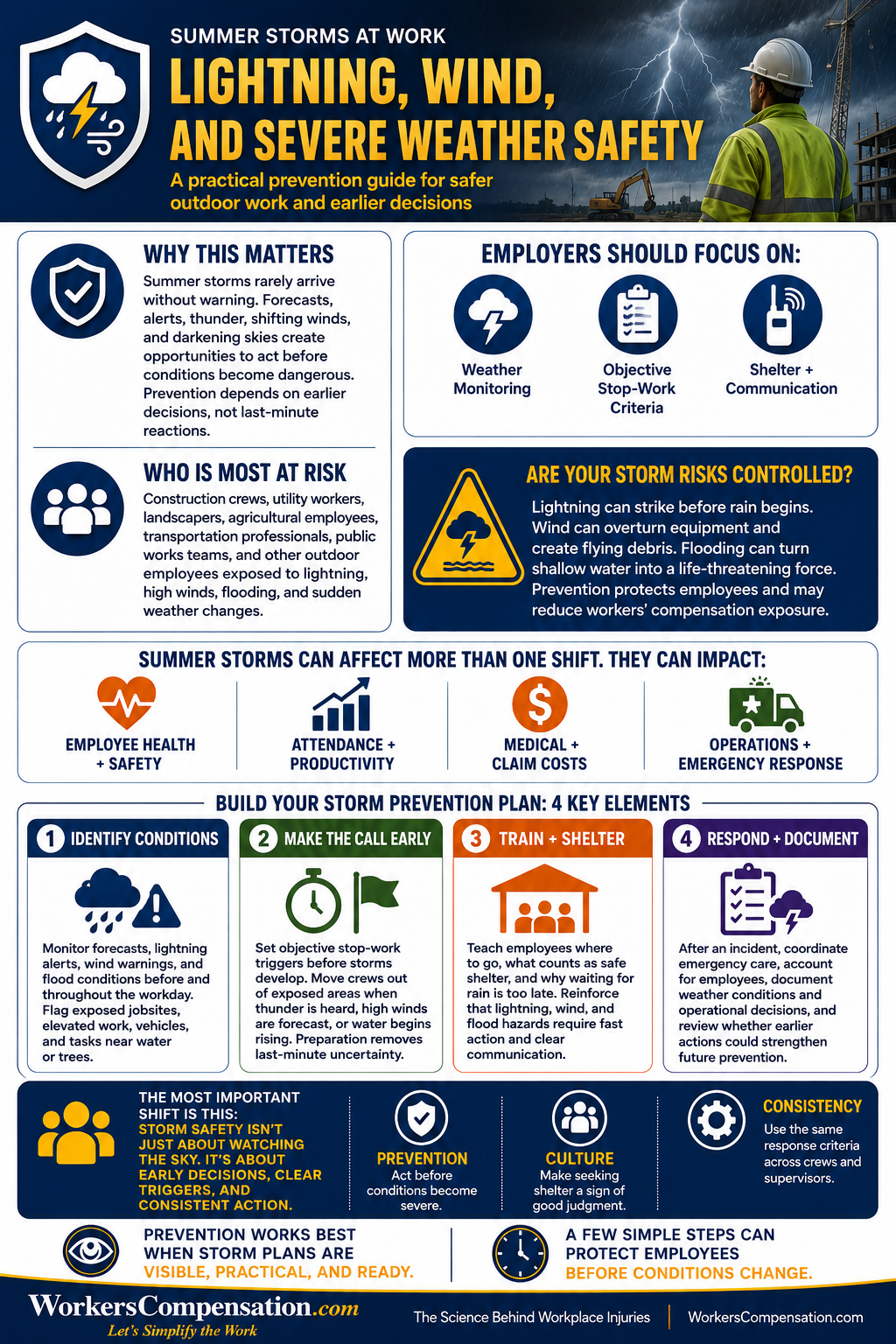
Weather is one of the few workplace variables no one controls. Construction crews, utility workers, landscapers, agricultural employees, transportation professionals, and public works teams all begin the day with access to the same forecast. Meteorologists often identify developing storms hours before the first raindrop falls. Lightning detection networks monitor electrical activity in real time. Smartphones deliver weather alerts within seconds. Despite having more information than ever before, storm-related injuries continue to occur. The science becomes less about the weather itself and more about how people make decisions before conditions become dangerous.
Darkening skies, increasing humidity, shifting winds, distant thunder, and weather alerts provide opportunities to act. Summer storms rarely arrive without warning. The challenge is deciding when enough information exists to change plans. Behavioral science helps explain why this decision can feel surprisingly difficult. People naturally seek additional information before committing to action. Supervisors may believe one more task can be completed before the storm arrives. Crews may continue working because conditions still appear manageable. Every decision feels reasonable in the moment. Storm safety depends on recognizing reasonable decisions can still increase risk.
Lightning is a great example. The National Weather Service notes lightning can strike as far as ten miles from the center of a storm. OSHA, NIOSH, and the Centers for Disease Control and Prevention reinforce the same evidence-based recommendation: If you hear thunder, you are close enough to be struck by lightning. Waiting until rain begins reduces the time available to reach shelter. "When thunder roars, go indoors" reflects decades of meteorological research rather than a memorable safety slogan.
Lightning is also an example that injury severity is not always reflected by injury frequency. Relatively few people are struck each year, although the consequences can be severe. Lanska's 2025 review of lightning injuries found most survivors experience neurological injury, with many developing persistent cognitive, neurological, or psychological symptoms affecting work months or years after the original event. A lightning strike lasts only fractions of a second while the recovery from a strike often extends far beyond the storm itself.
Wind is a similar example. Severe thunderstorms can produce straight-line winds exceeding one hundred miles per hour through events known as microbursts and derechos. Unlike tornadoes, these events often receive far less public attention despite their ability to overturn equipment, collapse scaffolding, bring down trees, and create dangerous flying debris within seconds. Employees cannot accurately judge wind speed by observation alone. Safe decisions depend on respecting weather warnings before conditions visibly deteriorate. Meteorology provides the forecast while leadership determines the response.
Flooding is an example of human perception versus physical reality. Most people naturally judge water by its depth because depth is easy to see. Force is much more difficult to grasp. The National Weather Service reports six inches of moving water can knock an adult off their feet, while approximately one foot of water can carry away many vehicles. "Turn Around, Don't Drown" has become one of the nation's most recognized public safety campaigns because it corrects a common misunderstanding. Moving water often contains far more force than appearances suggest. Occupational safety depends on understanding physics rather than trusting intuition.
The human brain also changes during severe weather. As uncertainty increases, the hypothalamus and amygdala activate the sympathetic nervous system, releasing adrenaline and cortisol that prepare the body for immediate action. Heart rate increases. Attention narrows. Simple reactions may become faster while complex decision-making becomes more challenging. The same physiological response designed to improve survival can reduce the ability to evaluate competing priorities under pressure. Preparation becomes essential because emergency decisions rely on systems established before the emergency begins.
Behavioral research provides another valuable perspective. Wong-Parodi's 2024 study published in PNAS Nexus followed nearly 2,800 residents living along the Gulf Coast and found preparedness increased immediately after major storms while perceived risk steadily declined as time passed. The findings illustrate a familiar pattern in behavioral science. Human beings naturally drift toward normal once the immediate threat disappears. Organizations create consistency by relying on policies rather than memory. Weather monitoring, objective stop-work criteria, emergency drills, and supervisor training continue protecting employees long after the previous storm has faded from memory.
Workers' compensation claims arise when severe weather presents challenges extending beyond the initial injury. Lightning strikes frequently involve neurological injuries. High winds contribute to falls, traumatic brain injuries, fractures, and struck-by incidents. Flooding increases the likelihood of motor vehicle crashes, slips, contaminated water exposures, electrical hazards, and injuries during cleanup operations. Claims investigations often focus on what happened during the incident. Summer storms encourage a different question. What information was available before the incident, and how did the organization respond? The answer frequently identifies the greatest opportunity for prevention.
Leadership becomes most visible before conditions become severe. Employees watch how supervisors respond to changing forecasts, approaching storms, and uncertainty. Delaying a decision by only a few minutes may appear productive in the moment, although weather rarely negotiates with a work schedule. Organizations build resilience by establishing objective stop-work criteria before storms develop, communicating expectations clearly, and creating a culture where seeking shelter reflects good judgment rather than lost productivity. Preparation removes uncertainty because the decision has already been made.
Summer storms remind us weather will always remain unpredictable. Decision-making does not have to be. Forecasting continues improving. Technology delivers faster warnings and of course there are apps to help. Science expands our understanding of severe weather every year. Organizations receive the greatest benefit when information is paired with preparation.
Tomorrow in The Science Behind Workplace Injuries - Vacation Brain: How Summer Distractions Influence Workplace Safety. Summer changes more than the weather. Vacations, changing routines, family schedules, and mental distractions all compete for attention long before employees realize their focus has shifted. Tomorrow, we explore the neuroscience of attention and why divided focus can quietly influence workplace safety.


AI best practices california case file caselaw case management case management focus claims compensability compliance compliance corner courts do you know the rule employers exclusive remedy florida fraud glossary check Healthcare hr homeroom insurance insurers iowa kentucky leadership NCCI new jersey new york ohio pennsylvania Safety safety at work state info tech technology the case manager violence WDYT what do you think women's history women's history month workers' comp 101 workers' recovery Workplace Safety Workplace Violence
Read Also
About The Author
About The Author
-
Claire Muselman
Meet Dr. Claire C. Muselman, the Chief Operating Officer at WorkersCompensation.com, where she blends her vast academic insight and professional innovation with a uniquely positive energy. As the President of DCM, Dr. Muselman is renowned for her dynamic approach that reshapes and energizes the workers' compensation industry. Dr. Muselman's academic credentials are as remarkable as her professional achievements. Holding a Doctor of Education in Organizational Leadership from Grand Canyon University, she specializes in employee engagement, human behavior, and the science of leadership. Her diverse background in educational leadership, public policy, political science, and dance epitomizes a multifaceted approach to leadership and learning. At Drake University, Dr. Muselman excels as an Assistant Professor of Practice and Co-Director of the Master of Science in Leadership Program. Her passion for teaching and commitment to innovative pedagogy demonstrate her dedication to cultivating future leaders in management, leadership, and business strategy. In the industry, Dr. Muselman actively contributes as an Ambassador for the Alliance of Women in Workers’ Compensation and plays key roles in organizations such as Kids Chance of Iowa, WorkCompBlitz, and the Claims and Litigation Management Alliance, underscoring her leadership and advocacy in workers’ compensation. A highly sought-after speaker, Dr. Muselman inspires professionals with her engaging talks on leadership, self-development, and risk management. Her philosophy of empathetic and emotionally intelligent leadership is at the heart of her message, encouraging innovation and progressive change in the industry. "Empowerment is key to progress. By nurturing today's professionals with empathy and intelligence, we're crafting tomorrow's leaders." - Dr. Claire C. Muselman
More by This Author
Read More
- Oct 19, 2026
- Claire Muselman
- Oct 19, 2026
- Anne Llewellyn
- Oct 19, 2026
- Chriss Swaney
- Oct 18, 2026
- Claire Muselman
- Oct 17, 2026
- Claire Muselman