


Share This Article:
Summer Safety Series
Welcome to The Science Behind Workplace Injuries: 30 Days of Summer Safety, where we explore the environmental hazards, human physiology, behavioral science, and organizational decisions shaping workplace safety. This article is part of our July series examining the science behind workplace injuries and the factors influencing workplace safety during the summer months.
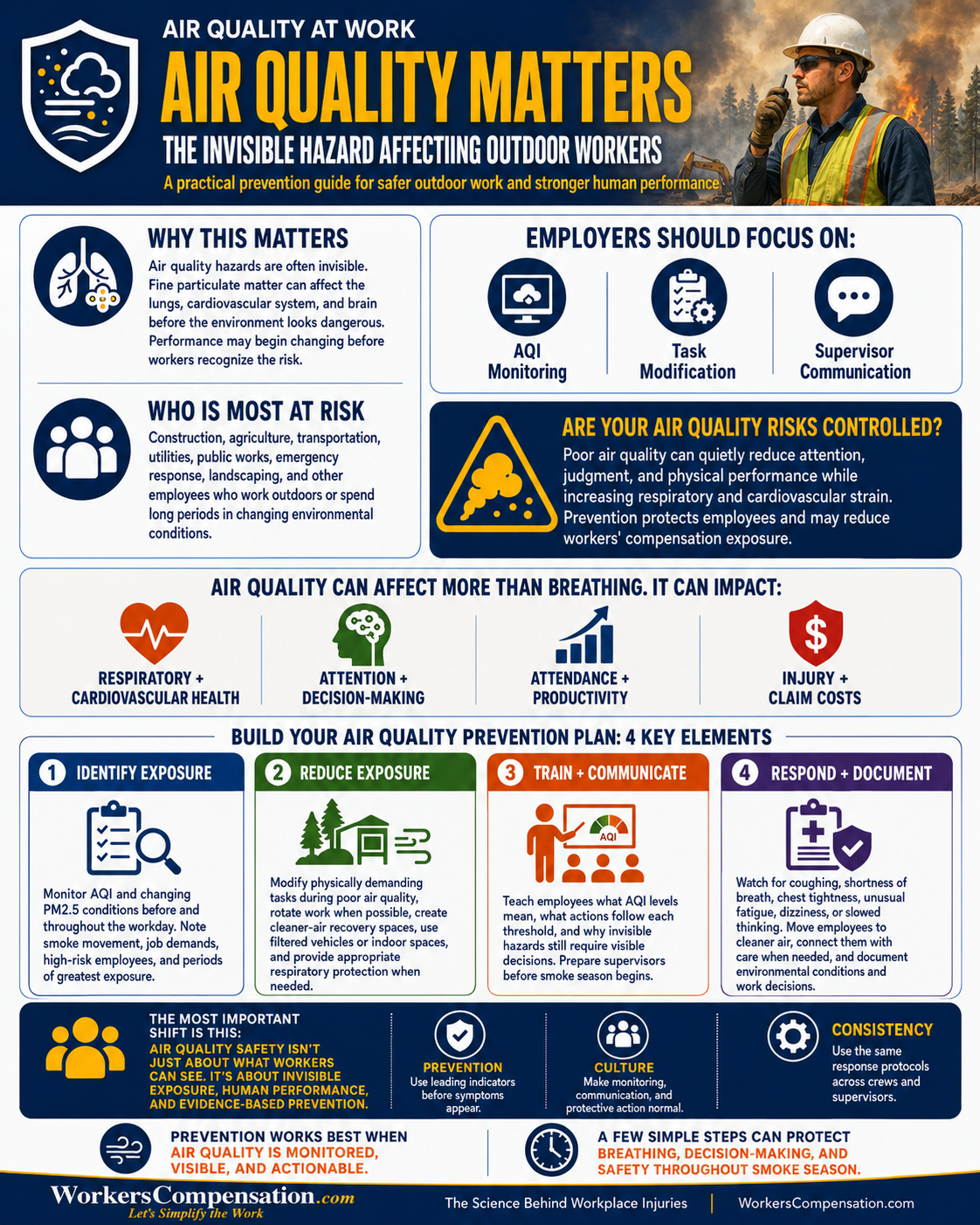
The most dangerous workplace hazards are not always the easiest to see. A missing guardrail captures attention immediately. An exposed electrical wire demands respect. An open trench changes how people move across a jobsite. Human beings are remarkably good at recognizing visible danger because the brain continuously scans the environment for threats. Air quality operates differently. The worksite often looks the same. Employees begin the shift performing familiar tasks. Nothing appears unusual. Biology reaches a different conclusion. The lungs, cardiovascular system, and brain begin responding long before the environment looks dangerous.
Air quality has quietly evolved from a public health concern into an occupational exposure issue for construction, agriculture, transportation, utilities, public works, emergency response, landscaping, and countless other industries requiring employees to work outdoors. The National Institute for Occupational Safety and Health now identifies fine particulate matter, commonly known as PM2.5, as the primary hazard of concern during wildfire smoke events because the smallest particles travel deep into the lungs and contribute to systemic health effects extending far beyond respiratory irritation.
For many years, conversations surrounding air quality focused primarily on coughing, wheezing, asthma, and respiratory disease. Current science paints a much broader picture. Fine particulate matter contributes to systemic inflammation, oxidative stress, endothelial dysfunction, autonomic imbalance, and cardiovascular strain. The lungs may represent the point of entry, although the physiological response extends throughout the body. Air quality has become a human performance issue as much as a respiratory health issue. The brain has become one of the most interesting parts of that story.
Researchers have only recently begun understanding how airborne pollutants influence cognitive performance. In 2025, Faherty and colleagues, writing in Nature Communications, exposed healthy adults to particulate pollution for one hour and evaluated cognitive performance several hours later. Selective attention and emotion recognition declined despite participants having no underlying neurological disease. Earlier work by Ke and colleagues linked short-term PM2.5 exposure with executive dysfunction and altered neural activity, providing a physiological explanation for the cognitive changes. Different research teams approached different questions. Both arrived at a remarkably similar conclusion: Air pollution influences the brain before people associate poor air quality with declining performance.
Cognitive performance is not separate from workplace safety. Construction workers constantly evaluate changing footing while operating tools and communicating with coworkers. Utility crews make decisions around energized equipment under changing environmental conditions. Transportation employees process traffic, weather, pedestrians, and vehicle movement simultaneously. Agricultural workers perform physically demanding tasks requiring sustained attention for long periods. Every occupation asks the brain to integrate information, movement, communication, and judgment without interruption.
Air quality challenges one of our most basic assumptions about risk perception. Most people expect to recognize danger before danger affects them. Air quality rarely works that way. Ozone cannot be seen. Fine particulate matter frequently remains invisible. Smoke may travel hundreds of miles from its source before reaching a worksite. The body does not require visibility before responding. Physiology begins adapting immediately, even while perception remains unchanged. Invisible hazards produce visible consequences.
Human beings instinctively respond most to hazards they can immediately recognize such as flames, lightning, and heavy rain. Flames demand attention. Lightning changes behavior. Heavy rain slows traffic. Air quality rarely creates the same sense of urgency because the body's sensory systems were never designed to measure microscopic particulate matter or ozone concentrations. Workers tend to rely on sight or smell to judge exposure, even though neither provides a reliable indication of physiological risk. PM2.5 cannot be seen with the naked eye, ozone is frequently odorless at harmful concentrations, and wildfire smoke may travel hundreds of miles before arriving at a worksite.
Bice, Van Overbeke, and Hill surveyed outdoor workers in Colorado and found perceived risk influenced protective actions, although confidence in knowing what to do proved an even stronger predictor of information-seeking behavior. The finding carries an important lesson for employers. Announcing an Air Quality Index of 142 tells employees very little unless they also understand how the number affects their work, what actions should follow, and why each action reduces risk. Effective communication does more than report conditions. Effective communication changes behavior.
A qualitative study examining agricultural workplaces found supervisor attitudes strongly influenced whether protective measures were implemented consistently. More recently, Postma's 2025 Washington agricultural supervisor study reported agricultural supervisors frequently experienced wildfire smoke exposure themselves while simultaneously directing employees working under the same conditions. Leadership does not occur outside the exposure. Leadership occurs within the exposure. Decisions surrounding work pace, task modification, recovery breaks, equipment, and scheduling often determine whether environmental hazards become workplace injuries.
Workers' compensation implications extend beyond smoke inhalation claims. Air quality can contribute to occupational asthma, chronic obstructive pulmonary disease exacerbations, cardiovascular events, and toxic inhalation claims. Another pattern deserves equal attention. Environmental exposures can quietly increase the likelihood of traumatic injuries by degrading human performance before a specific incident occurs. Cabral and Dillender connected wildfire smoke exposure with Texas workers' compensation data and found every additional smoke day increased workplace injury claims by approximately 2.8 percent. The finding supports an important shift in thinking.
The Environmental Protection Agency, NIOSH, and several state occupational safety agencies encourage employers to monitor Air Quality Index conditions before and throughout the workday, modify physically demanding tasks during poor air quality, establish cleaner-air spaces, provide filtered vehicles when available, train supervisors before smoke season begins, and document environmental conditions alongside operational decisions. Every recommendation reflects the same philosophy. Build systems supporting human performance instead of expecting human performance to overcome environmental stressors.
Air quality reminds us the most important hazards are often the ones we never see coming. Human beings instinctively trust what they can see, hear, and smell. Biology does not. The body responds to exposure long before perception catches up. Effective leadership requires the same discipline. Organizations preventing tomorrow's injuries learn to trust evidence before symptoms, leading indicators before lagging indicators, and science before assumptions.
Tomorrow in The Science Behind Workplace Injuries - Ultraviolet Radiation: The Workplace Hazard That Continues Long After the Shift Ends. Sunlight feels familiar, making it one of the easiest occupational hazards to underestimate. Ultraviolet radiation quietly damages skin, eyes, and cellular DNA long before a sunburn appears. Tomorrow, we explore why one of the most common summer exposures also represents one of the most preventable occupational risks and how employers can better protect employees working outdoors.


AI california case file caselaw case management case management focus claims compensability compliance compliance corner courts covid do you know the rule employers exclusive remedy florida fraud glossary check Healthcare hr homeroom insurance insurers iowa kentucky leadership NCCI new jersey new york ohio pennsylvania Safety safety at work state info tech technology the case manager violence WDYT what do you think women's history women's history month workers' comp 101 workers' recovery Workplace Safety Workplace Violence
Read Also
- Sep 06, 2026
- WorkersCompensation.com
- Sep 06, 2026
- WorkersCompensation.com
- Sep 05, 2026
- Frank Ferreri
About The Author
About The Author
-
Claire Muselman
Meet Dr. Claire C. Muselman, the Chief Operating Officer at WorkersCompensation.com, where she blends her vast academic insight and professional innovation with a uniquely positive energy. As the President of DCM, Dr. Muselman is renowned for her dynamic approach that reshapes and energizes the workers' compensation industry. Dr. Muselman's academic credentials are as remarkable as her professional achievements. Holding a Doctor of Education in Organizational Leadership from Grand Canyon University, she specializes in employee engagement, human behavior, and the science of leadership. Her diverse background in educational leadership, public policy, political science, and dance epitomizes a multifaceted approach to leadership and learning. At Drake University, Dr. Muselman excels as an Assistant Professor of Practice and Co-Director of the Master of Science in Leadership Program. Her passion for teaching and commitment to innovative pedagogy demonstrate her dedication to cultivating future leaders in management, leadership, and business strategy. In the industry, Dr. Muselman actively contributes as an Ambassador for the Alliance of Women in Workers’ Compensation and plays key roles in organizations such as Kids Chance of Iowa, WorkCompBlitz, and the Claims and Litigation Management Alliance, underscoring her leadership and advocacy in workers’ compensation. A highly sought-after speaker, Dr. Muselman inspires professionals with her engaging talks on leadership, self-development, and risk management. Her philosophy of empathetic and emotionally intelligent leadership is at the heart of her message, encouraging innovation and progressive change in the industry. "Empowerment is key to progress. By nurturing today's professionals with empathy and intelligence, we're crafting tomorrow's leaders." - Dr. Claire C. Muselman
More by This Author
- Aug 28, 2026
- Claire Muselman
- Aug 26, 2026
- Claire Muselman
Read More
- Sep 06, 2026
- WorkersCompensation.com
- Sep 06, 2026
- WorkersCompensation.com
- Sep 05, 2026
- Frank Ferreri
- Sep 04, 2026
- WorkersCompensation.com
- Sep 04, 2026
- WorkersCompensation.com
- Sep 03, 2026
- Frank Ferreri