


Share This Article:
Financial Incentives Quietly Shape Workers’ Compensation Pharmacy Decisions
08 May, 2026 Claire Muselman
Beneath the Surface
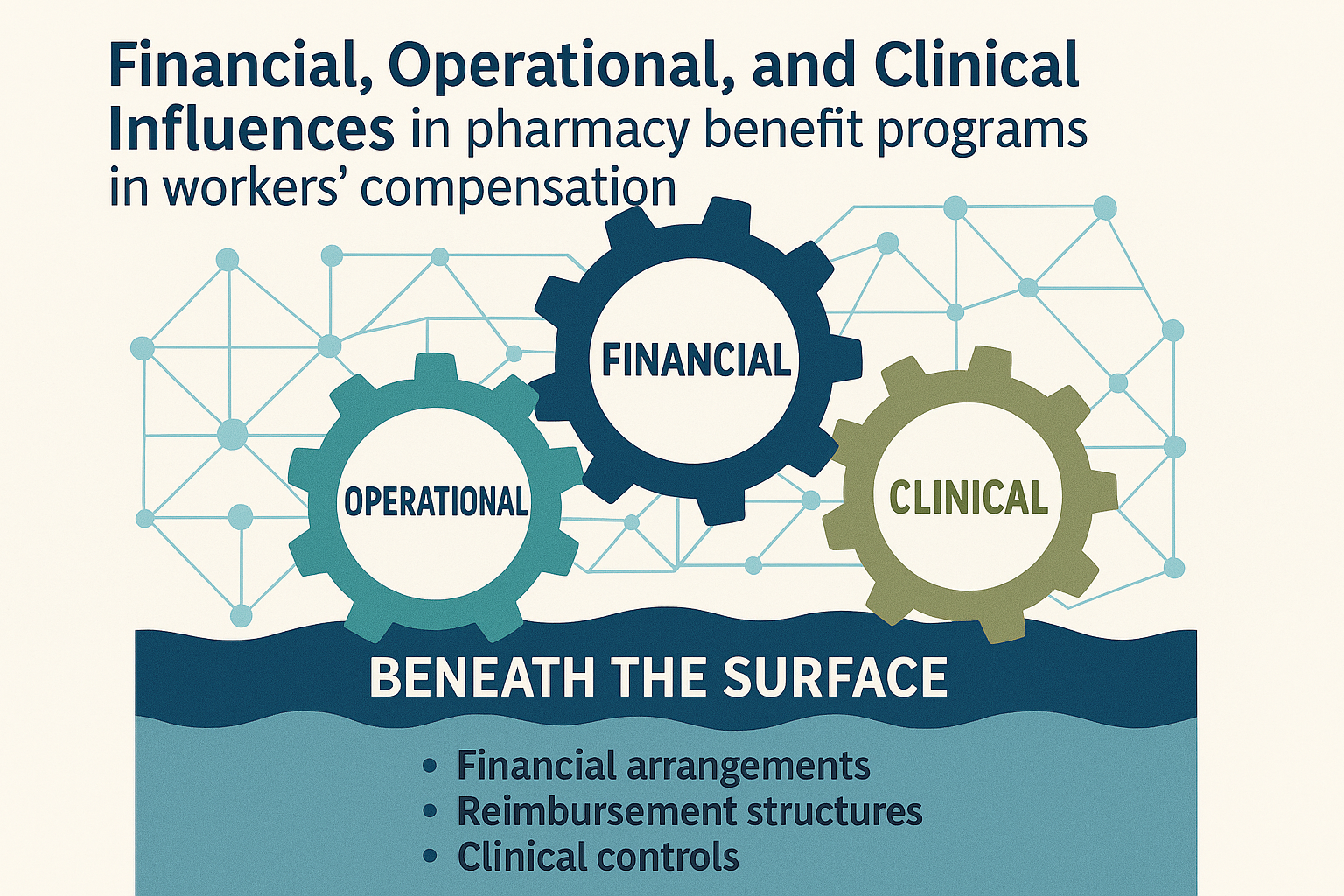
Most workers’ compensation leaders are not spending their day analyzing pharmacy benefit management structures, and on the surface, there is little reason to. Prescriptions continue moving through the system, injured workers receive medications, and pharmacy programs appear operationally stable. Beneath that stability sits a network of financial arrangements, reimbursement structures, and clinical controls influencing how medications are selected, approved, and dispensed. Increased scrutiny surrounding PBM transparency is beginning to expose how interconnected those decisions have become. Understanding those relationships creates a clearer view into how pharmacy programs truly function within workers’ compensation.
The conversation often begins with rebates, yet the larger issue involves how financial incentives move through the system and influence decision-making at multiple levels. Formularies determine medication access. Prior authorization criteria influence treatment pathways. Reimbursement structures shape dispensing behavior across pharmacy channels. Each component serves an operational purpose while also carrying financial implications. Problems emerge when financial influence operates without visibility, oversight, or clear separation from clinical rationale.
Formulary placement provides one of the clearest examples. Medications placed in preferred positions move through the system with fewer barriers, while non-preferred medications often require additional review, substitution, or authorization. Clinical evidence should drive those distinctions, particularly in workers’ compensation where treatment decisions directly influence recovery and return-to-work outcomes. Financial arrangements tied to utilization can also influence formulary positioning when governance lacks transparency. Once financial influence enters clinical structure without visibility, confidence in the process begins to erode.
The same pattern appears within prior authorization. Prior authorization plays an important role in controlling inappropriate utilization, managing high-risk medications, and validating medical necessity. Delays become problematic when operational or financial friction extends beyond clinical review. An injured worker standing at the pharmacy counter does not experience “utilization management” as a technical process. The worker experiences uncertainty surrounding treatment access during an already vulnerable moment. Small barriers inside the system often create larger behavioral consequences across the life of a claim.
Behavioral science helps explain why those moments matter. Human beings interpret delays as signals, particularly during periods of stress, injury, and uncertainty. Delays increase frustration, reduce trust, and elevate emotional response. An injured worker navigating denials, redirections, or repeated authorizations often begins evaluating the employer, claims process, and healthcare experience as one connected system. Friction introduced at one point influences perception of the entire experience. Operational design therefore shapes both financial performance and human response simultaneously.
Dispensing channels introduce another layer where financial incentives quietly shape behavior. Prescriptions move across retail, mail-order, and specialty pharmacies based on reimbursement structure and network design. Financial relationships between PBMs and affiliated dispensing channels can influence where medications are directed, particularly for higher-cost drugs. Dispensing patterns often appear operational on the surface while reflecting deeper financial strategy underneath. Visibility into those patterns matters because dispensing location influences cost, convenience, access, and adherence.
An injured worker prescribed a specialty medication may initially receive approval through a local retail pharmacy before later being redirected into a specialty channel. In some situations, the transition improves coordination and monitoring. In others, the process introduces delays, communication gaps, or additional administrative requirements. The worker experiences disruption while the financial and operational drivers behind the transition remain largely invisible. Understanding how incentives shape these movements allows leaders to evaluate whether system design is supporting recovery or creating unnecessary friction.
Workers’ compensation leaders often focus on total pharmacy spend without fully examining how spending patterns develop across a claim. Financial exposure rarely distributes evenly within a program. High-cost topicals, specialty medications, physician dispensing, and repackaged drugs frequently drive disproportionate impact on claim severity. These categories also tend to operate in areas where pricing structures become less transparent and oversight becomes more difficult without detailed data access. Visibility into utilization trends and reimbursement patterns strengthens the ability to identify risk before costs escalate.
The growing attention surrounding PBM transparency is bringing these structural questions into sharper focus across healthcare markets. Federal scrutiny surrounding rebate classification, payment disclosure, and PBM compensation structures is influencing purchaser expectations well beyond group health plans. Workers’ compensation programs may not fall directly under every federal requirement, yet market expectations continue shifting regardless. Employers, insurers, and claims organizations are beginning to ask more detailed questions surrounding financial flow, operational governance, and data access because broader healthcare scrutiny is exposing how connected these systems have become.
The most important takeaway is not the existence of financial incentives within pharmacy programs. Every system contains incentives influencing behavior and decision-making. The defining issue involves whether those incentives remain visible, aligned, and appropriately governed. Financial structures influence behavior at every level of the pharmacy process, from formulary placement to dispensing patterns to operational workflows at the pharmacy counter. Leaders who understand those relationships gain the ability to evaluate performance with greater clarity and precision. Strong oversight begins with understanding how the system functions beneath the surface.


AI best practices california case file caselaw case management case management focus claims compensability compliance compliance corner courts do you know the rule employers exclusive remedy florida fraud glossary check Healthcare hr homeroom insurance insurers iowa kentucky leadership NCCI new jersey new york ohio pennsylvania Safety safety at work state info tech technology the case manager violence WDYT what do you think women's history women's history month workers' comp 101 workers' recovery Workplace Safety Workplace Violence
Read Also
About The Author
About The Author
-
Claire Muselman
Meet Dr. Claire C. Muselman, the Chief Operating Officer at WorkersCompensation.com, where she blends her vast academic insight and professional innovation with a uniquely positive energy. As the President of DCM, Dr. Muselman is renowned for her dynamic approach that reshapes and energizes the workers' compensation industry. Dr. Muselman's academic credentials are as remarkable as her professional achievements. Holding a Doctor of Education in Organizational Leadership from Grand Canyon University, she specializes in employee engagement, human behavior, and the science of leadership. Her diverse background in educational leadership, public policy, political science, and dance epitomizes a multifaceted approach to leadership and learning. At Drake University, Dr. Muselman excels as an Assistant Professor of Practice and Co-Director of the Master of Science in Leadership Program. Her passion for teaching and commitment to innovative pedagogy demonstrate her dedication to cultivating future leaders in management, leadership, and business strategy. In the industry, Dr. Muselman actively contributes as an Ambassador for the Alliance of Women in Workers’ Compensation and plays key roles in organizations such as Kids Chance of Iowa, WorkCompBlitz, and the Claims and Litigation Management Alliance, underscoring her leadership and advocacy in workers’ compensation. A highly sought-after speaker, Dr. Muselman inspires professionals with her engaging talks on leadership, self-development, and risk management. Her philosophy of empathetic and emotionally intelligent leadership is at the heart of her message, encouraging innovation and progressive change in the industry. "Empowerment is key to progress. By nurturing today's professionals with empathy and intelligence, we're crafting tomorrow's leaders." - Dr. Claire C. Muselman
More by This Author
Read More
- Oct 10, 2026
- Claire Muselman
- Oct 10, 2026
- Frank Ferreri
- Oct 10, 2026
- Claire Muselman
- Oct 10, 2026
- Chris Parker
- Oct 08, 2026
- Claire Muselman