


Share This Article:
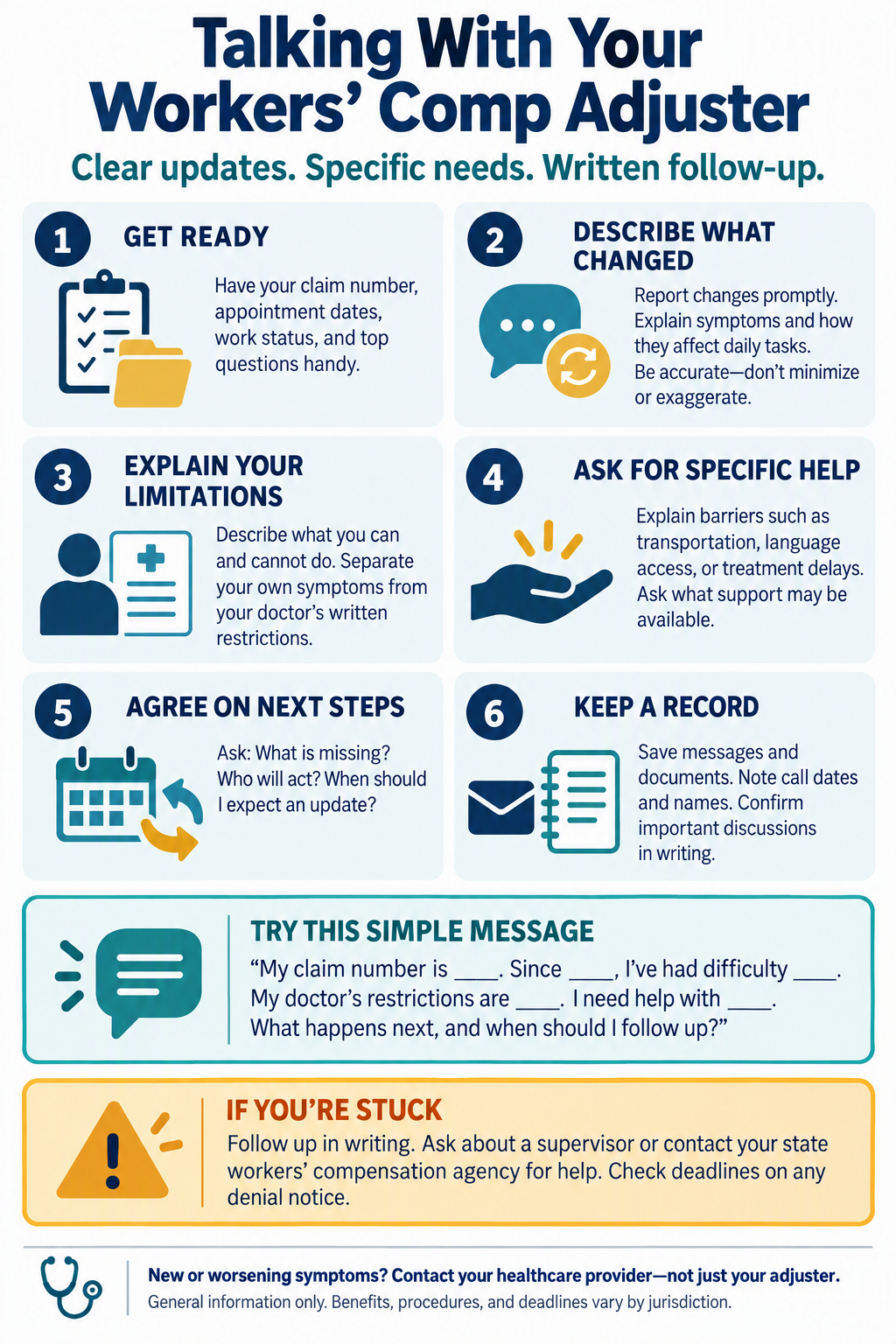
How to Communicate Effectively With Your Workers’ Compensation Adjuster
28 Nov, 2026 WorkersCompensation.com
Guidance for Injured Workers'
A workers' compensation claim often moves more smoothly when the injured worker and adjuster communicate clearly and consistently. Most adjusters handle many claims at once and rely on accurate information to make decisions regarding medical treatment, lost wages, return-to-work options, and other benefits.
The goal isn't to become a legal expert. It's to become an effective communicator and advocate for your recovery.
Understand the Adjuster's Role
A workers' compensation adjuster is responsible for:
- Investigating the claim
- Coordinating benefits
- Reviewing medical information
- Authorizing approved treatment
- Managing wage-loss benefits
- Monitoring return-to-work efforts
The adjuster is not your doctor and generally cannot make medical diagnoses or treatment recommendations.
Best Practice
Think of the adjuster as the person managing your claim file. The more complete and accurate the information in the file, the easier it is for them to understand your situation.
1. Report Changes Promptly
One of the most common communication problems occurs when workers wait too long to report changes.
Tell your adjuster quickly if:
- Your symptoms worsen
- A doctor removes you from work
- Work restrictions change
- A medical appointment is scheduled
- A surgery is recommended
- You move or change phone numbers
- You return to work
- You miss work because of the injury
Example
Instead of:
"My back is getting worse."
Try:
"Since my appointment on Nov. 20, I've developed numbness in my right leg and have difficulty standing longer than 15 minutes. Dr. Smith scheduled an MRI for Dec. 5."
Specific information helps the adjuster understand what is happening.
2. Focus on Functional Limitations
Many workers describe only pain levels.
Adjusters and doctors often need information about how the injury affects daily activities.
Helpful Statements
- "I can't lift more than 10 pounds."
- "I can sit comfortably for only 20 minutes."
- "I need help driving to appointments."
- "I can't climb ladders."
- "I cannot use my right hand for repetitive tasks."
Less Helpful Statements
- "I'm hurting."
- "It's really bad."
- "I don't feel right."
Pain matters, but describing what you can and cannot do is often more useful.
3. Keep a Recovery Journal
A simple notebook or phone app can help you track:
- Doctor visits
- Symptoms
- Medication side effects
- Missed work days
- Questions for providers
- Communications with the adjuster
Document:
| Date | What Happened |
|---|---|
| Nov. 25 | Physical therapy appointment |
| Nov. 28 | Increased shoulder pain after therapy |
| Dec. 2 | Follow-up with orthopedic specialist |
This record can help prevent misunderstandings later.
4. Be Honest About Your Capabilities
Some injured workers unintentionally create confusion by overstating or understating their condition.
Avoid Saying:
- You are completely unable to function if doctors have released you to modified work.
- You are fully recovered when you are still experiencing significant restrictions.
Better Approach
Provide an accurate picture:
"I can work four-hour shifts, but my shoulder becomes painful when lifting above chest level."
Credibility is one of the most important assets in a workers' compensation claim.
5. Prepare for Every Phone Call
Before speaking with your adjuster:
Write down:
- Questions you need answered
- Upcoming medical appointments
- Benefit concerns
- Changes in restrictions
Sample Questions
- Has the doctor submitted the latest report?
- Have my wage benefits been approved?
- Has physical therapy been authorized?
- What information do you still need from me?
Prepared conversations tend to be shorter and more productive.
6. Communicate Professionally
Workers' compensation claims can be frustrating.
Delays may occur because the adjuster is waiting for:
- Medical records
- Physician reports
- Employer information
- Utilization review decisions
- Independent medical examination reports
Effective Communication
"Can you help me understand what information is still needed before a decision can be made?"
Less Effective Communication
"Nobody is doing anything!"
Professional conversations generally produce better results than emotional confrontations.
7. Confirm Important Discussions in Writing
After a significant conversation, consider sending a brief email.
Example
Thank you for speaking with me today. My understanding is that authorization for physical therapy has been requested and you are waiting for the physician's notes. Please let me know if I misunderstood anything.
This creates a record and reduces misunderstandings.
8. Share Barriers to Recovery
Sometimes the greatest challenge is not the injury itself.
Tell your adjuster if you are experiencing:
- Transportation problems
- Difficulty attending appointments
- Medication side effects
- Language barriers
- Mental health concerns related to the injury
- Childcare issues affecting treatment attendance
Many problems can be addressed only if the adjuster knows they exist.
9. Understand Return-to-Work Restrictions
If your doctor provides restrictions:
- Obtain a copy
- Read them carefully
- Share them with your employer if required
- Discuss questions immediately
Example
Rather than saying:
"I'm not sure if I can do the job."
Try:
"My restrictions limit lifting to 15 pounds. The job requires moving boxes weighing approximately 30 pounds."
Specific concerns are easier to evaluate.
10. Ask Questions When You Don't Understand
Workers often hesitate to ask for clarification.
It is reasonable to ask:
- What happens next?
- Why was a request delayed or denied?
- What documents are needed?
- When should I expect an update?
- Who should I contact if you are unavailable?
The more you understand the process, the less stressful it becomes.
Communication Checklist for Injured Workers
Before contacting your adjuster:
✅ Know your current work status
✅ Know your medical restrictions
✅ Have dates of recent appointments
✅ Write down your questions
✅ Be prepared to describe specific limitations
✅ Communicate changes promptly
✅ Keep notes of important conversations
✅ Follow up in writing on major issues
Key Takeaway
The most successful worker-adjuster relationships are built on timely, factual, respectful communication. Focus on what has changed, what limitations you are experiencing, what treatment is occurring, and what help you need to continue your recovery. The clearer the information you provide, the easier it is for everyone involved to make informed decisions and keep your claim moving forward.


AI best practices california case file caselaw case management case management focus claims compensability compliance compliance corner courts do you know the rule employers exclusive remedy florida fraud glossary check Healthcare hr homeroom insurance insurers iowa kentucky leadership NCCI new jersey new york ohio pennsylvania Safety safety at work state info tech technology the case manager violence WDYT what do you think women's history women's history month workers' comp 101 workers' recovery Workplace Safety Workplace Violence
Read Also
- Nov 27, 2026
- WorkersCompensation.com
- Nov 22, 2026
- WorkersCompensation.com
- Nov 21, 2026
- WorkersCompensation.com
About The Author
About The Author
- WorkersCompensation.com
More by This Author
- Nov 27, 2026
- WorkersCompensation.com
- Nov 25, 2026
- WorkersCompensation.com
- Nov 25, 2026
- WorkersCompensation.com
Read More
- Nov 27, 2026
- WorkersCompensation.com
- Nov 22, 2026
- WorkersCompensation.com
- Nov 21, 2026
- WorkersCompensation.com
- Nov 19, 2026
- NCCI
- Nov 19, 2026
- WorkersCompensation.com
- Nov 19, 2026
- WorkersCompensation.com