


Share This Article:
What did 30 Days of Summer Safety Teach us about Preventing Workplace Injuries?
01 Aug, 2026 Claire Muselman
Summer Safety Series
Welcome to The Science Behind Workplace Injuries: 30 Days of Summer Safety, where we explored the environmental hazards, human physiology, behavioral science, and organizational decisions shaping workplace safety. This final article brings together the scientific themes that emerged throughout the series and reflects on what the evidence teaches us about preventing workplace injuries.
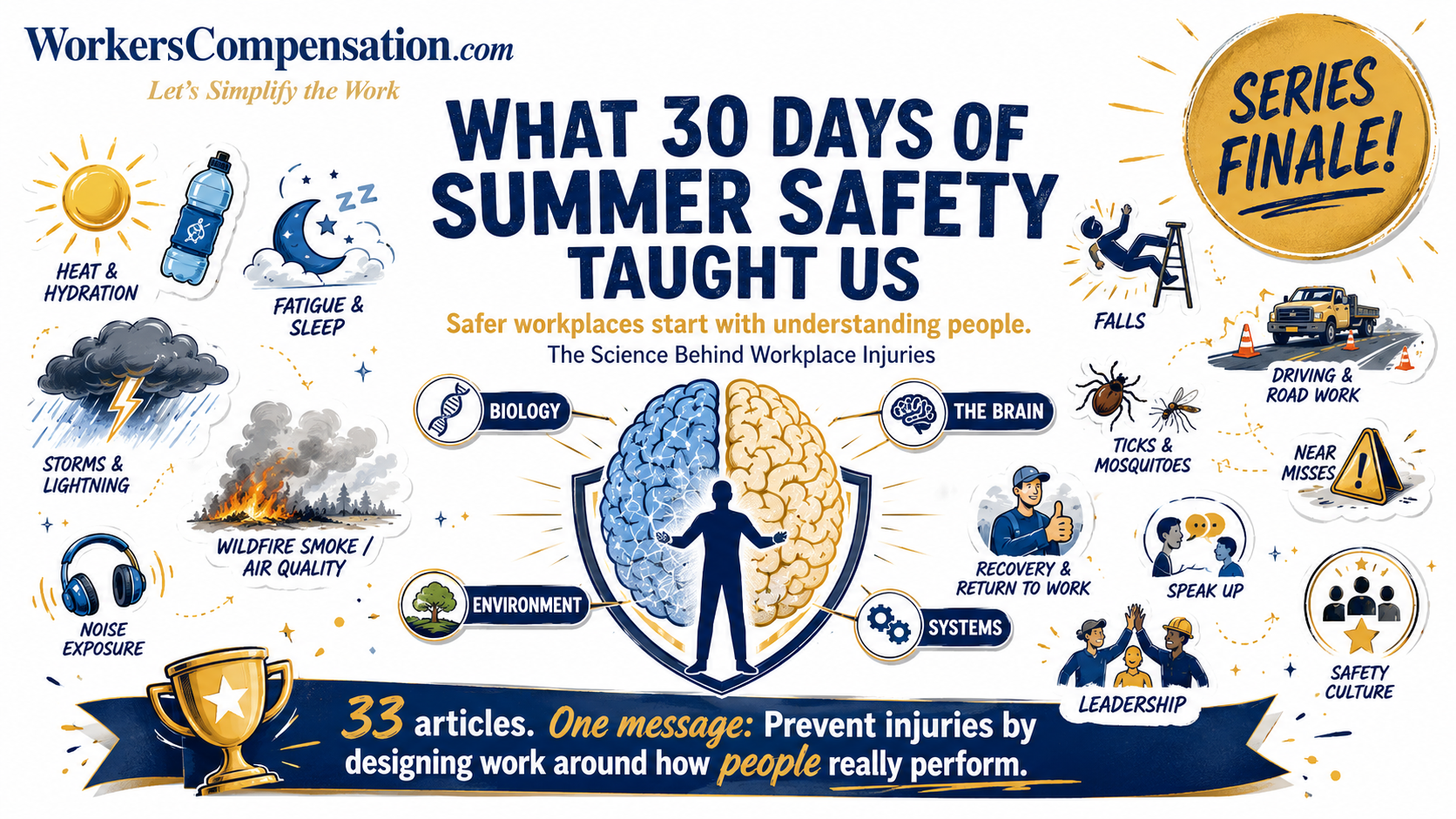
Over the past month, this series examined more than thirty factors contributing to workplace injuries during the summer months. Heat, fatigue, severe weather, road construction, driving, vector-borne diseases, noise, rushing, new employee onboarding, leadership, communication, recovery, and organizational culture may appear to represent separate workplace challenges. The scientific literature suggests otherwise.
Across neuroscience, occupational medicine, physiology, psychology, ergonomics, public health, and organizational behavior, remarkably consistent themes emerged. Human performance is shaped through the continuous interaction of biology, cognition, environment, and organizational systems. Workplace injuries rarely result from one isolated event. More often, they develop through the accumulation and interaction of multiple contributing factors that influence how people perceive hazards, make decisions, communicate concerns, and respond to changing conditions.
Human beings are remarkably predictable because the human body and brain respond to stressors in consistent and measurable ways. Heat alters judgment. Fatigue reduces attention. Noise competes for cognitive resources. Time pressure narrows focus. Cognitive overload limits working memory. Psychological safety influences communication. Leadership shapes trust. Recovery begins long before healing becomes visible. These findings appeared repeatedly across disciplines, populations, industries, and research methods. The consistency of the evidence reminds us workplace safety is fundamentally a human performance issue.
One theme surfaced repeatedly throughout the literature: biology establishes the boundaries within which people perform. Human physiology influences attention, reaction time, balance, decision-making, hydration, inflammation, sleep, thermoregulation, and recovery. These biological processes are neither weaknesses nor failures. They are predictable characteristics of being human. Organizations achieve stronger safety outcomes when they design work around those realities rather than expecting employees to overcome physiological limitations through determination alone.
A second theme centered on the remarkable complexity of the human brain. Many workplace injuries historically attributed to carelessness become easier to understand when viewed through contemporary cognitive science. Optimism bias, automaticity, decision fatigue, cognitive load, normalization of deviance, situational awareness, and attentional limitations all demonstrate that people rarely make decisions in isolation. Every decision reflects the interaction between experience, environment, available information, mental workload, and competing demands on attention. Understanding those influences does not remove personal accountability. It strengthens our ability to design workplaces where better decisions become easier to make.
The scientific literature also consistently demonstrated that organizational systems shape human behavior. Leadership, communication, onboarding, work design, production expectations, reporting processes, recognition systems, and return-to-work philosophies all influence how employees respond long before an injury occurs. People learn what an organization values by observing what leaders repeatedly reinforce. Systems encouraging curiosity, learning, reporting, and collaboration create different behavioral outcomes than systems emphasizing speed, silence, or fear. Organizational culture is is demonstrated through the experiences employees have every day.
Another important lesson involved the timing of prevention. Traditional safety programs often focus on the moment immediately preceding an injury. The evidence reviewed throughout this series suggests prevention begins much earlier. Heat acclimatization starts before temperatures rise. Onboarding begins before independent work assignments. Near misses provide opportunities to learn before someone is injured. Recovery begins with the first conversation following an incident. Leadership influences whether concerns are voiced before conditions deteriorate. The strongest organizations recognize the greatest opportunities for prevention often exist long before a claim is ever reported.
This perspective also changes how we think about workers' compensation.
Throughout my career, I have often heard workplace injuries discussed in terms of fault, fraud, or isolated unsafe acts. I stayed curious and went to look at the science of WHY. The science consistently encourages a broader perspective. Every workers' compensation claim represents the intersection of a person, a workplace, and a set of conditions that evolved over time. Understanding those conditions creates opportunities to improve prevention, strengthen recovery, support return to work, and build healthier organizations. Workers' compensation is one of the richest sources of information available for understanding how work can be designed more effectively in the future.
Another observation became increasingly clear as this series moved forward: Safety is never the responsibility of one department. Supervisors influence psychological safety. Executives establish priorities. Safety professionals identify hazards. Human resources supports onboarding. Claims professionals guide recovery. Healthcare providers restore function. Employees observe changing conditions that no policy could ever anticipate. Prevention succeeds when each part of the organization contributes to a shared understanding of how people perform at their best.
Throughout these articles, one principle continued to emerge regardless of the topic being discussed. Human performance improves when organizations intentionally support the people performing the work. Whether the conversation focused on heat, infectious disease, noise exposure, driving, falls, fatigue, rushing, near misses, leadership, or recovery, the evidence consistently pointed toward the same conclusion. The strongest safety programs recognize that understanding human behavior is one of the most effective forms of injury prevention available.
Human biology continues advancing through scientific discovery. Neuroscience continues expanding our understanding of attention, decision-making, and learning. Technology continues providing new tools for monitoring environmental conditions, predicting risk, and improving communication. Leadership research continues demonstrating the measurable influence of trust, psychological safety, and organizational culture on performance. Each new discovery gives organizations another opportunity to better align work with the people performing it.
Summer provided the context for this series and showcased principles that outlast a season. Themes emerged that apply every day an employee walks onto a jobsite, enters a manufacturing facility, drives a company vehicle, cares for a patient, responds to an emergency, climbs a ladder, operates equipment, or simply makes hundreds of small decisions throughout the workday.
The science behind workplace injuries needs to focus more about understanding how people succeed rather than explaining why people fail. As researchers continue expanding our understanding of human performance, one conclusion becomes increasingly difficult to ignore. Organizations that align leadership, communication, workplace design, and operational systems with the realities of human biology and behavior will create safer workplaces, stronger cultures, healthier employees, and better organizational outcomes. That may be the most valuable lesson of this entire series because it reminds us that preventing workplace injuries has never been solely about reducing risk. It has always been about understanding people.
Thank you for joining me throughout this journey. My hope is that these 33 articles encourage continued curiosity, meaningful conversations, and a deeper appreciation for the remarkable science that shapes how we work, recover, lead, and care for one another. The research will continue evolving and what started as “The Science Behind Workplace Injuries” ended up evolving into “The Science Behind Human Performance at Work.” Our responsibility to learn from it should continue evolving as well.


AI best practices california case file caselaw case management case management focus claims compensability compliance compliance corner courts do you know the rule employers exclusive remedy florida fraud glossary check Healthcare hr homeroom insurance insurers iowa kentucky leadership NCCI new jersey new york ohio pennsylvania Safety safety at work state info tech technology the case manager violence WDYT what do you think women's history women's history month workers' comp 101 workers' recovery Workplace Safety Workplace Violence
Read Also
About The Author
About The Author
-
Claire Muselman
Meet Dr. Claire C. Muselman, the Chief Operating Officer at WorkersCompensation.com, where she blends her vast academic insight and professional innovation with a uniquely positive energy. As the President of DCM, Dr. Muselman is renowned for her dynamic approach that reshapes and energizes the workers' compensation industry. Dr. Muselman's academic credentials are as remarkable as her professional achievements. Holding a Doctor of Education in Organizational Leadership from Grand Canyon University, she specializes in employee engagement, human behavior, and the science of leadership. Her diverse background in educational leadership, public policy, political science, and dance epitomizes a multifaceted approach to leadership and learning. At Drake University, Dr. Muselman excels as an Assistant Professor of Practice and Co-Director of the Master of Science in Leadership Program. Her passion for teaching and commitment to innovative pedagogy demonstrate her dedication to cultivating future leaders in management, leadership, and business strategy. In the industry, Dr. Muselman actively contributes as an Ambassador for the Alliance of Women in Workers’ Compensation and plays key roles in organizations such as Kids Chance of Iowa, WorkCompBlitz, and the Claims and Litigation Management Alliance, underscoring her leadership and advocacy in workers’ compensation. A highly sought-after speaker, Dr. Muselman inspires professionals with her engaging talks on leadership, self-development, and risk management. Her philosophy of empathetic and emotionally intelligent leadership is at the heart of her message, encouraging innovation and progressive change in the industry. "Empowerment is key to progress. By nurturing today's professionals with empathy and intelligence, we're crafting tomorrow's leaders." - Dr. Claire C. Muselman
More by This Author
Read More
- Oct 21, 2026
- Claire Muselman
- Oct 21, 2026
- Frank Ferreri
- Oct 20, 2026
- Claire Muselman
- Oct 20, 2026
- Chris Parker
- Oct 19, 2026
- Claire Muselman