


Share This Article:
Social Determinants of Health: What Do They Have to Do with a Workers’ Compensation Injury or Illness?
09 Sep, 2026 Anne Llewellyn
The Case Manager
Workers’ compensation nurse case managers may think Social Determinants of Health (SDoH) do not apply to injured workers because workers’ compensation generally covers the medical expenses related to the work injury. But that is not the whole story.
An injured worker brings much more than an injury to the workers’ compensation system. They bring their home environment, family responsibilities, financial situation, transportation needs, education and health literacy, social support, and access to community resources. All of these factors can influence how well they recover and whether they are able to return to work.
Consider the working poor. The U.S. Bureau of Labor Statistics defines the working poor as people who spend at least 27 weeks in a year working or looking for work, but whose family income remains below the official poverty level. Millions of Americans fall into this category.
For someone living paycheck to paycheck, a workplace injury can create challenges that go far beyond the physical injury. Even when medical care for the compensable injury is covered, the injured worker may struggle to pay the mortgage or rent, ability to buy groceries, get to and from medical appointments, care for children or an aging parent, or manage household expenses while their income is reduced.
This is where understanding Social Determinants of Health becomes important for the nurse case manager.
SDoH are the conditions in which people are born, live, learn, work, play, worship, and age. These conditions can influence health, quality of life, and health outcomes. For the nurse case manager, recognizing these factors can provide important insight into why an injured worker may be struggling to follow a treatment plan or return to work.
In this article, I want to explore what SDoH are, how they can affect an injured worker’s recovery, and what nurse case managers can do to identify and address these barriers as part of effective case management.
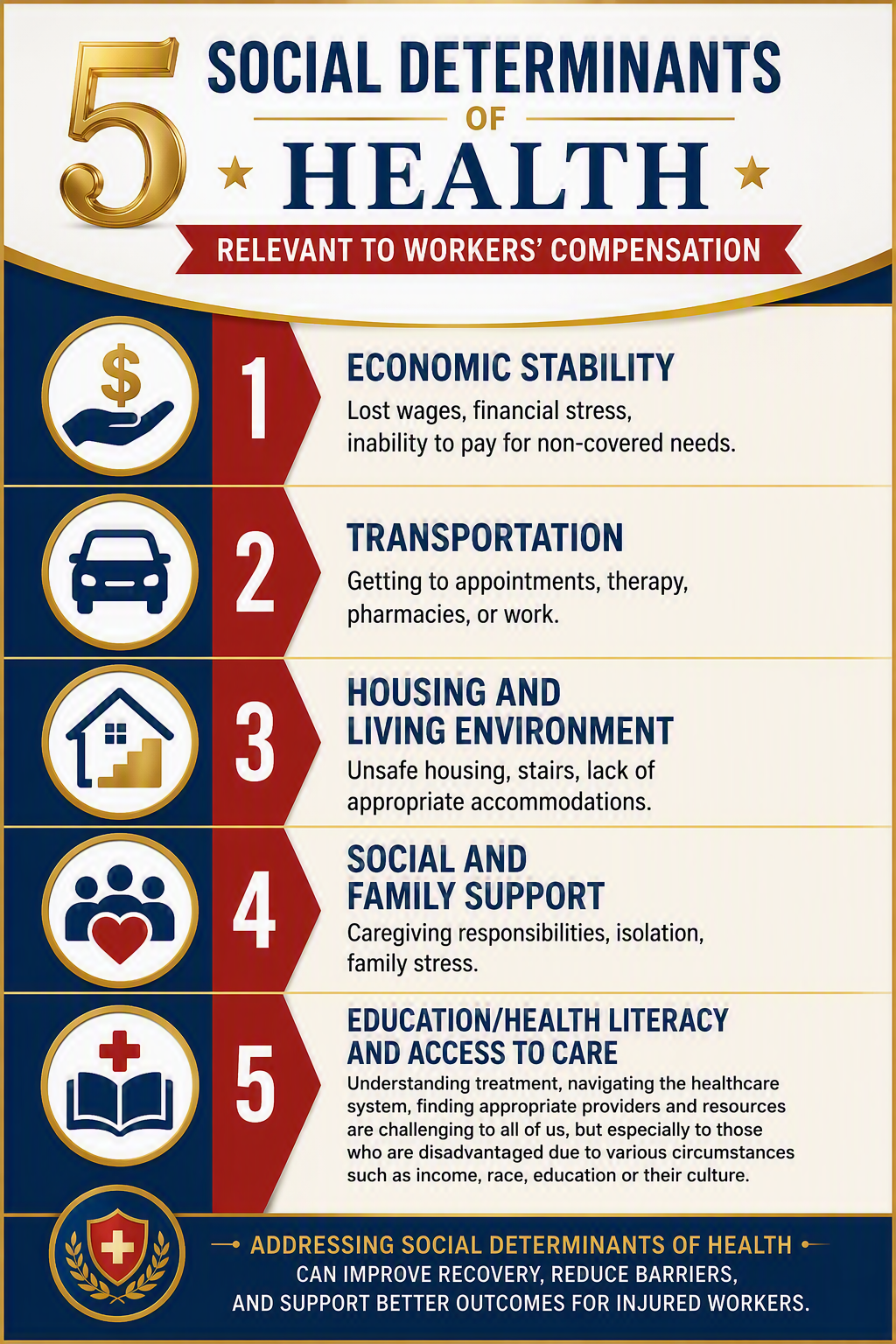
5 SDoH areas that are particularly relevant to workers’ compensation:
- Economic stability — lost wages, financial stress, inability to pay for non-covered needs.
- Transportation — getting to appointments, therapy, pharmacies, or work.
- Housing and living environment — unsafe housing, stairs, lack of appropriate accommodations.
- Social and family support — caregiving responsibilities, isolation, family stress.
- Education/health literacy and access to care — understanding treatment, navigating the healthcare system, finding appropriate providers and resources are challenging to all of us, but especially to those who are disadvantaged due to various circumstances such as income, race, education or their culture.
The nurse case manager is not responsible for solving every Social Determinant of Health affecting an injured worker. In fact, many of these issues fall outside the responsibility of the workers’ compensation system. So what can the nurse case manager do?
The answer is to identify, connect, and follow up.
First, identify the barrier. A worker who misses appointments may not be unwilling to participate in treatment. They may lack transportation. A worker who has difficulty following a medication regimen may not understand the instructions due to health literacy — A worker who appears reluctant to return to work may be dealing with childcare, financial, housing, or family concerns.
Second, connect the injured worker with appropriate resources. The nurse case manager can develop knowledge of community resources and establish relationships with social workers, community health workers, healthcare organizations, transportation services, food programs, and other community agencies. The case manager does not have to provide these services if they are not usually covered; the role is to help the injured worker find the appropriate resource.
Finally, follow up. Did the worker make the connection? Was the resource actually available? Was the barrier resolved? Did another barrier arise?
This approach changes the role of the nurse case manager from someone who simply monitors whether an injured worker is following the treatment plan to someone who looks at the circumstances that may be affecting the worker’s ability to follow that plan.
The goal is not to make the workers’ compensation system responsible for solving every social problem. The goal is to recognize when a social need is interfering with recovery and help the injured worker find a path around that barrier.
Sometimes the most important intervention a nurse case manager can make is not providing the solution — but helping the injured worker find the person or organization that can.
I hope this article provides insights into how the nurse case manager can address SDoH when they arise in a workers’ compensation claim If you have been involved in such claim — how did you and your team handle the situation? Let me know, and I can include some solutions in a future article.
Have a good week!


AI best practices california case file caselaw case management case management focus claims compensability compliance compliance corner courts do you know the rule employers exclusive remedy florida fraud glossary check Healthcare hr homeroom insurance insurers iowa kentucky leadership NCCI new jersey new york ohio pennsylvania Safety safety at work state info tech technology the case manager violence WDYT what do you think women's history women's history month workers' comp 101 workers' recovery Workplace Safety Workplace Violence
Read Also
About The Author
About The Author
-
Anne Llewellyn
Anne Llewellyn is a registered nurse with over forty years of experience in critical care, risk management, case management, patient advocacy, healthcare publications and training and development. Anne has been a leader in the area of Patient Advocacy since 2010. She was a Founding member of the Patient Advocate Certification Board and is currently serving on the National Association of Health Care Advocacy. Anne writes a weekly Blog, Nurse Advocate to share stories and events that will educate and empower people be better prepared when they enter the healthcare system.
More by This Author
Read More
- Oct 20, 2026
- Claire Muselman
- Oct 20, 2026
- Chris Parker
- Oct 19, 2026
- Claire Muselman
- Oct 19, 2026
- Anne Llewellyn
- Oct 19, 2026
- Chriss Swaney
- Oct 18, 2026
- Claire Muselman