


Share This Article:
Recognizing the Work Behind the Outcome: Celebrating Claims Professionals
09 Sep, 2026 Claire Muselman
What Went Right
Claims professionals make hundreds of decisions capable of shaping the trajectory of a workers’ compensation claim. Early contact, clear communication, timely authorization, coordinated care, documentation, expectation setting, and problem solving all influence what happens next. Many of these decisions occur quietly inside the life of the file. By the time a claim reaches closure, the final metrics may show a favorable result without revealing which behaviors helped create it.
This creates a challenge for recognition because outcomes often receive more attention than the work producing them. A claim closes below reserve and leadership sees the financial result. An employee returns to work and the organization sees the disability duration. Litigation never develops and the absence of conflict can make the file appear uneventful. Yet the claims professional may have prevented confusion, identified a psychosocial barrier, coordinated modified duty, clarified expectations, or solved a medical access problem weeks earlier. Success can become invisible when the system focuses only on the end point.
Behavioral science offers a useful lens for understanding why recognition matters in claims work. People refine performance when feedback connects a specific behavior with a specific outcome. General praise provides limited information about what should be repeated. Specific feedback helps an adjuster understand which action improved the claim and why the action mattered. Recognition then becomes part of professional development because it reinforces decision making, communication, judgment, and problem solving.
Early claim activity provides one of the clearest opportunities for this type of reinforcement. A claims professional who reaches the injured worker quickly can reduce uncertainty before assumptions begin filling the information gap. An adjuster who explains the process clearly can prevent avoidable confusion about medical care, benefits, restrictions, or return to work. A timely call to the employer may uncover modified-duty options before lost time extends. These actions may never become a line item on a traditional scorecard even though they influence claim direction.
The same principle applies when a claims professional identifies a barrier before it becomes a larger problem. A missed appointment may signal transportation trouble rather than disengagement. Hesitation around modified duty may reflect fear of reinjury rather than unwillingness to work. Repeated questions may reveal confusion rather than resistance. Claims professionals who remain curious can uncover the reason behind the behavior and respond with a more appropriate intervention. Recognizing this type of work reinforces critical thinking rather than simple task completion.
Return-to-work outcomes provide another opportunity for leaders to examine behavior behind the result. A successful return may reflect strong communication between the adjuster, employer, provider, and injured worker. The claims professional may have clarified restrictions, pushed for updated work status, resolved a delay, or helped the employer identify duties within current capacity. The return itself becomes the visible outcome. The coordination required to create the return deserves equal attention because similar behavior can be repeated across future claims.
Claims professionals also influence the emotional tone of the claim. Workers’ compensation contains uncertainty for injured employees and employers alike. Communication style can either reduce friction or intensify it. An adjuster who responds promptly, explains decisions, sets expectations, and follows through creates predictability in a process often experienced as unfamiliar and stressful. Recognizing these communication behaviors helps reinforce service quality while also supporting claim efficiency.
Leadership plays a central role in making this work visible. If claim reviews focus almost entirely on reserves, litigation, duration, and closure, adjusters learn which outcomes receive organizational attention. Those metrics matter, but they cannot fully explain professional performance. Leaders can expand the conversation by asking which behaviors contributed to the result. A claim review becomes more useful when the team identifies what the adjuster did early, what barrier was removed, what communication worked, and what should be repeated on future files.
Recognition should also occur close enough to the behavior for the connection to remain clear. Waiting until an annual review weakens the learning opportunity. A short message after a difficult call, a note during a file review, or a quick acknowledgment in a team meeting can reinforce performance while the situation remains fresh. The recognition gains value when it names the action and connects the action to the claim outcome. This creates a clearer feedback loop between behavior and result, showcasing what is possible.
Strong claims handling often produces outcomes defined by what never happened. The misunderstanding never became a dispute. The missed appointment never became a pattern. The medical delay never became six additional weeks of disability. The claims professional created those outcomes through judgment, communication, curiosity, and timely action. Leaders need to identify those behaviors while the work is visible and reinforce the claim practices worth repeating.
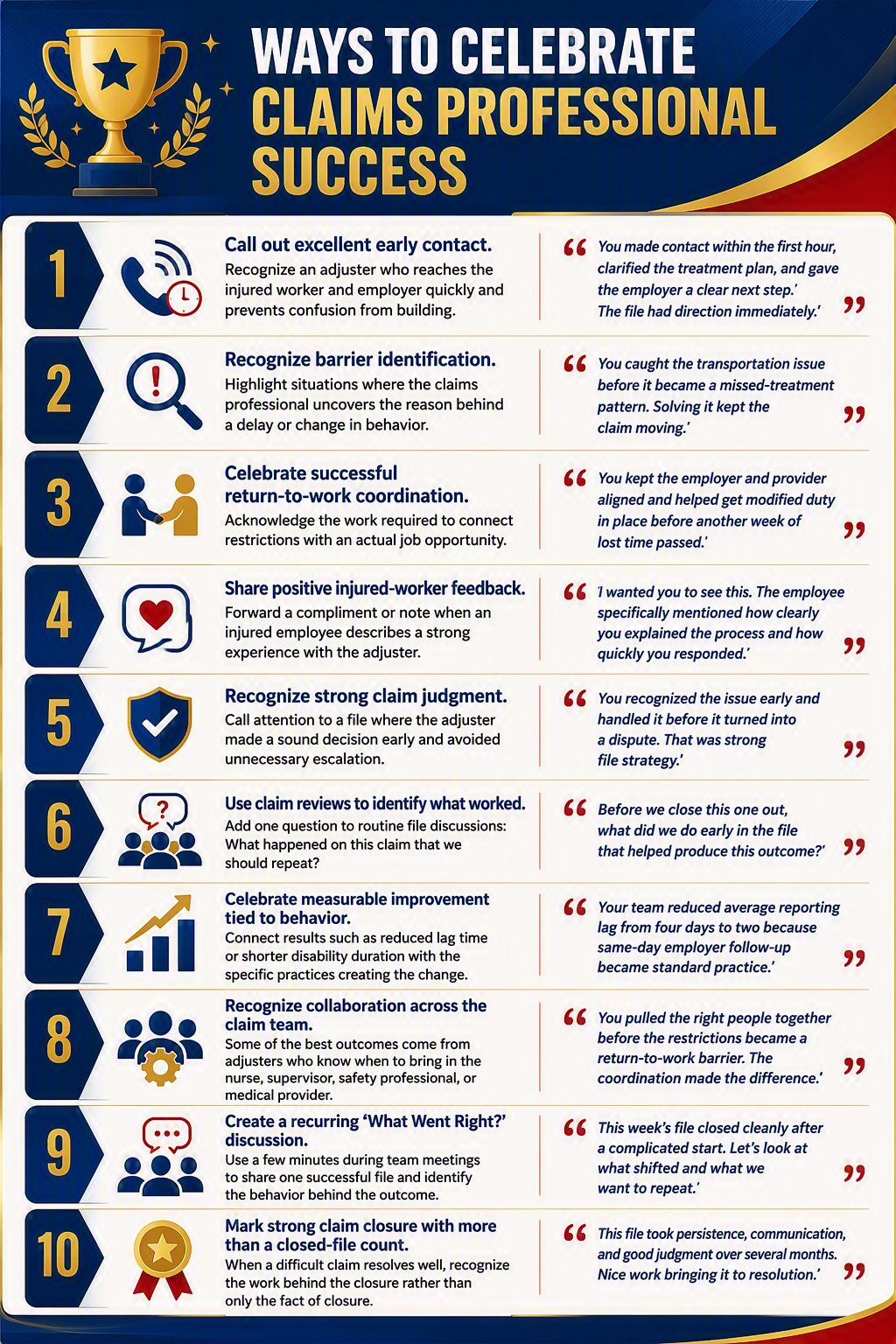
Ways to Celebrate Claims Professional Success
- Call out excellent early contact. Recognize an adjuster who reaches the injured worker and employer quickly and prevents confusion from building.
You made contact within the first hour, clarified the treatment plan, and gave the employer a clear next step. The file had direction immediately.
- Recognize barrier identification. Highlight situations where the claims professional uncovers the reason behind a delay or change in behavior.
You caught the transportation issue before it became a missed-treatment pattern. Solving it kept the claim moving.
- Celebrate successful return-to-work coordination. Acknowledge the work required to connect restrictions with an actual job opportunity.
You kept the employer and provider aligned and helped get modified duty in place before another week of lost time passed.
- Share positive injured-worker feedback. Forward a compliment or note when an injured employee describes a strong experience with the adjuster.
I wanted you to see this. The employee specifically mentioned how clearly you explained the process and how quickly you responded.
- Recognize strong claim judgment. Call attention to a file where the adjuster made a sound decision early and avoided unnecessary escalation.
You recognized the issue early and handled it before it turned into a dispute. That was strong file strategy.
- Use claim reviews to identify what worked. Add one question to routine file discussions: What happened on this claim that we should repeat?
Before we close this one out, what did we do early in the file that helped produce this outcome?
- Celebrate measurable improvement tied to behavior. Connect results such as reduced lag time or shorter disability duration with the specific practices creating the change.
Your team reduced average reporting lag from four days to two because same-day employer follow-up became standard practice.
- Recognize collaboration across the claim team. Some of the best outcomes come from adjusters who know when to bring in the nurse, supervisor, safety professional, or medical provider.
You pulled the right people together before the restrictions became a return-to-work barrier. The coordination made the difference.
- Create a recurring ‘What Went Right?’ discussion. Use a few minutes during team meetings to share one successful file and identify the behavior behind the outcome.
This week’s file closed cleanly after a complicated start. Let’s look at what shifted and what we want to repeat.
- Mark strong claim closure with more than a closed-file count. When a difficult claim resolves well, recognize the work behind the closure rather than only the fact of closure.
This file took persistence, communication, and good judgment over several months. Nice work bringing it to resolution.


AI best practices california case file caselaw case management case management focus claims compensability compliance compliance corner courts do you know the rule employers exclusive remedy florida fraud glossary check Healthcare hr homeroom insurance insurers iowa kentucky leadership NCCI new jersey new york ohio pennsylvania Safety safety at work state info tech technology the case manager violence WDYT what do you think women's history women's history month workers' comp 101 workers' recovery Workplace Safety Workplace Violence
Read Also
About The Author
About The Author
-
Claire Muselman
Meet Dr. Claire C. Muselman, the Chief Operating Officer at WorkersCompensation.com, where she blends her vast academic insight and professional innovation with a uniquely positive energy. As the President of DCM, Dr. Muselman is renowned for her dynamic approach that reshapes and energizes the workers' compensation industry. Dr. Muselman's academic credentials are as remarkable as her professional achievements. Holding a Doctor of Education in Organizational Leadership from Grand Canyon University, she specializes in employee engagement, human behavior, and the science of leadership. Her diverse background in educational leadership, public policy, political science, and dance epitomizes a multifaceted approach to leadership and learning. At Drake University, Dr. Muselman excels as an Assistant Professor of Practice and Co-Director of the Master of Science in Leadership Program. Her passion for teaching and commitment to innovative pedagogy demonstrate her dedication to cultivating future leaders in management, leadership, and business strategy. In the industry, Dr. Muselman actively contributes as an Ambassador for the Alliance of Women in Workers’ Compensation and plays key roles in organizations such as Kids Chance of Iowa, WorkCompBlitz, and the Claims and Litigation Management Alliance, underscoring her leadership and advocacy in workers’ compensation. A highly sought-after speaker, Dr. Muselman inspires professionals with her engaging talks on leadership, self-development, and risk management. Her philosophy of empathetic and emotionally intelligent leadership is at the heart of her message, encouraging innovation and progressive change in the industry. "Empowerment is key to progress. By nurturing today's professionals with empathy and intelligence, we're crafting tomorrow's leaders." - Dr. Claire C. Muselman
More by This Author
Read More
- Oct 21, 2026
- Claire Muselman
- Oct 21, 2026
- Frank Ferreri
- Oct 20, 2026
- Claire Muselman
- Oct 20, 2026
- Chris Parker
- Oct 19, 2026
- Claire Muselman