


Share This Article:
Fall Into Safety
Welcome to The Science Behind Workplace Injuries: Fall Safety Series, where we explore how seasonal conditions interact with human physiology, behavior, and workplace systems. Yesterday, we examined harvest as a peak-load operation that concentrates machinery, road travel, grain handling, fatigue, and production pressure. Today, we follow harvested grain into storage, where decisions made in autumn can create a lethal hazard months later.
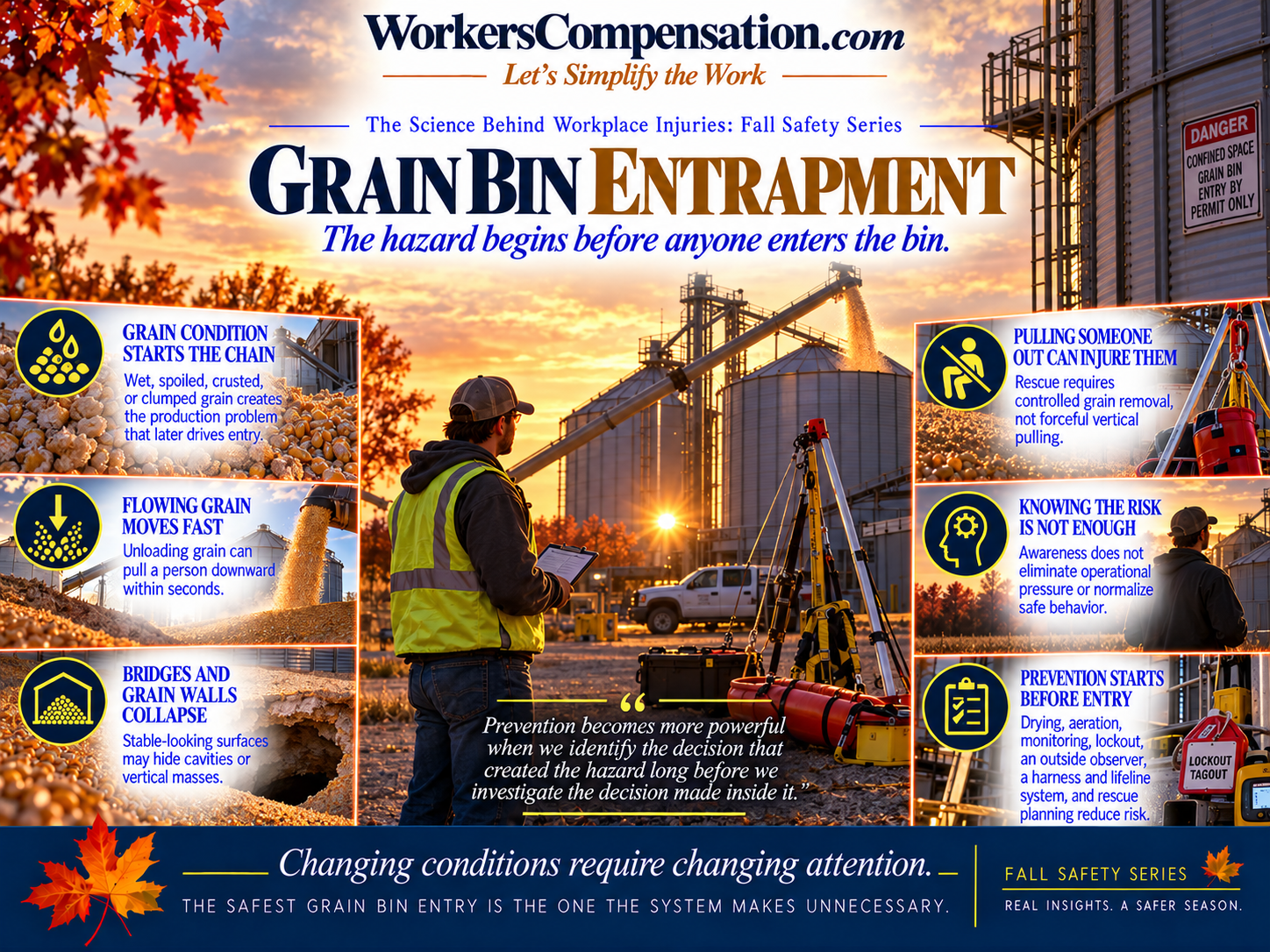
Grain bin entrapment is often described as a harvest hazard, but the timing is more complicated. The only peer-reviewed analysis of fatal on-farm entrapments by month found concentrations in November, December, January, March, and June. The stronger seasonal connection begins with grain condition. Grain stored too wet, inadequately aerated, or exposed to moisture can spoil, crust, clump, and stop flowing properly. When someone later enters the bin to restore that flow, a storage problem becomes a human exposure.
The Hazard Begins Before Anyone Enters the Bin
Daniel Kingman, William Field, and Dirk Maier examined 181 fatal on-farm grain-bin entrapments occurring between 1966 and 1998. Corn was involved in 53% of cases where the stored product was known and was frequently reported as being out of condition. Among cases where the victim’s activity could be identified, 76% occurred during bin unloading. The pattern points upstream: grain condition creates the production problem that eventually brings a person into contact with the hazard.
Moisture is central to that process. Grain stored above appropriate moisture levels can support mold growth and continued biological activity, while leaks and poorly managed aeration can reintroduce moisture after storage. Kernels begin binding together, producing clumps, surface crusts, or vertical masses along bin walls. A bridge can form across the surface while an empty cavity develops underneath it. Grain can also adhere to the side of the bin and later collapse as a wall. Each condition interrupts normal flow and creates a reason for someone to investigate, break material loose, or enter the structure.
That sequence changes how we should think about prevention. The worker standing inside the bin is near the end of the causal chain. Moisture at storage, drying capacity, aeration, temperature monitoring, roof and wall integrity, and grain management have already influenced whether the entry becomes necessary. Keeping grain in condition is therefore a safety intervention as well as a quality-control practice.
Once Grain Moves, Physics Takes Over
Flowing grain behaves differently from the solid surface people perceive when they look into a bin. When an unloading auger operates, grain moves toward the outlet in a funnel-shaped flow. A person standing above that moving column can be drawn downward with it. Bridged grain creates another hazard because a surface that appears stable may conceal an empty space underneath; when the crust collapses, the worker falls directly into the grain mass.
Entrapment progresses rapidly enough that human reaction provides little protection. Safety guidance commonly describes a person becoming trapped to approximately knee depth within four to five seconds and potentially becoming completely engulfed in roughly 20 seconds. The exact timing comes from older experimental work and should be treated as approximate, but the practical conclusion is clear: recognizing movement, deciding what to do, and escaping must all occur within seconds. Vigilance cannot reliably compensate for a process moving that quickly.
Once a worker is buried, the forces resisting extrication become substantial. Matthew Roberts and colleagues tested a mannequin in grain and measured approximately 283 pounds of force to pull it vertically when buried to the waist and 397 pounds when buried to the underarms. Adding a grain rescue tube did not reduce the pulling force; it increased the required force by 22% to 26% because insertion compacted the surrounding grain. The tube serves a different purpose by preventing additional grain from pressing against the victim while rescuers remove grain from inside the protected area. Forcefully pulling someone from an entrapment can create serious secondary injuries, which is why rescue requires controlled removal of the surrounding grain rather than simply attaching a rope or machine and pulling.
Physiology adds another layer. Grain surrounding the chest restricts expansion during breathing, while aspiration can obstruct the airway. As the worker exhales, grain can settle into the space created around the chest, making the next breath progressively more difficult. Panic increases oxygen demand at the same time breathing becomes mechanically restricted. The physical environment can therefore deteriorate faster than the worker can rescue themselves.
Knowing the Danger does not Eliminate the Exposure
Grain entrapment also offers a striking example of the difference between hazard awareness and safe behavior. Serap Gorucu and colleagues surveyed 162 farmers about grain-bin entry. Seventy-seven percent were concerned about being injured and 66% were concerned about being killed, demonstrating substantial awareness of the hazard. At the same time, 70% reported having entered a grain bin alone without an observer, and 60% had no written emergency-response plan.
The finding matters because education is frequently treated as the solution to unsafe behavior. These farmers did not need to be convinced that grain bins could kill them. The operational problem remained: grain sometimes stops flowing, someone needs to restore production, and informal entry can become the familiar solution. A rare event also creates a powerful learning problem. Repeated entries that end safely provide personal experience suggesting the practice is manageable, even though the potential consequence remains catastrophic.
Protective equipment cannot compensate for a weak entry system either. Salah Issa, Mahmoud Nour, and William Field examined 1,147 documented grain entrapment and engulfment cases and found only 38 in which a harness, lifeline, rope, or similar safety device was identified as being used by workers or rescuers. Of those 38 cases, 26 were fatal. The most common problems were lines that were too long and workers removing the harness while inside the structure. The authors cautioned that safety equipment used incorrectly can provide false security rather than effective protection.
A harness works as part of a system: a rated anchor, a properly sized lifeline that prevents the worker from sinking deeply into the grain, an observer outside the bin, controlled equipment energy, and a rescue plan. OSHA’s grain-handling requirements for covered facilities reflect that system by requiring equipment lockout, atmospheric testing, appropriate lifelines and harnesses, an outside observer, and rescue capability during bin entry. Many small farms fall outside federal OSHA enforcement, making voluntary adoption of those same controls particularly important.
Prevention Starts with Removing the Reason to Enter
The highest-leverage intervention occurs before a worker approaches the bin opening. Proper drying, aeration, moisture and temperature monitoring, and maintenance that prevents water intrusion reduce the formation of spoiled and non-flowing grain. Remote monitoring can identify developing storage problems without requiring someone to enter the bin to inspect them. When grain remains in condition, one of the primary reasons for human entry disappears.
When entry cannot be eliminated, it needs to become a planned operation instead of an improvised response to a production problem. Unloading equipment must be shut down and locked out. Bridged or hanging grain should never be walked down from inside. The worker needs an appropriate harness and correctly positioned lifeline attached to a rated anchor, with a trained observer remaining outside and capable of initiating the established emergency response. Rescue planning also needs to occur before an incident, including coordination with rural fire departments that may require specialized equipment or mutual aid to perform a grain rescue.
Workers’ compensation offers little help in describing the true scale of the problem because no published analysis isolates grain-bin entrapment claim frequency or cost. Agricultural coverage varies by state, owner-operators and family members may fall outside conventional workers’ compensation systems, and many incidents occur on farms beyond OSHA enforcement. Purdue’s national surveillance system itself relies heavily on news reports, obituaries, regulatory records, and other public sources and estimates that a meaningful portion of incidents are never captured. The absence of a large claim dataset should not be mistaken for absence of risk.
Grain entrapment is rare compared with many occupational injuries, but its causal pathway is unusually visible. Grain condition deteriorates. Flow stops. Production needs to resume. Someone enters to solve the problem, and granular physics eliminates the margin for recovery within seconds. Prevention becomes more powerful when we identify the decision that created the hazard long before we investigate the decision made inside it.
Tomorrow in The Science Behind Workplace Injuries: Fall Safety Series — Farm Equipment on Public Roads. We will examine what happens when slow, wide agricultural machinery enters a transportation system built around faster vehicles, including closing-speed perception, visibility, passing behavior, darkness, and the shared responsibility between agricultural operators and motorists.
Research Referenced
Gorucu, S., Pate, M. L., Fetzer, L., & Brown, S. (2022). Farmers’ perceptions of grain bin entry hazards. Journal of Agricultural Safety and Health, 28(1), 19–30. doi:10.13031/jash.14662
Issa, S. F., Nour, M. M., & Field, W. E. (2018). Utilization and effectiveness of harnesses and lifelines in grain entrapment incidents: Preliminary analysis. Journal of Agricultural Safety and Health, 24(2), 59–72. doi:10.13031/jash.12170
Kingman, D. M., Field, W. E., & Maier, D. E. (2001). Summary of fatal entrapments in on-farm grain storage bins, 1966–1998. Journal of Agricultural Safety and Health, 7(3), 169–184. doi:10.13031/2013.5441
Roberts, M. J., Field, W. E., Maier, D. E., & Stroshine, R. L. (2015). Determination of entrapment victim extrication forces with and without use of a grain rescue tube. Journal of Agricultural Safety and Health, 21(2), 71–83. doi:10.13031/jash.21.10150


AI best practices california case file caselaw case management case management focus claims compensability compliance compliance corner courts do you know the rule employers exclusive remedy florida fraud glossary check Healthcare hr homeroom insurance insurers iowa kentucky leadership NCCI new jersey new york ohio pennsylvania Safety safety at work state info tech technology the case manager violence WDYT what do you think women's history women's history month workers' comp 101 workers' recovery Workplace Safety Workplace Violence
Read Also
About The Author
About The Author
-
Claire Muselman
Meet Dr. Claire C. Muselman, the Chief Operating Officer at WorkersCompensation.com, where she blends her vast academic insight and professional innovation with a uniquely positive energy. As the President of DCM, Dr. Muselman is renowned for her dynamic approach that reshapes and energizes the workers' compensation industry. Dr. Muselman's academic credentials are as remarkable as her professional achievements. Holding a Doctor of Education in Organizational Leadership from Grand Canyon University, she specializes in employee engagement, human behavior, and the science of leadership. Her diverse background in educational leadership, public policy, political science, and dance epitomizes a multifaceted approach to leadership and learning. At Drake University, Dr. Muselman excels as an Assistant Professor of Practice and Co-Director of the Master of Science in Leadership Program. Her passion for teaching and commitment to innovative pedagogy demonstrate her dedication to cultivating future leaders in management, leadership, and business strategy. In the industry, Dr. Muselman actively contributes as an Ambassador for the Alliance of Women in Workers’ Compensation and plays key roles in organizations such as Kids Chance of Iowa, WorkCompBlitz, and the Claims and Litigation Management Alliance, underscoring her leadership and advocacy in workers’ compensation. A highly sought-after speaker, Dr. Muselman inspires professionals with her engaging talks on leadership, self-development, and risk management. Her philosophy of empathetic and emotionally intelligent leadership is at the heart of her message, encouraging innovation and progressive change in the industry. "Empowerment is key to progress. By nurturing today's professionals with empathy and intelligence, we're crafting tomorrow's leaders." - Dr. Claire C. Muselman
More by This Author
Read More
- Oct 25, 2026
- Claire Muselman
- Oct 25, 2026
- Chris Parker
- Oct 24, 2026
- Claire Muselman
- Oct 24, 2026
- Frank Ferreri
- Oct 24, 2026
- Claire Muselman
- Oct 23, 2026
- Claire Muselman